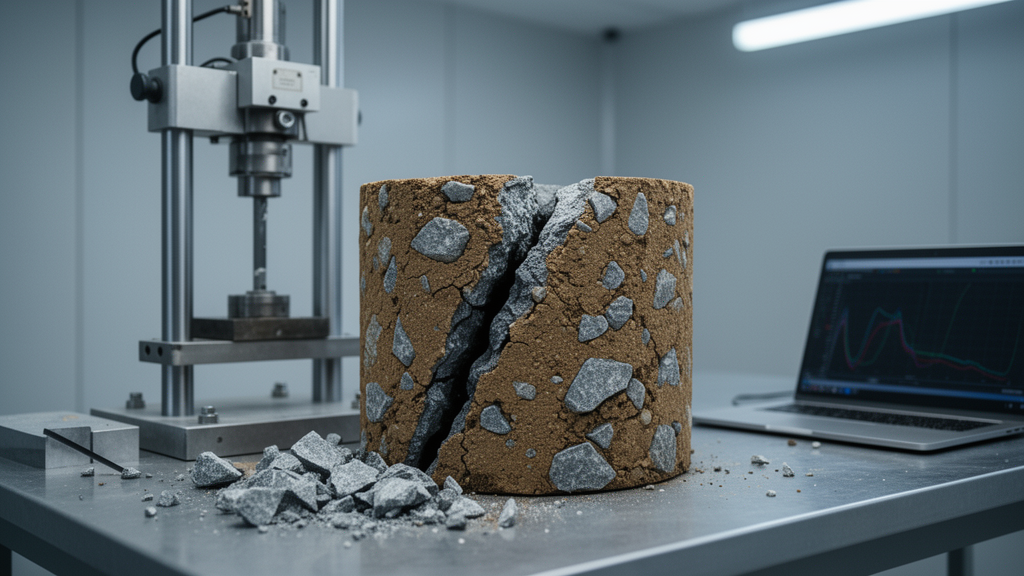
Soil-rock mixtures are among the most common geological materials on Earth, filling alluvial valleys, glacial deposits, mining slopes and the roadbeds of railways and highways. Engineers have long treated them as simple combinations: a weak soil matrix wrapped around strong rock blocks. A new laboratory and machine learning study shows that this picture breaks down when the matrix is cemented and the blocks themselves are soft, revealing rules of strength that flip direction depending on one seemingly minor detail: whether the soil around the blocks is glued together or loose.
Researchers led by Lei Li, Zhiqing Li, Shuangjiao Wang, Youxing Kong and Ruilin Hu combined more than one hundred triaxial compression tests with an interpretable machine learning framework to probe how matrix cementation and soft rock blocks control the mechanical response of soil-rock mixture, or SRM. Their work, published in Environmental Earth Sciences, focuses on blocks with unconfined compressive strengths between roughly 4 and 11 megapascals, a range the authors identify as badly underexplored compared with the high-strength rocks that dominate existing research. In weathered zones in nature, block strength varies enormously, and the study argues that assuming blocks are always far stronger than the surrounding soil misses much of the real behavior.
The specimens were built deliberately. A silty clay matrix, with a liquid limit of 29 percent and an optimum moisture content of 14.6 percent, was compacted to a dry density of 1.72 grams per cubic centimeter, corresponding to 95 percent compaction. Spherical artificial blocks about 7 millimeters in diameter, made from gypsum, fine sand and water in three different formulations, simulated rock blocks with unconfined compressive strengths of approximately 4.1, 6.3 and 10.6 megapascals. Some specimens received 10 percent cement by dry soil mass to mimic the cemented matrices found in ancient landslide bodies and other natural settings, while others were left uncemented. Volumetric block proportions ranged across the test program, and samples were cured for seven days before testing in the cemented case, whereas uncemented specimens were tested immediately after compaction.
Testing took place on a triaxial apparatus with a maximum axial load of 10 kilonewtons and confining pressures from 0 to 800 kilopascals, at a constant axial strain rate of 0.8 millimeters per minute. The stress-strain curves of both cemented and uncemented mixtures showed post-peak softening, but the character of that softening differed sharply. Cemented specimens failed in a brittle, localized manner, with the cemented matrix shifting the failure mechanism from plastic flow to distinct shear bands. Uncemented specimens bulged in the middle, their internal blocks squeezed and crushed while axial tensile cracks opened on the outside, occasionally with localized oblique shear bands.
One of the most striking quantitative results concerns how much cementation is worth at different confining pressures. Between confining pressures of 50 and 300 kilopascals, cementation raised peak deviatoric stress by 164 percent, 107 percent, 91 percent and 89 percent across the tested conditions. In other words, the lower the confining pressure, the more cementation contributes, and the benefit shrinks steadily as confinement grows. The authors attribute this to the brittle cemented structure being more prone to local damage or yielding early in shear at higher confinement, which erodes its strengthening effect. A brittleness index analysis reinforced the contrast: for uncemented mixtures, brittleness was strongly sensitive to block proportion, rising from nearly zero at 20 percent block content to around 0.4 at 50 percent, while cemented specimens showed much weaker sensitivity to block proportion.
The second headline finding is a reversal in how block strength affects the internal friction angle depending on cementation. In cemented soil-rock mixture, increasing block strength raised the friction angle increment, because stronger blocks suppress trans-block failure, forcing shear cracks to deflect into tortuous inter-block paths along block edges that dissipate more energy and enhance interlocking. In uncemented mixtures, the opposite occurred: the friction angle increment decreased as block strength increased, an effect especially noticeable with the strongest 10.6 megapascal blocks. The explanation lies in stiffness mismatch. When stiff blocks sit in a weak, uncemented matrix, differential sliding at the soil-rock interface weakens effective interlocking and stress transfer, so stronger blocks actually degrade macroscopic strength. The machine learning analysis captured this same inversion, with Shapley Additive Explanations values showing that block strength contributed positively in cemented specimens but negatively in uncemented ones.
Particle breakage emerged as the physical driver of a third result: the nonlinear strength of uncemented mixtures. Under rising confining pressure, the soft blocks broke progressively, changing the gradation and reorganizing the internal structure into a denser packing that weakens interlocking friction between large particles. Because of this, the internal friction angle measured by linear Mohr-Coulomb fitting depended on the pressure range used, with apparent cohesion rising alongside it, making the classic linear strength envelope unreliable. The team introduced an exponent alpha, tied quantitatively to a relative breakage index of the blocks, into a modified Mohr-Coulomb criterion. The resulting nonlinear criterion fit the shear strength curves with a coefficient of determination above 0.99, and alpha decreased nonlinearly as block breakage increased, linking a microscopic damage measure directly to the macroscopic bending of the strength envelope. Samples with higher block proportion showed larger base friction parameters and faster-declining envelopes, consistent with blocks forming a load-bearing skeleton that then breaks more readily.
To extend beyond the limited laboratory conditions, the researchers built a hybrid neural network combining a multilayer perceptron with an autoencoder. The autoencoder compresses each full stress-strain curve into four low-dimensional latent features that capture curve morphology, and the multilayer perceptron learns the mapping from experimental conditions, including confining pressure, block proportion, matrix strength and block strength, to those features, which are then decoded back into complete curves. Trained on 96 standardized samples drawn from strain ranges of 0 to 15 percent with stress points at 1 percent intervals, and evaluated with 5-fold cross-validation, the framework achieved coefficients of determination of 0.988 on training data and 0.962 on test data, with root mean square and mean absolute errors of 100.1 and 67.8 kilopascals respectively. The small gap between training and test performance indicates no significant overfitting, and the predicted curves reproduced both peak stresses and the nonlinear post-peak softening of low-strength uncemented and high-strength cemented specimens alike.
The interpretability analysis delivered a result the authors highlight as a critical physical insight: for these soft rock-soil mixtures, matrix strength carried more weight in the model’s predicted strength than block proportion, inverting the usual hierarchy for hard rock-soil mixtures where block content is considered the dominant control. Globally, the importance ranking ran from matrix strength, through confining pressure and block proportion, down to block strength. Locally, at low parameter levels of 50 kilopascals confinement, 20 percent block content and 4.1 megapascal blocks, the block strength contribution was negative in uncemented specimens and positive in cemented ones, and the pattern held at high parameter levels of 300 kilopascals, 50 percent block content and 10.6 megapascal blocks. This sample-level evidence confirms the stiffness mismatch mechanism that the friction angle data suggested independently.
The authors are candid about limits. The artificial blocks were spherical and the specimens small, so the results do not fully reflect the properties of in-situ soil-rock mixtures, and only three block strengths were tested. Collecting field material and running in-situ tests remain future priorities. Even so, the practical stakes are considerable. Block breakage strongly influences the strength and deformation of mixtures in high-fill embankments, high soil-rock dams in mountainous areas, slopes and roadbeds, and for mixtures containing soft rock it reshapes gradation and therefore stability. By showing that cementation governs whether stronger blocks help or hurt, and by supplying a validated, interpretable tool that predicts entire stress-strain curves from a handful of conditions, the study offers engineers a way to move past one-size-fits-all assumptions about these widespread, treacherous materials.
Subject of Research: Laboratory and machine learning study of how matrix cementation and soft rock block strength control the mechanical behavior of soil-rock mixtures
Article Title: Influence of matrix cementation and soft rock blocks on the mechanical behavior of soil-rock mixture: insights from triaxial experiments and interpretable machine learning
Article References: Li, L., Li, Z., Wang, S., Kong, Y., & Hu, R. (2026). Influence of matrix cementation and soft rock blocks on the mechanical behavior of soil-rock mixture: insights from triaxial experiments and interpretable machine learning. Environmental Earth Sciences, 85(17), Article 449. https://doi.org/10.1007/s12665-026-13177-9
Image Credits: AI Generated
DOI: 10.1007/s12665-026-13177-9
Keywords: soil-rock mixture, matrix cementation, soft rock blocks, triaxial tests, internal friction angle, particle breakage, nonlinear strength criterion, machine learning, multilayer perceptron, autoencoder, SHAP interpretability, stress-strain curves
Cite Scienmag News
Teresa Odom. (October 30, 2026). Cement, cracks and machine learning reshape soil-rock mixture strength rules. Scienmag. https://scienmag.com/cement-cracks-and-machine-learning-reshape-soil-rock-mixture-strength-rules/
Teresa Odom. "Cement, cracks and machine learning reshape soil-rock mixture strength rules." Scienmag, 30 October 2026, https://scienmag.com/cement-cracks-and-machine-learning-reshape-soil-rock-mixture-strength-rules/. Accessed 1 November 2026.
Teresa Odom. "Cement, cracks and machine learning reshape soil-rock mixture strength rules." Scienmag. October 30, 2026. https://scienmag.com/cement-cracks-and-machine-learning-reshape-soil-rock-mixture-strength-rules/