

Thursday, October 22, 2026
Science
No Result
View All Result
  • Login
  • HOME
  • SCIENCE NEWS
  • CONTACT US
  • HOME
  • SCIENCE NEWS
  • CONTACT US
No Result
View All Result
Scienmag
No Result
View All Result
Home Science News Biology

Cell and mouse study links RNF14 palmitoylation to colorectal cancer progression

October 22, 2026
in Biology
Nathaniel Bowman
By Nathaniel Bowman Scienmag Editorial Profile - Precision Oncology
Reading Time: 2 mins read
0
Cell and mouse study links RNF14 palmitoylation to colorectal cancer progression

Cell and mouse study links RNF14 palmitoylation to colorectal cancer progression

65
SHARES
587
VIEWS
Share on FacebookShare on Twitter
ADVERTISEMENT

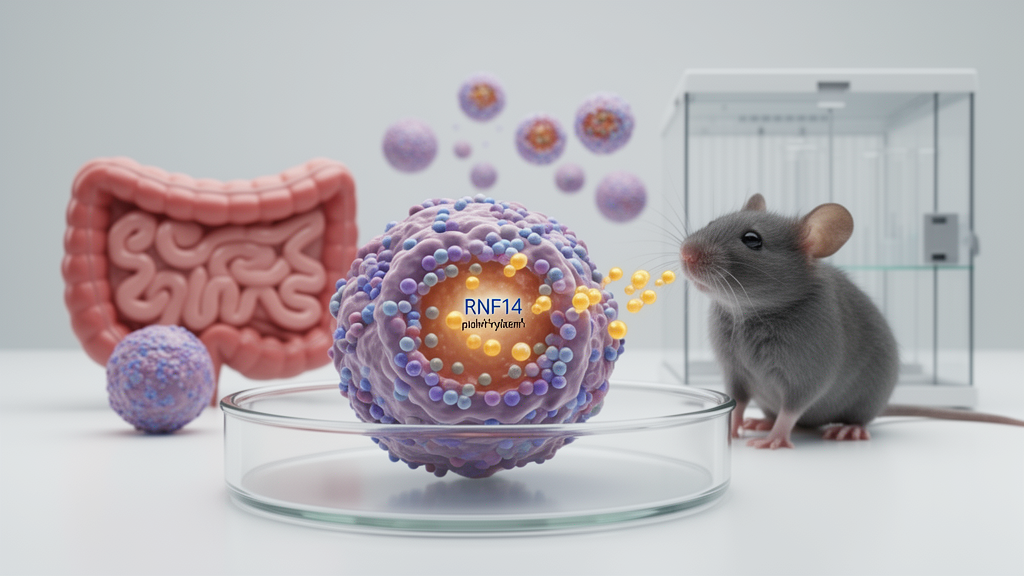
A preclinical study reports that palmitoylation of the RING finger protein RNF14 stabilizes it by preventing ubiquitin-mediated degradation, enhancing lipid metabolism and promoting tumor growth in colorectal cancer models. The researchers also identified an upstream regulatory pathway in which the acetyltransferase GCN5 modifies the transcription factor YY1, increases expression of ZDHHC9 and thereby enables RNF14 palmitoylation. The work used colorectal cancer cell lines and a mouse xenograft model, so its findings concern experimental models rather than clinical outcomes in people with colorectal cancer.

The investigators focused on modification of RNF14 at cysteine 407. Adenoviral transduction was used to introduce either wild-type or palmitoylation-deficient RNF14 constructs, allowing the researchers to test the functional importance of this site. The study reports that palmitoylation stabilized RNF14 and supported the protein’s role in lipid metabolism and tumor growth.

Silencing ZDHHC9 disrupted RNF14 palmitoylation, impaired lipid metabolism and strongly suppressed tumor progression in the tested models. Together, these observations support a causal regulatory relationship between the modification, RNF14 stability and the measured growth-related phenotypes within the experimental system. Protein-interaction and modification assays identified ZDHHC9, a zinc finger DHHC-type palmitoyltransferase, as the enzyme that catalyzed RNF14 palmitoylation.

The study then traced increased ZDHHC9 expression to GCN5-mediated acetylation of YY1. According to the results, acetylation of YY1 activated ZDHHC9 expression, forming a four-part regulatory axis: GCN5 acetylates YY1, activated YY1 raises ZDHHC9 expression, ZDHHC9 promotes RNF14 palmitoylation at cysteine 407, and stabilized RNF14 supports lipid metabolic reprogramming and colorectal cancer progression. Researchers used western blotting to assess protein expression, immunoprecipitation to examine protein–protein interactions and immunofluorescence to visualize relevant cellular features.

Post-translational modifications were also analyzed. RNF14 palmitoylation levels were measured using an acyl resin-assisted capture assay, and cell viability was examined with a Cell Counting Kit-8 assay. These complementary approaches were used to connect the molecular modification with changes in RNF14 stability, lipid metabolism, cell viability and tumor behavior.

The authors characterized the findings as evidence for a palmitoylation-dependent mechanism regulating lipid metabolism in colorectal cancer and proposed the GCN5–YY1–ZDHHC9–RNF14 axis as a potential therapeutic target. That proposal remains preclinical. The supplied study evidence does not include a human clinical trial, patient outcomes, treatment safety data or evidence that inhibiting any component of the pathway would benefit people with colorectal cancer.

The article was published in Cellular and Molecular Life Sciences on 22 October 2026 as an open-access, peer-reviewed article shared ahead of the final version of record, with further edits still possible.

Subject of Research: Preclinical analysis of a GCN5–YY1–ZDHHC9–RNF14 pathway regulating lipid metabolism and tumor growth in colorectal cancer models.

Article Title: GCN5-mediated acetylation of YY1 enhances ZDHHC9-dependent palmitoylation of RNF14 and promotes colorectal cancer progression

Article References: Li, B.-F., Li, G.-Q., Lv, F.-Y., Li, Q.-H., & Lv, L. (2026). GCN5-mediated acetylation of YY1 enhances ZDHHC9-dependent palmitoylation of RNF14 and promotes colorectal cancer progression. Cellular and Molecular Life Sciences. https://doi.org/10.1007/s00018-026-06493-7

Image Credits: AI Generated

DOI: 10.1007/s00018-026-06493-7

Keywords: colorectal cancer, RNF14 palmitoylation, GCN5, YY1 acetylation, ZDHHC9, lipid metabolism, cancer cell lines, mouse xenografts, GCN5-mediated, acetylation, enhances, ZDHHC9-dependent

Cite Scienmag News

Nathaniel Bowman. (October 22, 2026). Cell and mouse study links RNF14 palmitoylation to colorectal cancer progression. Scienmag. https://scienmag.com/cell-and-mouse-study-links-rnf14-palmitoylation-to-colorectal-cancer-progression/


Nathaniel Bowman. "Cell and mouse study links RNF14 palmitoylation to colorectal cancer progression." Scienmag, 22 October 2026, https://scienmag.com/cell-and-mouse-study-links-rnf14-palmitoylation-to-colorectal-cancer-progression/. Accessed 22 October 2026.

Nathaniel Bowman. "Cell and mouse study links RNF14 palmitoylation to colorectal cancer progression." Scienmag. October 22, 2026. https://scienmag.com/cell-and-mouse-study-links-rnf14-palmitoylation-to-colorectal-cancer-progression/

Tags: acetylationcancer cell linesColorectal cancercolorectal cancer progressioncysteine 407 modificationenhancesGCN5GCN5 acetyltransferase roleGCN5-mediatedlipid metabolismlipid metabolism in cancermouse xenograft modelsmouse xenograftspreclinical cancer researchprotein stabilization in cancerRNF14 palmitoylationtranscription factor YY1 regulationtumor growth mechanismsubiquitin-mediated protein degradationYY1 acetylationZDHHC9ZDHHC9 palmitoyltransferaseZDHHC9-dependent
Share26Tweet16
Previous Post

Caesalpinia spinosa extract selectively affects mouse colorectal cancer cells

Next Post

Model links spatial capacity and utility to resilience in karst towns

Related Posts

Retrospective cohort links age, HPV type to persistence in women with cervical LSIL
Biology

Retrospective cohort links age, HPV type to persistence in women with cervical LSIL

October 22, 2026
Early Feeding After Gastrectomy Linked to Immune-Cell Preservation
Biology

Early Feeding After Gastrectomy Linked to Immune-Cell Preservation

October 22, 2026
Review assesses miRNA nanocarriers for osteosarcoma
Biology

Review assesses miRNA nanocarriers for osteosarcoma

October 22, 2026
Disordered substrates promote tumor cell escape in simplified models
Biology

Disordered substrates promote tumor cell escape in simplified models

October 22, 2026
Rainfall, vegetation and latitude correlate with Huangshan amphibian diversity
Biology

Rainfall, vegetation and latitude correlate with Huangshan amphibian diversity

October 22, 2026
Protonation reshapes MmpL3 to coordinate mycobacterial lipid transport
Biology

Protonation reshapes MmpL3 to coordinate mycobacterial lipid transport

October 22, 2026
Next Post
Model links spatial capacity and utility to resilience in karst towns

Model links spatial capacity and utility to resilience in karst towns

  • Mothers who receive childcare support from maternal grandparents show more optimized

    Mothers who receive childcare support from maternal grandparents show more parental warmth, finds NTU Singapore study

    27656 shares
    Share 11059 Tweet 6912
  • University of Seville Breaks 120-Year-Old Mystery, Revises a Key Einstein Concept

    1061 shares
    Share 424 Tweet 265
  • Bee body mass, pathogens and local climate influence heat tolerance

    682 shares
    Share 273 Tweet 171
  • Researchers record first-ever images and data of a shark experiencing a boat strike

    546 shares
    Share 218 Tweet 137
  • Groundbreaking Clinical Trial Reveals Lubiprostone Enhances Kidney Function

    531 shares
    Share 212 Tweet 133
Science

Embark on a thrilling journey of discovery with Scienmag.com—your ultimate source for cutting-edge breakthroughs. Immerse yourself in a world where curiosity knows no limits and tomorrow’s possibilities become today’s reality!

RECENT NEWS

  • MASLD prevalence reverses after 50 in hospitalized adults
  • Federated System Could Connect BBNJ and Fisheries Governance
  • Researchers propose product-based rules for changing kratom market
  • Meta-analysis links intrinsic-capacity decline to age, sex and education

Categories

  • Agriculture
  • Anthropology
  • Archaeology
  • Athmospheric
  • Biology
  • Biotechnology
  • Blog
  • Bussines
  • Cancer
  • Chemistry
  • Climate
  • Earth Science
  • Editorial Policy
  • Marine
  • Mathematics
  • Medicine
  • Pediatry
  • Policy
  • Psychology & Psychiatry
  • Science Education
  • Science News
  • Social Science
  • Space
  • Technology and Engineering

Subscribe to Blog via Email

Enter your email address to subscribe to this blog and receive notifications of new posts by email.

Join 5,151 other subscribers

© 2025 Scienmag - Science Magazine

Welcome Back!

Login to your account below

Forgotten Password?

Retrieve your password

Please enter your username or email address to reset your password.

Log In
No Result
View All Result
  • HOME
  • SCIENCE NEWS
  • CONTACT US

© 2025 Scienmag - Science Magazine

Discover more from Science

Subscribe now to keep reading and get access to the full archive.

Continue reading