


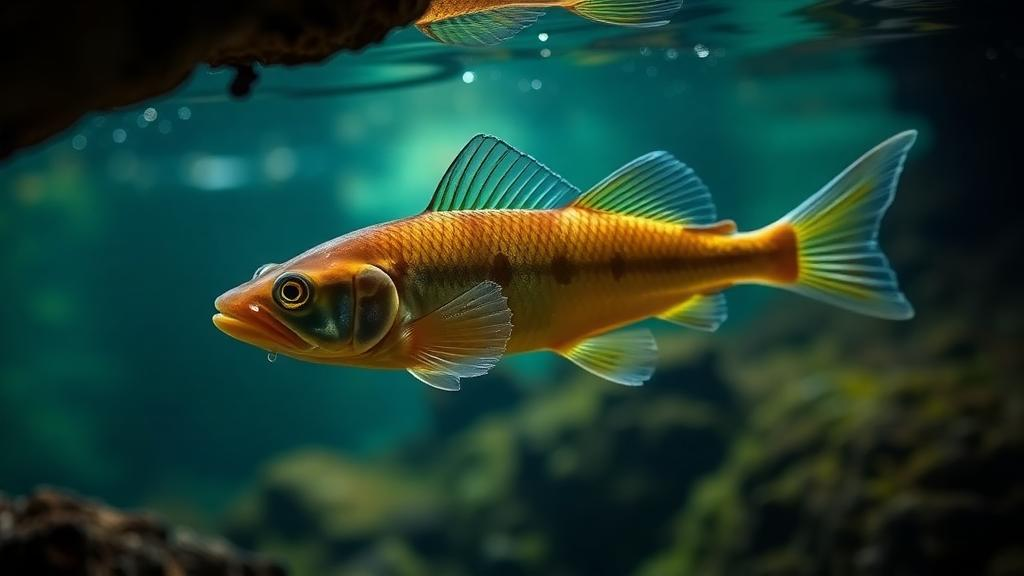
Deep in the forested mountains of western Thailand, a small striped loach has been hiding a secret for more than three decades. When Schistura jarutanini was formally described in 1990, scientists classified it as a cave-dwelling fish, known from a single underground stream in Kanchanaburi Province. A new redescription, published in Zoosystematics and Evolution, overturns that picture entirely. Fresh field collections and a large molecular dataset show that this species is primarily a surface-dwelling fish, widespread across the Mae Klong and Ataran River basins, and only rarely encountered in caves.
The original description rested on specimens collected from Tham Sao Hin, a large cave in Srisawat District whose waters feed the Khlong Ngu, a tributary of the Khwae Yai River. The type locality was recorded as Tham Ba Dan, but the authors note this is simply a generic Thai phrase meaning subterranean cave. Tham Sao Hin is no ordinary cavern: it contains the tallest natural column in the world, a 61.5-meter joined stalactite and stalagmite recognized by Guinness World Records. Earlier observers had already noticed something odd. A 2002 study found only fully pigmented individuals with normal eyes at the type locality, a combination inconsistent with a truly cave-adapted lifestyle.
To resolve the species’ identity and relationships, the team combined traditional morphology with modern molecular and imaging tools. Fishes were collected with nets, anesthetized, fixed in 10 percent formalin, and stored in 70 percent ethanol. Live and preserved specimens were photographed with Canon EOS 7D and R cameras, and X-rays and computed tomography scans were generated with a Phoenix v|tome|x M scanner at the University of Florida’s Nanoscale Research Facility. The CT data, which can be downloaded from MorphoSource, allowed detailed visualization of internal skeletal anatomy, including the air bladder capsule, ribs, and frontal bone.
The molecular work built on a major 2024 phylogeny of the loach family Nemacheilidae, which analyzed 471 samples representing 279 species across 37 genera. The researchers added new sequences for three genes, the mitochondrial cytochrome c oxidase subunit 1, cytochrome b, and the nuclear recombination-activating gene 1, for 224 specimens of 60 species from nine genera. The combined dataset covered 465 specimens, with twelve new sequences for S. jarutanini itself. Maximum likelihood analyses in IQ-TREE, using the GTR+F+G4 model selected by the Bayesian Information Criterion, confirmed what earlier work had suggested: the closest relative of S. jarutanini is S. mahnerti, a species with which it lives side by side in the same streams.
Despite being sister species, the two loaches are easy to tell apart. Schistura mahnerti sports a bright red caudal fin and a cream-colored bar at the end of the caudal peduncle, while S. jarutanini lacks red on the fins and instead shows a black bar mostly restricted to the lower half of the caudal-fin base, plus a discrete black spot on the unbranched rays at the dorsal margin of the tail. The fin-ray counts differ as well: S. jarutanini consistently has five and a half branched anal-fin rays, whereas S. mahnerti has six and a half. Both species share a complete or nearly complete lateral line, an axillary pelvic-fin lobe, furrowed lips with a small median incision in the upper lip, and a manubrium connecting the two halves of the air bladder capsule.
Skeletal differences run deeper still. Computed tomography of two specimens per species revealed that S. jarutanini has five to six dorsal and four to five ventral procurrent caudal rays, compared with nine to ten dorsal and six ventral rays in S. mahnerti. The proximal portion of the anterior ribs is straight in S. jarutanini but curved in its relative, and the anterior portion of the frontal bone is V-shaped rather than U-shaped. Vertebral counts add another distinction: S. jarutanini has 22 abdominal plus 13 caudal vertebrae for a total of 35, while S. mahnerti has 20 plus 13 to 14, totaling 33 to 34.
Morphometric analysis of 70 specimens of S. jarutanini and 30 of S. mahnerti used standardized principal component analysis to compare body shape independently of size. The first principal component, dominated by overall size, accounted for 93.4 percent of variance and was excluded from plots. Eye diameter and interorbital width carried the strongest loadings on the second component, which separated the two species cleanly. A second PCA focused on variation among populations of S. jarutanini across three major drainages, the Khwae Noi, Khwae Yai, and Kasat rivers, and found the largest separation between the Khwae Noi and Khwae Yai populations, with the Kasat River samples overlapping both.
The phylogenetic results were more surprising than the morphology. Four major lineages emerged among S. jarutanini populations, and two of them linked populations across separate drainages rather than within them. A Southern lineage joined specimens from Kroeng Krawia in the Khwae Noi drainage with those from Khlong Ngu, the cave stream at the type locality in the Khwae Yai basin. A Central lineage spanned three drainages at once, the Khwae Yai, Khwae Noi, and the Kasat River, which flows westward to the Ataran River and ultimately to the Andaman Sea. A Northern lineage was confined to the Khiao River far upstream in the Khwae Yai drainage, and a fourth lineage rested on a GenBank sequence of unknown origin.
Each genetic lineage carries a matching signature in its fin-ray counts. The Northern lineage modally has 11 pectoral-fin rays and 8 pelvic-fin rays, the Southern lineage 11 and 7, and the Central lineage 12 and 8. These counts are accurate enough that roughly 70 percent of Northern specimens, 74 percent of Central specimens, and 70 percent of Southern specimens can be assigned to their lineage by counts alone. The Kasat River population sits intermediate, with 11 or 12 pectoral-fin rays in equal numbers, and its specimens could not be assigned by drainage, only by lineage. Shape, by contrast, varied little among lineages, which the authors attribute to the conservative nature of traits like head length and body depth in fast-flowing rocky streams.
The cross-drainage pattern defies the usual expectation that a species’ variation should mirror its river basins, since dispersal within a drainage is easy while movement between drainages is hard. The explanation, the researchers argue, lies in headwater stream capture, a geological process in which the headwaters of one river are diverted into another, or possibly in underground dispersal through cave systems. The headwaters of the Kasat, Khwae Noi, and Khwae Yai interdigitate in the mountains of northern Kanchanaburi Province, offering ample opportunity for such captures. Subterranean movement is plausible given the species’ occasional cave occupancy, and combinations of underground dispersal and surface migration have previously been invoked for North American amblyopsid cavefishes. Whatever the precise mechanism, the story of S. jarutanini shows how a supposedly relict cave species can turn out to be a widespread surface fish whose history is written in rivers that changed course and waters that flowed beneath them.
Subject of Research: Redescription and phylogeography of the Thai loach Schistura jarutanini in the Mae Klong River basin
Article Title: A redescription of Schistura jarutanini ( Cypriniformes , Nemacheilidae ) from the Mae Klong River Basin in western Thailand
Article References: Page, L. M., Kavanaugh, E. M., Cagle, D. K., Tangjitjaroen, W., Delano, C. V., Tongnunui, S., Williams, B. R., Sooksawat, T., & Randall, Z. S. (2026). A redescription of Schistura jarutanini (Cypriniformes, Nemacheilidae) from the Mae Klong River Basin in western Thailand. Zoosystematics and Evolution, 102(2), 589-599. https://doi.org/10.3897/zse.102.180630
Image Credits: AI Generated
Keywords: Schistura jarutanini, Nemacheilidae, Mae Klong River, cavefish, stream capture, Thailand, phylogenetics, loaches, Kanchanaburi, freshwater fish, biogeography, taxonomy
Cite Scienmag News
Drew Townsend. (October 17, 2026). Cave fish myth upended: Thai loach thrives in open streams, DNA reveals. Scienmag. https://scienmag.com/cave-fish-myth-upended-thai-loach-thrives-in-open-streams-dna-reveals/
Drew Townsend. "Cave fish myth upended: Thai loach thrives in open streams, DNA reveals." Scienmag, 17 October 2026, https://scienmag.com/cave-fish-myth-upended-thai-loach-thrives-in-open-streams-dna-reveals/. Accessed 17 October 2026.
Drew Townsend. "Cave fish myth upended: Thai loach thrives in open streams, DNA reveals." Scienmag. October 17, 2026. https://scienmag.com/cave-fish-myth-upended-thai-loach-thrives-in-open-streams-dna-reveals/


