


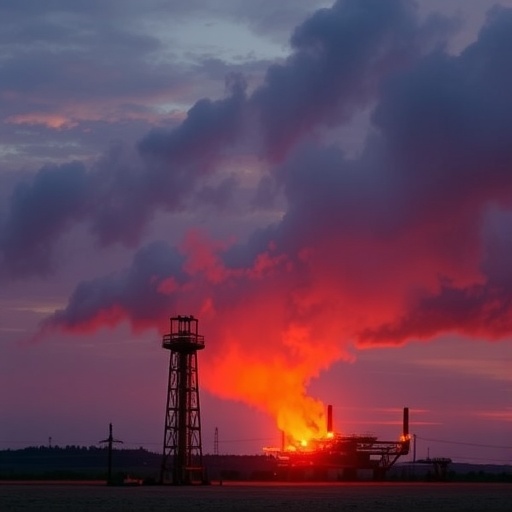
In the race to address climate change, the challenge of methane emissions from oil and gas operations has remained a stubborn obstacle. Methane, a potent greenhouse gas with a global warming potential many times that of carbon dioxide over a 20-year period, represents a critical target for immediate climate action. A groundbreaking new study introduces a cause-informed framework for risk-targeted methane emission mitigation, signaling a transformative step forward in how the energy sector can curtail its environmental footprint while maintaining operational efficiency.
Methane emissions arise from a complex web of sources within oil and gas operations, ranging from leaks in infrastructure to intentional venting and equipment malfunction. Traditional mitigation strategies often apply uniform reduction measures, focusing on broad compliance without necessarily prioritizing the riskiest or most impactful emission points. This new research pivots to a cause-informed, risk-targeted approach, aiming to identify and address the root causes of emissions by proxy of their associated risk profiles, thereby maximizing the return on mitigation investment.
Central to the proposed framework is an integrated data-driven methodology that leverages advanced sensors, real-time monitoring technologies, and predictive analytics. By synthesizing operational data with emissions measurements, the framework creates a dynamic model capable of pinpointing high-risk emission sources with unprecedented precision. This methodology moves beyond static reporting, incorporating temporal variability and operational context into the assessment, which allows for more agile and targeted intervention strategies.
The researchers begin by establishing comprehensive emission causal maps relevant to the oil and gas production lifecycle. This involves detailed categorization of emissions sources, distinguishing between equipment types, operational phases, and environmental conditions. By mapping these upstream and downstream factors, the framework can better trace emission events back to specific operational practices or equipment failures, facilitating root-cause analysis rather than symptomatic treatment.
A key innovation lies in the integration of probabilistic risk assessment with emission quantification. Rather than merely tallying emission volumes, the framework weights sources according to their likelihood and potential impact, concentrating mitigation resources where they will yield the greatest climate benefits. This risk prioritization addresses the often-observed phenomenon that a small fraction of malfunctioning sites or equipment may produce a disproportionate share of total methane emissions, known as the “super-emitter” effect.
The study further underscores the critical role of adaptive management strategies within oil and gas operations. Unlike conventional static mitigation protocols, this framework allows operators to dynamically recalibrate their approaches based on ongoing data feeds and emerging emission trends. This flexibility enhances the capacity for rapid response to unexpected emission spikes or newly identified risk clusters, crucial for continuous improvement and compliance in a shifting regulatory landscape.
Moreover, the framework offers significant potential for cost optimization in methane mitigation efforts. By targeting only the highest-risk areas rather than diffuse, low-probability sources, operators can allocate resources more efficiently, turning what was once an economic challenge into a financially feasible climate solution. This model encourages investment in technology upgrades and maintenance precisely where they are most needed, aligning financial and environmental incentives seamlessly.
The implications for policy and regulatory frameworks are profound. The adoption of a cause-informed, risk-targeted paradigm could inform the design of new regulations that push beyond uniform emission caps and toward smarter, data-driven governance. This could include performance-based standards, tiered compliance obligations, and incentive structures rewarding operators who demonstrate effective risk management and measurable emission reductions.
Technologically, the integration of machine learning algorithms is a standout feature of the framework. These algorithms process vast datasets, identify patterns invisible to human analysts, and continuously refine predictive models of emission risk. This capability not only enhances accuracy but also anticipates future emission risks based on evolving operational profiles, enabling proactive rather than reactive management.
The research also calls attention to the importance of cross-sector collaboration, emphasizing that effective methane mitigation requires the convergence of expertise across engineering, data science, environmental science, and policy domains. Collaborative platforms for data sharing and joint problem-solving could accelerate the deployment of this framework at scale, amplifying its impact across the global oil and gas industry.
Importantly, the framework maintains a strong focus on transparency and accountability. By enabling detailed tracking of emission sources and mitigation efficacy, it supports enhanced reporting and verification mechanisms essential for building public trust and meeting international climate commitments. Transparency in emission management helps dispel skepticism around industry claims and fosters dialogue grounded in empirical evidence.
The approach also aligns well with emerging sustainability and environmental, social, and governance (ESG) investment criteria. By demonstrating robust risk management and verifiable emission reductions, oil and gas operators adopting this framework could strengthen their ESG profiles, attracting investment and improving stakeholder relations in an increasingly climate-conscious market.
Underpinning the entire framework is a recognition that methane mitigation is not a one-size-fits-all challenge. Variability across geological settings, operational scales, ownership structures, and technological capabilities requires customizable solutions. The framework’s modular design enables adaptation to diverse operational contexts, enhancing its usability from upstream exploration and production through to midstream processing and downstream distribution.
Looking ahead, the implementation of this cause-informed framework promises significant climate benefits. Recent estimates suggest that targeted methane reduction could drastically cut near-term warming rates, buying critical time for broader decarbonization efforts. By prioritizing risk and causality, this research provides a scientifically rigorous pathway for achieving these reductions at scale.
In conclusion, the development of a cause-informed framework for risk-targeted methane emission mitigation stands to revolutionize how the global oil and gas sector approaches its climate responsibilities. Combining cutting-edge technological innovation with practical operational insights, this framework offers a powerful tool for accelerating effective methane reductions, facilitating sustainable energy production, and contributing meaningfully to global climate goals.
Cite Scienmag News
Blake Davidson. (May 4, 2026). Cause-Based Framework Targets Methane Risks in Oil&Gaz. Scienmag. https://scienmag.com/cause-based-framework-targets-methane-risks-in-oilgaz/
Blake Davidson. "Cause-Based Framework Targets Methane Risks in Oil&Gaz." Scienmag, 4 May 2026, https://scienmag.com/cause-based-framework-targets-methane-risks-in-oilgaz/. Accessed 6 September 2026.
Blake Davidson. "Cause-Based Framework Targets Methane Risks in Oil&Gaz." Scienmag. May 4, 2026. https://scienmag.com/cause-based-framework-targets-methane-risks-in-oilgaz/


