


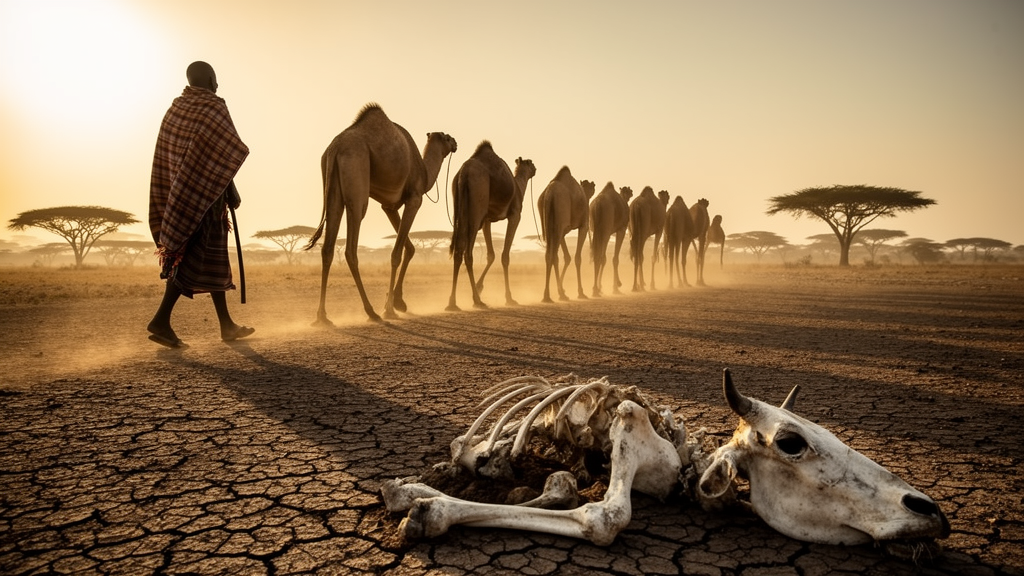
When the rains failed across northern Kenya in 2019, herders in the Obbu region of Marsabit County did not know they were entering a drought that would stretch across four punishing years. By the time showers finally returned, cattle and sheep lay dead in staggering numbers, fodder had been trucked in from hundreds of kilometres away, and families had sold breeding animals at throwaway prices to buy food. Yet a new study of the 2019–2022 drought shows that these households were far from passive victims of climate stress. Drawing on a household monitoring effort that stretches back 34 years, researchers have documented how pastoralists reorganised their labour, diversified their herds, and invented collective institutions such as women-led fodder banking to keep their livelihoods alive under some of the harshest conditions in living memory.
The study, published in the journal Pastoralism, was conducted by Gufu Oba of the Gaadisa Gummi Foundation, Hussein Tadicha Wario of the Center for Research and Development in Drylands, and Hassan Guyo Roba of The Christensen Fund. It forms part of a rare longitudinal research programme: 164 households were randomly selected in 1983 across eight locations in the Obbu region and interviewed repeatedly over three decades about their drought experiences. For the current analysis, the team added 74 newly selected households from the settlements of Ambalo and Walda, ultimately surveying 234 households, running three focus group discussions of 12 to 20 participants each, and conducting 20 key informant interviews with local experts and leaders. Interviews were carried out in the Oromo dialect with the help of local primary school teachers, and when original household heads had died, researchers spoke with their children or surviving spouses. Because the data varied widely and contained gaps, the authors deliberately used non-parametric, frequency-based analysis that integrates quantitative indicators such as mortality rates and market prices with qualitative narratives.
The region itself is a study in ecological gradients. The Obbu Borana, the main residents of Sololo sub-county in Marsabit County, live across ten locations that the study divides into semi-arid, arid, and very arid zones, each supporting different combinations of farming, range enclosures, and mobile livestock keeping. In normal years, rainfall of 250 to 400 millimetres falls in two seasons—short rains between October and December and long rains between March and May. Drought sets in when one or both of these seasons fail, exhausting surface water in dams and pools and the pasture left from the previous year. By the third and fourth consecutive dry years, the situation becomes catastrophic, and families depend almost entirely on diesel-engine and solar-powered boreholes for water. The researchers asked three interlinked questions: how environmental vulnerability shaped species-specific coping, how labour arrangements and herd mobility influenced drought management, and how land-use change, fodder practices, and market fluctuations affected both coping and adaptation.
The answer to the first question was stark. Cattle suffered mortality rates of 80 to 90 percent during the drought and, with annual recovery of only around 2.3 percent, offered households little hope of a rapid rebound. Sheep and goats lost 73.6 percent of their numbers but regenerated at roughly 13.7 percent per year, making small stock critical assets for food security and liquidity. Camels were the clear winners, with mortality of just 45 percent, thanks to their tolerance of thirst and their ability to browse on diverse forage. The consequences of this species-specific vulnerability are already visible in the herd composition of the region: the number of households owning camels has increased by 40 percent over the last decade, echoing earlier research showing that a 30-year shift from cattle to camels among Kenyan pastoralists represents a multifaceted adaptation to climate variability. The study argues that the long-term solution to drought vulnerability lies in managing multiple species together, combining grazers and browsers whose differing adaptive capacities spread risk across the herd.
Community narratives painted a picture of ecological collapse that made these losses almost inevitable. Sixty-six percent of surveyed households reported complete loss of vegetation cover and increased bare ground, 27 percent described rampant overgrazing, and smaller proportions reported loss of grass cover, tree die-back, and the drying of water pans. One informant told the researchers that even grass litter could not be seen on the ground. As surface pools and dams dried up, livestock were forced to trek ever-longer distances to boreholes, burning energy they could not replace through grazing. Cattle, which need watering every one to two days, were hit hardest; sheep and goats could endure intervals of three to four days, while camels went seven to ten days without water. Some households reported walking up to 60 kilometres to reach water, and most walked 10 to 20 kilometres daily—a burden borne largely by women. The Borana manage these distances through a specialised watering system called buulto, in which herders camp midway between pasture and water and shuttle animals back and forth, but even this sophisticated strategy could not prevent mass deaths when the entire landscape dried simultaneously.
Herd mobility, the traditional first line of defence, also met its limits. Herders traditionally move stock seasonally between dry- and wet-season grazing zones and across the border into Ethiopia, and modern tools—trucks, motorbikes, and mobile phones—have improved communication about where pasture and water remain. But during a regional drought, there is nowhere for herds to go. Families with large herds attempted long-distance migration, negotiating access and scouting resources across multiple relocations, while owners of smaller herds favoured local management, fencing enclosures and feeding animals at home. Twenty-nine percent of households migrated to find pasture, and 66 percent used mobility to search for grazing, yet focus groups reported that these movements often failed to preserve stock given the scale of the regional crisis. The timing of movement proved critical: herds moved early in the drought, while animals were still in fair condition, fared better than those moved after body condition had deteriorated.
Compounding these ecological pressures was a quiet revolution in herding labour. In the traditional Borana system, family labour formed the backbone of herd management, and hired herders were paid in heifers. Today, family labour is in decline as younger generations pursue schooling and alternative employment, and herding has become monetised: 42 percent of households relied on hired labour, typically paid less than 40 US dollars per month, often recruited from across the Ethiopian border because local labour was scarce. Low wages, insufficient rations during droughts when milk production collapsed, harsh living conditions, and owners’ inexperience in managing workers led to high turnover, with hired herders frequently quitting midway through the drought. Cooperative labour arrangements offered partial relief but diluted individual attention to animals. The authors suggest that if wages and working conditions improved, waged herding could become a genuine employment sector rather than a crisis-driven stopgap.
Market dynamics turned ecological disaster into economic ruin. With 92 percent of families reporting that low livestock prices crushed their purchasing power, distressed sales of weakened cattle and sheep at what respondents called throwaway prices created destitution affecting more than 80 percent of households in some locations. Meanwhile, the costs of survival mounted: 94 percent of households listed animal feed as their main expense, 58 percent veterinary drugs, and 36 percent water trucking. Some families paid as much as 200,000 Kenyan shillings for a lorry load of hay bales hauled from Meru County or across the Ethiopian border. One informant in Mukutano described bringing the last of his animals into his compound, watching them die in groups of five or eight a day, buying hay delivered by lorry, and finally feeding the survivors boiled maize and beans—an improvised measure that saved a few cows. Land-use changes, including the more than 600 square kilometres of farms and semi-private range enclosures that now fragment the region, failed to buffer the drought: bush encroachment, poor maintenance, exclusionary land tenure, high input costs, trespassing neighbours, and a lack of storage infrastructure meant enclosures produced little surplus forage when it was needed most.
Amid these failures, one innovation stands out. Women, who make up 96.67 percent of participants in fodder banking, organised into registered groups to harvest, bale, and store grass on community-allocated land. The chairlady of the Maliti Women’s Group in Mado Adhi recounted how 60 members cleared allocated land, harvested more than 60 backloads of grass over two seasons, sold them for 60,000 shillings, and, after training in baling, built a store of 2,000 bales valued at 800,000 shillings. This represents a new pathway to asset creation that incorporates conservation elements largely absent from the traditional system, and the authors argue that such registered groups could access external support to fill gaps in local fodder markets. Fodder banking anchors households to local reserves, reducing the need for desperate long-distance trekking—though the study cautions that these sedentary strategies must be balanced against the ecological necessity of mobility.
Ultimately, the study’s deepest insight is temporal: the decisions households made during 2019–2022 were not improvised in isolation but informed by cumulative lessons from four decades of droughts. Families entered this drought already favouring camels and goats over vulnerable cattle, already weighing the risks of hired labour, and already sceptical of enclosures that had failed before. The researchers conclude that resilience in drought-prone pastoral systems depends on integrating ecological knowledge, gendered initiatives, and adaptive diversification—and that pastoralists themselves are leading the way, actively reorganising labour, diversifying herds, and innovating through collective action to sustain their livelihoods as the climate crisis intensifies.
Subject of Research: Pastoralist household coping and adaptive strategies during northern Kenya's 2019–2022 drought
Article Title: Insights into pastoralist households’ coping and adaptive strategies during northern Kenya’s 2019–2022 drought
Article References: Insights into pastoralist households’ coping and adaptive strategies during northern Kenya’s 2019–2022 drought. (n.d.). https://doi.org/10.3389/past.2026.16489
Image Credits: AI Generated
Keywords: pastoralism, drought, northern Kenya, livestock mortality, camels, herd diversification, fodder banking, herding labour, herd mobility, rangeland degradation, livelihood resilience, Borana
Cite Scienmag News
William Thompson. (October 15, 2026). Cattle Died, Camels Endured: How Kenyan Herders Fought a Four-Year Drought. Scienmag. https://scienmag.com/cattle-died-camels-endured-how-kenyan-herders-fought-a-four-year-drought/
William Thompson. "Cattle Died, Camels Endured: How Kenyan Herders Fought a Four-Year Drought." Scienmag, 15 October 2026, https://scienmag.com/cattle-died-camels-endured-how-kenyan-herders-fought-a-four-year-drought/. Accessed 15 October 2026.
William Thompson. "Cattle Died, Camels Endured: How Kenyan Herders Fought a Four-Year Drought." Scienmag. October 15, 2026. https://scienmag.com/cattle-died-camels-endured-how-kenyan-herders-fought-a-four-year-drought/


