


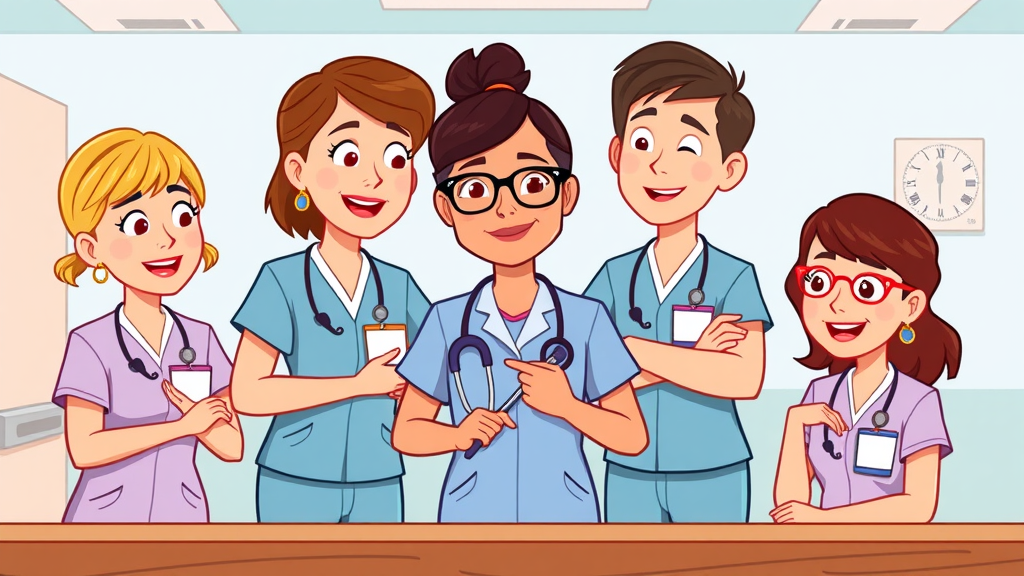
A single careless moment with a used hypodermic needle can change a young nurse’s career, and sometimes their health, forever. Needlestick injuries remain one of the most persistent occupational hazards in hospitals worldwide, exposing healthcare workers to bloodborne pathogens such as hepatitis B, hepatitis C, and HIV. Now, a research team in China reports that an unexpectedly playful tool, a series of caricature-style animated videos built around a continuous storyline, may offer a surprisingly powerful way to teach newly minted nurses how to protect themselves. The study, published in BMC Nursing, followed 260 nursing interns and found dramatic, lasting improvements in their knowledge, attitudes, behaviors, and motivation to prevent these injuries.
The research, led by Ping Gao and Xiaomei Chen of Chengdu Wenjiang District People’s Hospital along with colleagues at several Chinese institutions, addressed a well-known gap in clinical training. Nursing interns, who have just transitioned from classroom to bedside, are among the most vulnerable members of the hospital workforce. They perform injections, venipunctures, and sharps disposal under time pressure and supervision that is often inconsistent. Traditional safety training, typically delivered as lectures or static pamphlets, tends to fade quickly once the demands of real clinical work take over. Although animation-based education has proven effective in other areas of clinical teaching, its potential for preventing needlestick injuries had been largely unexplored until now.
The intervention at the heart of the study was what the researchers call caricature storyline-based audiovisual education. Rather than presenting isolated facts about sharps safety, the educational materials wove preventive principles into a narrative told through exaggerated, cartoon-like animated images, which the authors note were generated with the assistance of the AI tool Doubao. The storyline format is more than an aesthetic choice. Educational psychology suggests that narrative structure helps learners encode and retrieve procedural information, because characters, conflicts, and resolutions give abstract rules a concrete emotional and situational anchor. For a novice nurse, watching a caricatured character fumble a recapping maneuver and face the consequences may be more memorable than memorizing a checklist.
To test whether the approach actually worked, the team used a sequential mixed-methods design, combining rigorous quantitative measurement with in-depth qualitative exploration. They recruited 260 nursing interns enrolled in junior college or undergraduate nursing programs, all of whom had completed one to two months of clinical practice before entering the study. This timing was deliberate: the participants had enough ward experience to understand the risks firsthand, but were still early enough in their training for education to shape lasting habits. Every participant received the caricature-based audiovisual education, and the researchers measured outcomes at three points: before the intervention, immediately afterward, and again three months later.
The quantitative results were striking. Using validated scales, the team assessed four dimensions: knowledge about needlestick injuries, attitudes toward prevention, actual safety behaviors, and preventive motivation. Repeated-measures analysis of variance revealed significant main effects of time across all four outcomes, with p values below 0.001 and partial eta-squared values ranging from 0.968 to 0.992, effect sizes so large they are rarely seen in behavioral research. Corrected post-hoc comparisons confirmed that every score rose significantly from baseline to both the post-test and the three-month follow-up. In practical terms, the interns did not merely perform better on a quiz immediately after watching the videos; they internalized the material in a way that persisted.
The follow-up data revealed an especially interesting pattern. Knowledge and attitude scores plateaued between the post-test and the three-month mark, remaining statistically stable with p values of 0.473 and 0.541 respectively. Behavior and preventive motivation, however, continued to climb significantly during the same period, both with p values below 0.001. This suggests that the intervention did more than transmit information. It appears to have triggered a self-reinforcing cycle in which motivated interns kept practicing safer behaviors, and those behaviors in turn deepened their commitment to prevention. The most concrete outcome measure was perhaps the simplest: only six needlestick injuries were reported across the entire group during the follow-up period.
Numbers alone cannot explain why the intervention worked, which is where the qualitative arm of the study proved valuable. A subsample of 49 participants took part in ethnographic observations and semi-structured interviews, allowing the researchers to see how the education translated, or failed to translate, into daily ward practice. Thematic analysis of this material yielded four themes and six subthemes, capturing how the interns perceived the intervention and how it reshaped their thinking about sharps safety. The researchers report that most nursing interns rated the intervention positively, describing it as engaging and relevant to their real clinical situations, and suggesting that the format could be extended to other healthcare disciplines beyond nursing.
The study’s methodological choices strengthen its credibility. By requiring participants to have completed at least a month of clinical practice, the researchers ensured that baseline knowledge and attitudes reflected genuine ward experience rather than classroom theory. The three-time-point measurement design allowed them to distinguish immediate learning effects from durable behavioral change, a distinction that many training evaluations miss. The combination of repeated-measures ANOVA with corrected post-hoc testing guards against the inflated error rates that can plague before-and-after studies, and the very large effect sizes, while partly a reflection of a single-group design without a control arm, indicate that the intervention moved every measured dial.
That single-group design is also the study’s main limitation, and the authors and readers alike should interpret the findings with appropriate caution. Without a randomized control group receiving standard lecture-based training, it is difficult to isolate the specific contribution of the caricature storyline format from the general benefit of receiving any structured, engaging education on needlestick prevention. Self-reported behavior scales can also diverge from observed practice, although the ethnographic observations in the qualitative arm partially offset this concern. Still, the consistency of improvement across four distinct outcome dimensions, and the continued rise in behavior and motivation over three months, make a compelling case that the intervention produced real change rather than a fleeting testing effect.
The implications reach well beyond one hospital in Chengdu. Needlestick injuries impose enormous costs on health systems, from post-exposure prophylaxis and testing to the psychological toll of waiting weeks for serology results. If a low-cost, scalable package of animated videos can meaningfully reduce these injuries among the newest and most vulnerable members of the clinical workforce, hospital educators have a practical tool they can deploy widely. The authors suggest the model may support the standardization of clinical practice and help reduce the occurrence of needlestick injuries more broadly. As hospitals worldwide grapple with how to instill safety culture in a constantly rotating stream of trainees, this study offers a reminder that sometimes the most effective teacher is a well-told story, even one drawn in exaggerated cartoon lines.
Subject of Research: Caricature storyline-based audiovisual education for preventing needlestick injuries among nursing interns
Article Title: Effects of caricature storyline audiovisual education on knowledge, attitudes, behavior, and preventive motivation regarding needlestick injuries among nursing interns: a mixed methods study
Article References: Gao, P., Cheng, L., Wang, Z., Zeng, X., Xu, X., Huang, J., Li, L., Li, W., Tang, M., Wang, Q., & Chen, X. (2026). Effects of caricature storyline audiovisual education on knowledge, attitudes, behavior, and preventive motivation regarding needlestick injuries among nursing interns: a mixed methods study. BMC Nursing. https://doi.org/10.1186/s12912-026-05373-6
Image Credits: AI Generated
DOI: 10.1186/s12912-026-05373-6
Keywords: needlestick injuries, nursing interns, audiovisual education, caricature animation, nursing education, occupational safety, mixed methods study, preventive motivation, clinical training, BMC Nursing, healthcare workers, sharps safety
Cite Scienmag News
Ophelia Keating. (September 12, 2026). Cartoon-Style Videos Help Nursing Students Sharpen Safety Habits Around Needles. Scienmag. https://scienmag.com/cartoon-style-videos-help-nursing-students-sharpen-safety-habits-around-needles/
Ophelia Keating. "Cartoon-Style Videos Help Nursing Students Sharpen Safety Habits Around Needles." Scienmag, 12 September 2026, https://scienmag.com/cartoon-style-videos-help-nursing-students-sharpen-safety-habits-around-needles/. Accessed 4 October 2026.
Ophelia Keating. "Cartoon-Style Videos Help Nursing Students Sharpen Safety Habits Around Needles." Scienmag. September 12, 2026. https://scienmag.com/cartoon-style-videos-help-nursing-students-sharpen-safety-habits-around-needles/


