

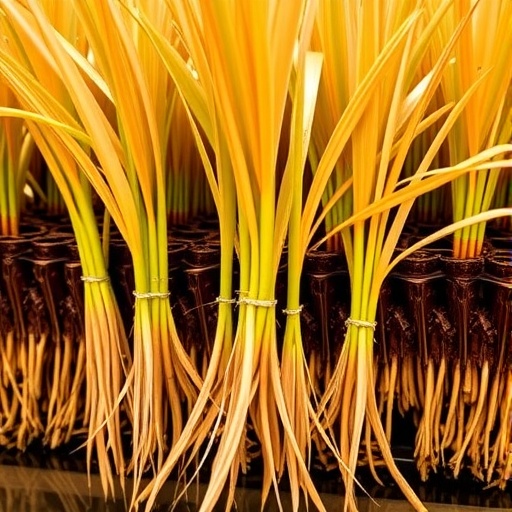
In a groundbreaking study published in Nature Plants, researchers have unveiled a crucial link between carotenoid biosynthesis and root plasticity in rice, shedding new light on how plants adapt to challenging environmental conditions. This discovery centers on how carotenoids, a class of pigments traditionally associated with photosynthesis and photoprotection, also play a pivotal role in the formation of aerenchyma and iron plaque in rice roots. These structures enhance the ability of rice plants to thrive in flooded or iron-rich soils, revealing an intricate biochemical mechanism that could revolutionize crop engineering and sustainable agriculture.
Root plasticity, the ability of roots to adjust their structure and function in response to environmental stimuli, is fundamental for plant survival and productivity. In rice, which is often cultivated in waterlogged fields, this plasticity allows for optimized oxygen diffusion and iron homeostasis—key traits for sustaining growth under hypoxic or metal-stressed conditions. The study conducted by Shrestha et al. provides robust experimental evidence that carotenoid biosynthesis directly influences these adaptive root features, fundamentally altering our understanding of plant stress physiology.
At the heart of this discovery is the role that carotenoid-derived signaling molecules play in modulating root architecture. Specifically, the researchers demonstrated that enhanced carotenoid biosynthesis activates pathways leading to increased formation of aerenchyma—air-filled spaces within root cortical tissue that facilitate gas exchange. This physiological adaptation mitigates the effects of oxygen deprivation in flooded soils, a common stressor in rice paddies worldwide. By promoting aerenchyma development, carotenoids indirectly support aerobic respiration and overall root health.
In addition to aerenchyma formation, carotenoid biosynthesis was found to drive the generation of iron plaques on root surfaces. These iron plaques act as crucial barriers that prevent the excessive uptake of potentially toxic ferrous iron ions into the root system. The mechanism involves carotenoid-mediated signaling events that trigger the deposition of iron oxides in strategic locations, effectively sequestering iron in a form that is less harmful while still accessible for nutritional purposes. This nuanced regulation ensures root function is not compromised by imbalanced iron levels in flooded soils.
The implications of these findings go far beyond basic plant biology. Carotenoids, once primarily studied in the context of leaf pigmentation and photoprotection, now emerge as central players in root environmental adaptation. This paradigm shift refocuses attention on metabolic pathways that might be targeted to improve crop resilience. Given the increasing challenges posed by climate change—such as intensified flooding and soil contamination—leveraging carotenoid biosynthesis pathways could allow for the development of rice varieties better equipped to withstand harsh conditions while maintaining yields.
Methodologically, the team utilized a combination of genetic, biochemical, and microscopic analyses to dissect the role of carotenoids in root plasticity. Through mutant rice lines deficient in key carotenoid biosynthetic enzymes, the researchers were able to show substantial decreases in aerenchyma formation and iron plaque deposition. Complementary biochemical assays quantified carotenoid content and related signaling metabolites, correlating their abundance with phenotypic changes in root tissue. Imaging techniques then visually confirmed the structural and compositional alterations in roots, providing a comprehensive multi-scale validation of their hypothesis.
Interestingly, the study also explored the upstream regulatory networks that govern carotenoid biosynthesis under stress conditions. Their data suggest that environmental stress cues, such as low oxygen levels and iron excess, stimulate specific transcription factors that enhance the expression of carotenoid biosynthetic genes. This regulatory loop facilitates a dynamic adjustment of root morphology and chemistry, enabling rapid and efficient stress adaptation. Understanding this transcriptional control mechanism offers exciting potential for precision gene editing approaches aiming to optimize these pathways in agricultural contexts.
The broader agricultural significance is underpinned by the essential role of rice as a staple food for over half the world’s population. Enhancing rice tolerance to abiotic stresses is critical for food security, especially in vulnerable regions prone to flooding or soil contamination. By harnessing the carotenoid-driven root plasticity mechanisms elucidated in this study, agronomists and crop scientists could engineer or select for rice cultivars with improved resilience, better nutrient acquisition, and reduced susceptibility to stress-induced yield losses.
Moreover, this research illuminates a more general principle applicable to other wetland and semi-aquatic plants, potentially offering insights into their adaptive strategies. If carotenoid biosynthesis similarly governs root plasticity across diverse species, as suggested by preliminary cross-kingdom comparisons, it may mark a conserved evolutionary mechanism for coping with fluctuating oxygen and iron availability. Such discoveries have far-reaching ecological and evolutionary implications and open avenues for cross-disciplinary studies linking molecular biology, ecology, and agricultural science.
From a biotechnological perspective, the discovery accelerates efforts to manipulate metabolic pathways to improve crop performance. Carotenoids and their derivatives are already exploited in biofortification programs aimed at enhancing nutritional value, notably Vitamin A precursors. Adding stress resilience features to this portfolio strengthens the agricultural value proposition of targeting carotenoid metabolism. Future research might focus on fine-tuning the balance between biosynthetic flux toward photoprotective pigments and those signaling molecules mediating root adaptations.
The potential for synthetic biology to engineer custom metabolic circuits in roots based on the findings of Shrestha et al. presents a thrilling frontier. By introducing or enhancing specific enzymes involved in carotenoid biosynthesis, it may be possible to design root systems that dynamically modulate architecture and biochemistry in response to real-time environmental cues. Such innovations would represent a significant leap in plant engineering, contributing to sustainable agriculture in the face of an increasingly unpredictable climate.
Importantly, this study also highlights the complexity and interconnectedness of plant metabolic networks, exemplifying how metabolites traditionally tied to one physiological domain can have unexpected roles elsewhere. It challenges reductionist views and stresses the need for integrative research approaches that consider metabolism, development, and environmental interactions as a unified system. This insight resonates with current trends in systems biology and holistic crop improvement strategies.
The elucidation of the connection between carotenoid biosynthesis and root stress adaptation not only enriches fundamental plant science but also offers pragmatic solutions for the future of global food systems. With climate projections indicating increased incidence of flooding and soil toxicity issues, understanding and exploiting root plasticity mechanisms at the molecular level becomes paramount. This research paves a clear path toward breeding or engineering crops equipped for tomorrow’s challenges.
In the broader scientific community, the findings have already sparked considerable interest. Ongoing discussions revolve around the potential for carotenoid pathway manipulation to simultaneously enhance photosynthetic efficiency, nutritional quality, and stress resilience—traits often considered in isolation until now. The integrative perspective presented here fosters a new wave of interdisciplinary research aimed at multifaceted crop improvement.
In conclusion, the study by Shrestha et al. decisively elevates carotenoid biosynthesis from a colorful pigment-producing pathway to a master regulator of root environmental plasticity in rice. By driving the formation of aerenchyma and iron plaques, carotenoids enable rice roots to overcome oxygen and iron stresses, strategies essential for survival and productivity in challenging ecosystems. These insights supply novel molecular targets and conceptual frameworks destined to influence both basic plant biology and applied agricultural science for years to come.
Subject of Research: Carotenoid biosynthesis and root plasticity mechanisms in rice
Article Title: Carotenoid biosynthesis drives root plasticity through aerenchyma and iron plaque formation in rice
Article References:
Shrestha, J.K., Lin, C.Y., Wang, J.Y. et al. Carotenoid biosynthesis drives root plasticity through aerenchyma and iron plaque formation in rice. Nat. Plants (2026). https://doi.org/10.1038/s41477-025-02170-y
Image Credits: AI Generated


