


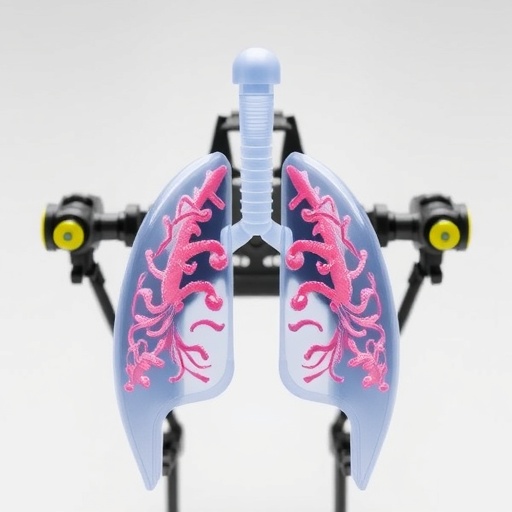
A groundbreaking endeavor is taking place at Carnegie Mellon University’s Ren lab, where researchers are developing innovative “designer” biological robots using human lung cells. These microscopic entities, dubbed AggreBots, represent a rare fusion of engineering prowess and biological understanding that may enable the delivery of targeted therapeutic interventions within the complex environments of the human body. The recent advancements articulated in the journal Science Advances signify a transformative leap forward in the motility and usefulness of biobots, therapies, and synthetic biology.
Biobots, or biological machines engineered to navigate autonomously through their environments, have for many years relied on muscle fibers to produce movement. This approach mimics the natural contraction and relaxation mechanisms of muscle, allowing for limited programmability. However, researchers have long sought alternatives that could allow for enhanced control and variability in biobot behavior. The introduction of cilia as a propulsion mechanism opens a new chapter in this pursuit, lending itself to a variety of applications. Cilia are minuscule, hair-like structures that not only facilitate fluid movement within the body but also assist aquatic organisms in locomotion.
A significant barrier has been controlling the cilia’s structural characteristics to dictate the movement patterns of cilia-powered biobots, now referred to as CiliaBots. The Ren lab’s pioneering work utilizes a unique modular assembly strategy that leverages the spatially controlled aggregation of tissue spheroids—engineered from lung stem cells—to craft CiliaBots. By embedding stem cells that possess a genetic mutation, researchers can create spheroids with specific regions where the cilia do not function, but still enable the propulsion that ciliated portions can provide.
This intricate crafting of biobots resembles a rowing technique where strategically removing oars from specific locations enhances directional control. Dhruv Bhattaram, the principal author of the associated research paper, explains this analogy effectively. The implications of this research are manifold, as Bhattaram emphasizes the importance of precisely controlling the cilia’s positioning and number on the surface of these bioengineered tissues. By synergizing spheroids in different arrangements, they can dictate how AggreBots navigate through their environment, an advance that paves the way for unprecedented applications in biobots, specifically within the healthcare sector.
Victoria Webster-Wood, an associate professor in mechanical engineering at Carnegie Mellon, highlights the new design ecosystem available with the AggreBots mechanism. The potential for combining ciliated and non-ciliated tissue elements modularly opens new avenues in biobots’ engineering. As these AggreBots are developed from entirely biological materials, they carry inherent biocompatibility and biodegradability, which are crucial features for medical applications that aim to minimize adverse reactions within the body.
The lab’s innovation is not only focused on technical prowess; it aims to address significant medical challenges. The research harbors profound implications for the biorobotics community, healthcare practitioners, and medical researchers. Conditions such as primary ciliary dyskinesia and cystic fibrosis present complex health challenges where cilia fail to function properly. The potential deployment of patient-derived CiliaBots, created from their stem cells, opens doors to personalized medicine, minimizing immune rejection risks while allowing customized therapeutic delivery systems.
Motility stands as a critical factor within therapeutic interventions. Xi (Charlie) Ren, the associate professor of biomedical engineering, articulates the necessity of reliable propulsion mechanisms. Given the body’s intricate environments, even advanced cellular therapies can fail if their delivery method is thwarted. The Ren lab group emphasizes that by enabling better control over CiliaBot movement, they aim to transform how we approach therapeutic delivery, exploration of environmental impacts on health, and potentially improve significant healthcare outcomes.
As research progresses, the team is committed to expanding the capability and applications of AggreBots. The versatility of this technology not only promises enhanced medical treatments but offers valuable insights into biological systems, yielding a deeper comprehension of cilia’s role in health and disease. Bridging engineering and biology, this work exemplifies the potential of integrative approaches to tackle some of modern medicine’s most challenging problems.
In summary, the pioneering work by the Ren lab at Carnegie Mellon University heralds a significant advance in biobots and tissue engineering. The AggreBots represent an innovative approach in the use of biological materials and cilia for targeted medical interventions, demonstrating how engineering can join forces with biology to create solutions that were once thought unattainable. With ongoing research and collaborative efforts, the future of personalized therapeutics and biorobotics could be on the verge of an extraordinary transformation that resonates across numerous fields and specialties.
Through careful investigation and novel methodologies, the Ren lab is poised at the forefront of an interdisciplinary revolution in biomedical engineering. The groundwork laid in this study sets the stage for a new era of biobots, catalyzing possibilities that could drastically enhance the efficacy of clinical therapies and redefine our understanding of biological motility systems.
With clinical settings increasingly leaning towards biologically integrated materials for treatment, the implications of these findings are vast and significant. As researchers delve deeper into the capabilities of AggreBots, it’s reasonable to expect a transition in how we develop medical devices and systems, further solidifying engineering’s role in shaping future medical innovations.
In conclusion, the Advent of AggreBots signifies a monumental leap into an exciting future. It showcases the profound interconnectedness of engineering and biology while setting a precedent for using living systems to address everyday health concerns and diseases, and ultimately, enrich human life.
Keywords
Cystic fibrosis, Tissue engineering, Biomedical engineering, Nanomedicine.
Cite Scienmag News
Denise Maddox. (September 26, 2025). Carnegie Mellon Scientists Create Custom Biobots Using Human Lung Cells. Scienmag. https://scienmag.com/carnegie-mellon-scientists-create-custom-biobots-using-human-lung-cells/
Denise Maddox. "Carnegie Mellon Scientists Create Custom Biobots Using Human Lung Cells." Scienmag, 26 September 2025, https://scienmag.com/carnegie-mellon-scientists-create-custom-biobots-using-human-lung-cells/. Accessed 5 September 2026.
Denise Maddox. "Carnegie Mellon Scientists Create Custom Biobots Using Human Lung Cells." Scienmag. September 26, 2025. https://scienmag.com/carnegie-mellon-scientists-create-custom-biobots-using-human-lung-cells/


