


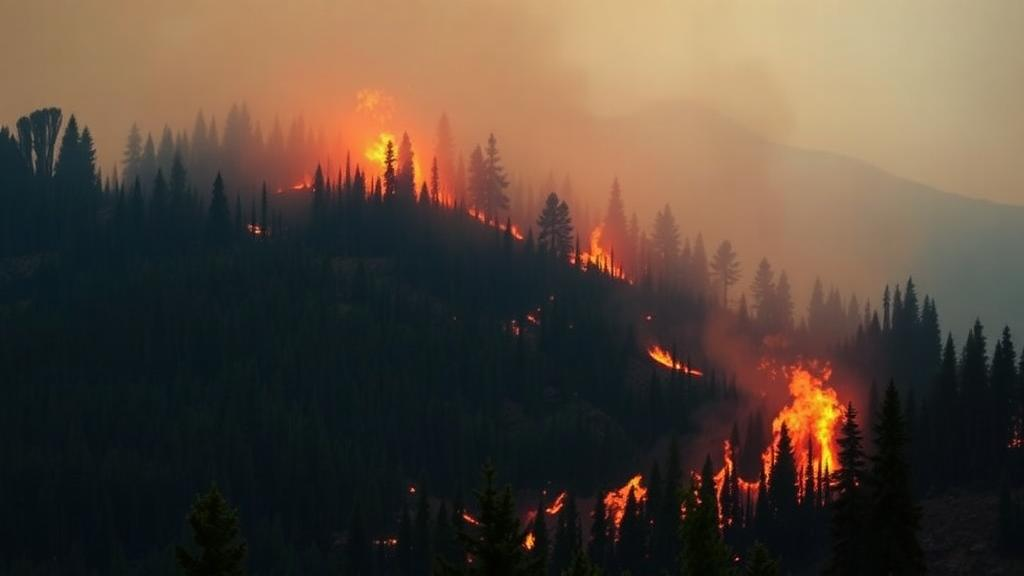
Canada’s wildfires have long been treated as a national problem, a seasonal hazard measured in hectares burned and communities evacuated. A new modeling study from Simon Fraser University argues that this framing dramatically understates the stakes. According to the research, published in the journal Environmental Research, the cumulative cost of climate change-driven wildfire impacts over the twenty-first century could exceed $2.1 trillion even under a middle-of-the-road warming trajectory, and the true figure is likely far higher once major categories of damage are left out of the accounting.
The study, led by Sian Kou-Giesbrecht, an assistant professor of resource and environmental management at Simon Fraser University, is among the first attempts to attach a comprehensive price tag to projected Canadian wildfire activity under a warming climate. Rather than focusing solely on the immediate costs of fighting fires, the analysis takes a deliberately broad view of what wildfire damage means, both for Canada and for the rest of the world.
Technically, the projection model integrates several interacting components of the fire system. It represents the influence of fire weather, the vegetation growth dynamics that determine how much fuel accumulates on the landscape, the effect of suppression efforts, and the two principal ignition sources: lightning and human activity. By coupling these fire processes to different global warming pathways, the model can translate atmospheric conditions into burned area, and burned area into dollars. The researchers then calculated costs under three possible scenarios: one in which global temperature rise is held to 2 degrees Celsius or less, one in which it reaches 3 to 4 degrees, and one in which it climbs to 4 to 5 degrees above pre-industrial levels.
The cost categories are divided into direct Canadian losses and global societal damages. Within Canada, the model counted the direct expense of wildfire suppression, the net loss of timber yield as burned forests cease producing commercially valuable wood, and the loss of nature-based recreation as smoke, closures, and burned landscapes degrade the natural assets Canadians and tourists rely on. Beyond the border, the study estimated the global societal costs of the carbon that Canadian wildfires release into the atmosphere, including changes in crop losses, damages driven by sea level rise, and declines in human health worldwide. This global dimension is what pushes the totals into the trillions: boreal forests store enormous quantities of carbon, and when they burn, the climate consequences ripple outward to agricultural systems, coastlines, and populations far from the fire line.
The scenario results carry a clear message about the sensitivity of these costs to near-term policy. If global warming is kept to 2 degrees Celsius or less, the study finds that wildfire impacts and costs will remain similar to what Canada has experienced over recent decades. But if fossil fuel dependence continues and the world drifts farther from that target, costs rise steeply. In the 3-to-4-degree scenario, which the study’s lead author describes as a more realistic worst case, the total annual cost of climate change-driven wildfire impacts reaches $43 billion by the end of the century, with cumulative costs over the twenty-first century exceeding $2.1 trillion.
There is, in the researcher’s assessment, a sliver of cautious optimism embedded in the projections. Kou-Giesbrecht notes that the world is now thought unlikely to hit the most extreme 4-to-5-degree pathway, largely because of green energy developments taking place primarily outside of Canada. The rapid global buildout of renewable electricity, electrified transport, and low-carbon industrial processes has bent the emissions curve enough that the very worst scenarios modeled a decade ago have receded. That shift alone, the study implies, spares Canada a substantial fraction of potential wildfire damage, even before any additional domestic action is taken.
Yet the $2.1 trillion figure is almost certainly a floor rather than a ceiling. The projection model deliberately excluded several major cost categories, and their omission matters. Wildfire-related health impacts, from respiratory illness caused by smoke exposure to heat stress, are absent from the calculation. So are the costs of evacuations, the destruction of homes and infrastructure, and the broader economic disruptions that follow when highways close, mills shut down, and regional labor forces are displaced. Each of these categories has produced measurable, sometimes enormous, costs in recent Canadian fire seasons, and none is reflected in the headline number.
The model also cannot capture singular extreme events, and here the recent record is instructive. Canada’s record-breaking 2023 wildfire season forced more than 200 communities to evacuate and exposed millions of Canadians to hazardous air pollutants, with smoke plumes that traveled across provincial borders and into the United States. A single season of that magnitude can reshape national cost expectations on its own, and a warming climate is expected to increase the frequency of such outlier years. Because the modeling framework projects average behavior across scenarios rather than simulating every possible catastrophic season, the true distribution of future costs likely has a fatter tail than the study’s central estimates suggest.
For Kou-Giesbrecht, the policy implication is unambiguous. The societal and economic costs of wildfire, she argues, are highly dependent on the actions taken to mitigate climate change right now, not in future decades. Immediate and drastic reductions in greenhouse gas emissions, sufficient to hold global temperature rise to 2 degrees Celsius, are described as the only available path to mitigate the economic and environmental consequences of wildfires in Canada. Adaptation measures such as improved suppression capacity and fire-smart land management can reduce losses at the margins, but no adaptation strategy can fully offset the exponential growth in fire activity that higher warming pathways imply for the boreal biome.
The study’s broader significance lies in how it reframes the economics of climate mitigation. Trillion-dollar damage estimates are usually associated with sea level rise or agricultural collapse in vulnerable regions; wildfire has often been treated as a secondary, regional concern. By quantifying the global societal costs of Canadian fire emissions, alongside domestic suppression, timber, and recreation losses, the research demonstrates that a single country’s fire regime can generate climate damages measured on a planetary scale. As boreal and temperate forests worldwide face longer fire seasons and more severe burning conditions, similar accounting exercises in other nations are likely to follow, and the cumulative global bill for wildfire in a warming century may prove to be one of the largest single line items in the climate ledger.
Subject of Research: Projected economic and global societal costs of climate change-driven wildfires in Canada over the 21st century
Article Title: Cost of Canadian wildfires could top $2 trillion over the 21st century: SFU study
Article References: Cost of Canadian wildfires could top $2 trillion over the 21st century: SFU study. (n.d.). Original publication
Image Credits: AI Generated
DOI: Not provided
Keywords: wildfires, Canada, climate change, economic costs, carbon emissions, boreal forests, global warming, wildfire suppression, Environmental Research, Simon Fraser University, climate modeling, greenhouse gas emissions
Cite Scienmag News
Sloane Callahan. (October 8, 2026). Canadian Wildfire Bill Could Pass $2 Trillion This Century, Study Warns. Scienmag. https://scienmag.com/canadian-wildfire-bill-could-pass-2-trillion-this-century-study-warns/
Sloane Callahan. "Canadian Wildfire Bill Could Pass $2 Trillion This Century, Study Warns." Scienmag, 8 October 2026, https://scienmag.com/canadian-wildfire-bill-could-pass-2-trillion-this-century-study-warns/. Accessed 8 October 2026.
Sloane Callahan. "Canadian Wildfire Bill Could Pass $2 Trillion This Century, Study Warns." Scienmag. October 8, 2026. https://scienmag.com/canadian-wildfire-bill-could-pass-2-trillion-this-century-study-warns/


