


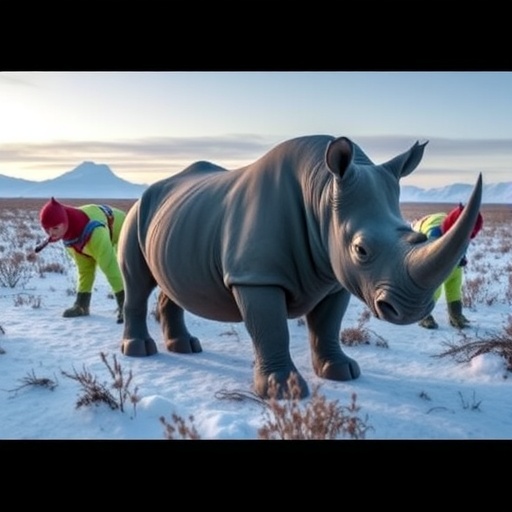
In a groundbreaking paleontological discovery, researchers from the Canadian Museum of Nature have unveiled the existence of a previously unknown species of rhinoceros that roamed the Canadian High Arctic approximately 23 million years ago. This newly identified species, named Epiaceratherium itjilik, represents the most northerly rhinoceros ever documented in the fossil record, shedding unprecedented light on the evolutionary journey and biogeography of rhinocerotids during the Early Miocene epoch.
The nearly complete skeleton of Epiaceratherium itjilik was unearthed from the sedimentary layers of the Haughton Crater on Devon Island, Nunavut, a site famous for preserving a rich assortment of fossilized flora and fauna. The crater’s Miocene lake deposits have provided exceptional three-dimensional preservation of the rhino’s skeletal remains, including diagnostic features such as the skull, mandibles, and dentition. These well-preserved fossils allowed scientists to conduct a comprehensive morphological analysis that definitively classified the remains within the Rhinocerotidae family and established the specimen as a distinct species.
This extinct rhino species was relatively small and lightly built, comparable in size to the modern Indian rhinoceros but notably lacking the prominent horn typical of many rhinocerotids. Through detailed examination of tooth wear patterns, researchers determined that the fossil individual was likely in early to mid-adulthood. The species’ name, “itjilik,” derived from the Inuktitut word for “frosty” or “frost,” pays homage to the animal’s High Arctic habitat and honors the Inuit Elder Jarloo Kiguktak for his integral role in connecting paleontological endeavors with Indigenous knowledge.
The discovery of Epiaceratherium itjilik challenges longstanding assumptions about rhinoceros biogeography, particularly the routes and timing of dispersal events between continents. By integrating extensive fossil data—including 57 taxa of rhinocerotids predominantly extinct—and employing advanced phylogenetic and biogeographic modeling, the research team reconstructed an updated evolutionary tree that highlights the North Atlantic Land Bridge as a vital dispersal corridor. Contrary to previous beliefs that this bridge ceased facilitating faunal exchanges around 56 million years ago, new evidence suggests that rhinoceroses migrated from Europe to North America across this pathway much later, likely during the Miocene.
The biogeographic implications extend beyond the rhino’s existence; they propose a more dynamic and prolonged interchange of terrestrial mammals between Eurasia and North America during this period. This updated timeline necessitates a revision of models explaining mammalian diversification and distribution patterns in the Northern Hemisphere. It also underscores the complex paleoclimatic and geological factors that enabled such dispersals despite the challenging northern latitude and climatic constraints.
Further heightening the significance of this find, researchers successfully extracted partial protein sequences from the tooth enamel of Epiaceratherium itjilik. This remarkable molecular preservation, reported in a complementary study, pushes forward the temporal boundaries for recovering ancient biomolecules, which are typically highly susceptible to diagenetic degradation over millions of years. The proteomic data offer fresh insight into evolutionary lineages and metabolic pathways, complementing morphological assessments and opening new frontiers for molecular paleontology.
The collaborative effort that led to this discovery spans several decades and includes key contributions from notable scientists such as Dr. Mary Dawson, whose initial expeditions in the 1980s uncovered critical elements of the skeleton, and Dr. Natalia Rybczynski, who spearheaded recent Arctic palaeontological campaigns. Together with Senior Research Assistant Marisa Gilbert, these researchers meticulously pieced together the fossil evidence, culminating in the formal description published in Nature Ecology & Evolution—a testament to the enduring value of Arctic fieldwork and museum curation.
Beyond its scientific dimensions, this finding enriches our understanding of the Miocene Arctic environment. Contrary to the current frigid permafrost conditions typifying the region, Haughton Crater bore a temperate forest ecosystem during the Miocene, as corroborated by fossilized plant remains found alongside the rhino and other fauna. This paleoenvironmental reconstruction provides critical context for interpreting how mammals like Epiaceratherium itjilik adapted to and thrived in what was then a far more hospitable High Arctic landscape.
The discovery also has broader implications for the study of Arctic biodiversity and climate evolution. By establishing a deeper historical baseline for mammalian presence in polar regions, it informs models forecasting future ecological responses amidst ongoing global climate change. Additionally, it provides an extraordinary case study for examining how lineages expand, contract, and migrate in response to shifting environmental conditions over geological timescales.
Importantly, the Epiaceratherium itjilik fossil is now curated within the Canadian Museum of Nature’s extensive collections, ensuring its availability for ongoing and future research. The fossil preparation performed at the Carnegie Museum of Natural History further exemplifies the international nature of paleontological scholarship and the essential partnerships that facilitate scientific progress.
This discovery reiterates the Arctic’s unparalleled potential to yield novel data on mammalian evolution and dispersal. As Dr. Danielle Fraser, lead researcher and head of paleobiology at the Canadian Museum of Nature, aptly summarized, the findings not only enrich the rhinoceros family tree but also deepen our appreciation of the Arctic paleontological record as a frontier for transformative discoveries in evolutionary biology.
Cite Scienmag News
Violet Maxwell. (October 28, 2025). Canadian Scientists Uncover Extinct Rhino Species in the High Arctic. Scienmag. https://scienmag.com/canadian-scientists-uncover-extinct-rhino-species-in-the-high-arctic/
Violet Maxwell. "Canadian Scientists Uncover Extinct Rhino Species in the High Arctic." Scienmag, 28 October 2025, https://scienmag.com/canadian-scientists-uncover-extinct-rhino-species-in-the-high-arctic/. Accessed 3 September 2026.
Violet Maxwell. "Canadian Scientists Uncover Extinct Rhino Species in the High Arctic." Scienmag. October 28, 2025. https://scienmag.com/canadian-scientists-uncover-extinct-rhino-species-in-the-high-arctic/


