


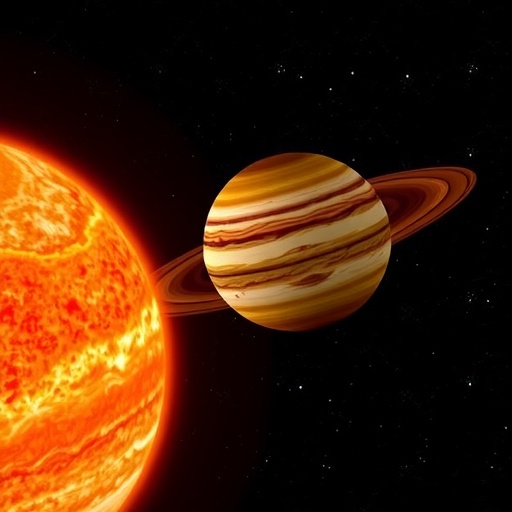
In the ever-expanding universe of exoplanet studies, researchers often encounter celestial phenomena that challenge conventional understandings of planetary formation. A prime example of this is the enigmatic class of gas giants known as eccentric warm Jupiters. Situated thousands of light-years away from Earth, and in orbits that deviate from traditional patterns, these planets have sparked the curiosity of astrophysicists and astronomers alike. In a recent undertaking led by Diego Muñoz, an assistant professor in the Department of Astronomy and Planetary Science at Northern Arizona University, the intricate dynamics surrounding these unusual planetary bodies will be scrutinized over the next three years, aiming to unravel their origins and implications for our own solar system’s development.
With funding from the National Science Foundation and collaboration with his co-primary investigators at Indiana University Bloomington, Muñoz’s ambitious investigation will probe the formation mechanisms of eccentric warm Jupiters. This classification is characterized by their warm temperatures, significant distance from their stars, and, notably, their uniquely shaped, elliptical orbits. The research is set to conclude by 2028, with hopes that insights gleaned from these alien worlds could provide clues about the formative processes of the solar system we call home.
Muñoz emphasizes the incredible diversity among exoplanetary systems, arguing that understanding these variances is key to painting a full picture of planetary evolution. While certain planetary systems may bear resemblance to our solar system, others exhibit configurations that are wildly different, prompting inquiries into the extremes of planetary formation. This contrast is pivotal, as it allows scientists to gauge how conventional theories of solar system formation apply in broader contexts, revealing the richness of astronomical phenomena beyond our immediate experience.
The investigation into warm Jupiters specifically builds upon the understanding that they cannot be formed solely through processes applicable to their similarly massed counterparts, known as hot Jupiters. The discrepancy in their orbital characteristics has become increasingly evident with advancements in telescope technology and data-gathering capabilities. Unlike hot Jupiters, which can exhibit varied orbit orientations in relation to their host stars, warm Jupiters show a striking tendency to align closely with the equatorial planes of their stars. This newly observed alignment, coupled with the pronounced eccentricity of their orbits, introduces complexity into current models of planetary formation.
Muñoz’s approach will involve leveraging observational data gathered by NASA’s Transiting Exoplanet Survey Satellite, creating a broader sample of eccentric warm Jupiters. By synthesizing this new data with modifications to existing models, he aims to construct a more complete understanding of their formation. The inquiry recognizes that these warm Jupiters may represent a distinct evolution mechanism that diverges from the traditional narratives surrounding planet formation. Exploring the underlying history of these planets could unveil previously overlooked principles that govern their existence.
A critical aspect of this research lies in dissecting potential theories that could explain the phenomena observed in eccentric warm Jupiters. One hypothesis suggests the existence of companion planets within these systems, which might exert gravitational influences that alter the warm Jupiter’s orbit without disrupting its alignment with its host star. This duality of eccentricity and inclination has been analytically feasible, yet integrating both factors into a cohesive model remains challenging.
Another avenue of investigation contemplates the conditions present in the nebulas from which these planetary systems arose. These gaseous environments may have interacted with nascent planets in ways that were not previously anticipated by scientists. The implications of such discoveries extend beyond the specific study of warm Jupiters, suggesting a comprehensive reevaluation of how we understand planetary formation within the broader cosmic framework.
A particularly intriguing theory posited by Muñoz revolves around the stars in these systems having a fundamental role in shaping the characteristics of their orbiting planets. He suggests that because stars can be treated as fluid entities, they can develop internal waves. These waves might have the capacity to interact with a planet’s orbit in unique ways, potentially even explaining the observed alignment of eccentric warm Jupiters with their host stars. This hypothesis opens up a new realm of possibilities for understanding the interactions between stellar dynamics and planetary formation.
As the investigation unfolds, Muñoz’s enthusiasm for creatively tackling the complexities inherent in these models is palpable. Employing a mix of computational techniques and analytical reasoning, he aims to push the boundaries of what is currently understood in exoplanetary science. With the help of a graduate student who will join him in the next academic year, Muñoz plans to engage in a robust exploration of the myriad potential explanations for the behavior of these warm Jupiters.
The overarching goal of Muñoz’s research is to elucidate the processes that underpin the formation of these exotic planets, with the hope that such insights might also clarify the evolutionary history of our own solar system. By investigating the dynamic interplay of factors that govern eccentric warm Jupiters, we can broaden our understanding of planetary systems and perhaps reveal patterns that have implications for the entire universe.
The mystery surrounding the formation of these planets stands as a compelling challenge to theorists and observational astronomers alike, indicating that there are still unknown forces at play in the cosmos. As Muñoz delves deeper into the calculations and scenarios that could account for warm Jupiters’ behavior, the scientific community eagerly anticipates findings that could reshape our comprehension of planetary formation and the nature of planetary systems in our galaxy.
In conclusion, Muñoz’s study of eccentric warm Jupiters underscores a significant paradigm shift in exoplanet research, where the focus on these outlier planets is not merely an academic exercise but a crucial step in decoding the evolution of planetary systems. The potential revelations from this work may transcend the boundaries of astronomy, impacting our foundational understanding of how our solar system came into being and revealing the diverse tapestry of planetary dynamics present throughout the universe. As this research unfolds, it promises to lead to breakthroughs that challenge our perceptions of the cosmos and illuminate the complexity of its origins.
Keywords
Eccentric warm Jupiters, exoplanets, planetary formation, Diego Muñoz, astronomy, National Science Foundation, NASA, hot Jupiters, planet formation mechanisms, stellar dynamics, cosmic evolution.
Cite Scienmag News
Grant Pearson. (October 14, 2025). Can These Quirky Warm Jupiters Unlock the Secrets of Planet Formation? Scienmag. https://scienmag.com/can-these-quirky-warm-jupiters-unlock-the-secrets-of-planet-formation/
Grant Pearson. "Can These Quirky Warm Jupiters Unlock the Secrets of Planet Formation?" Scienmag, 14 October 2025, https://scienmag.com/can-these-quirky-warm-jupiters-unlock-the-secrets-of-planet-formation/. Accessed 3 September 2026.
Grant Pearson. "Can These Quirky Warm Jupiters Unlock the Secrets of Planet Formation?" Scienmag. October 14, 2025. https://scienmag.com/can-these-quirky-warm-jupiters-unlock-the-secrets-of-planet-formation/


