The swimming crab, Portunus trituberculatus, is one of the workhorses of the world’s crab fisheries, with annual catches exceeding 450,000 tonnes. It is also, according to a growing body of research, one of the most cadmium-laden crabs in the sea. Compared with species such as the red king crab, the sentinel crab and the blue swimming crab, the swimming crab can carry cadmium concentrations ten to even one hundred times higher, a discrepancy that has long raised food safety questions for consumers and regulators alike.
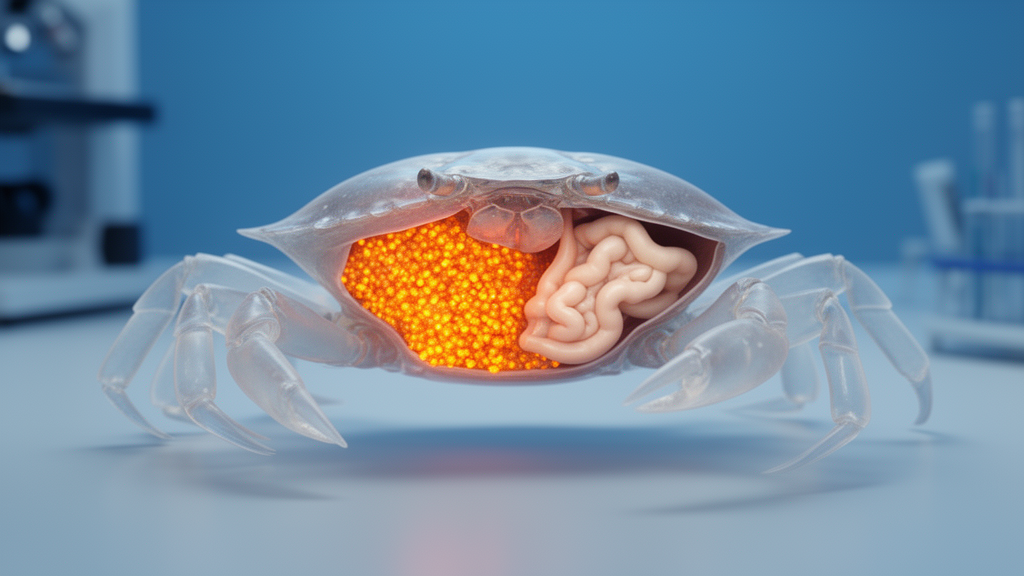
For years, researchers and food safety assessors grouped the crab’s edible tissues into two crude categories: brown meat, meaning the hepatopancreas and gonads together, and white meat, meaning the muscle. Because brown meat consistently showed far higher cadmium concentrations than white meat, the gonads were widely suspected of being a major storage site for the toxic metal. But the hepatopancreas and gonads sit so close together inside the crab’s body that complete separation during dissection is notoriously difficult, leaving genuine uncertainty about whether the gonads truly serve as a primary cadmium reservoir or were simply being counted alongside their contaminated neighbor.
To resolve the question, a research team collected 84 swimming crabs, 21 males and 63 females, from wharfs in Zhoushan, Zhejiang Province, between August 2023 and May 2024. The crabs, caught in the East China Sea, ranged in body weight from 138 to 391 grams, with an average of 226.3 grams. At least ten specimens were sampled for each gonadal developmental stage. The researchers then employed what they describe as a rigorous on-ice dissection procedure, sterilizing all tools and meticulously separating tissues to prevent cross-contamination, particularly between the anatomically adjacent hepatopancreas and gonads. Edible tissues examined included thoracic muscle, claw and chela muscle, hepatopancreas and gonads, while inedible tissues such as heart, gills and stomach were also analyzed.
Cadmium concentrations were measured using inductively coupled plasma mass spectrometry, following the Chinese national standard GB 5009.268-2025, with microwave digestion and indium as an internal standard. The method had a limit of detection of 0.02 milligrams per kilogram and a limit of quantification of 0.05 milligrams per kilogram on a wet-weight basis. Quality control was verified against a canned crab meat reference material: measured values of 5.66, 5.63 and 5.64 milligrams per kilogram fell comfortably within the certified range of 4.38 to 7.24 milligrams per kilogram. Because the data across tissue types did not meet the assumption of normality, the team used Kruskal-Wallis tests with Dunn post-hoc comparisons and Bonferroni correction, treating p values below 0.05 as significant.
The central finding is striking. In sexually mature crabs, cadmium content in the hepatopancreas of both males and females was significantly higher than in every other edible tissue, and the hepatopancreas alone accounted for more than 97 percent of the total cadmium in all edible tissues combined. The gonads, by contrast, contained very little of the metal, with concentrations ranging from non-detectable levels up to just 0.270 milligrams per kilogram across developmental stages. This, the authors argue, resolves the previous debate: the gonads are not a primary site of cadmium accumulation, and the traditional practice of lumping them with the hepatopancreas as brown meat may substantially overestimate the gonads’ contribution to dietary cadmium exposure.
The study also traced how cadmium distribution shifts across the female reproductive cycle, which the researchers divided into six stages based on gonadal appearance, from thin translucent bands in stage I to the orange-red, egg-releasing stage VI. Because stage I ovaries were too small and fragile to separate cleanly from the hepatopancreas, that stage was excluded from the cadmium analysis. In the hepatopancreas, cadmium content in sexually immature stage I-II and stage II crabs was significantly lower than in sexually mature stage VI crabs, a pattern the authors attribute in part to cadmium accumulating as individuals grow and their exposure time lengthens. Meanwhile, the hepatosomatic index, the hepatopancreas’s share of body weight, remained relatively high during early ovarian stages and declined during stages II-III and IV-VI, changes that may reflect the mobilization of stored nutrients to support egg production.
The ovaries told an unexpected story of their own. Cadmium levels there were neither constant nor simply increasing with time. Concentrations were comparatively elevated in the earliest stages of ovarian development and again in the late stages of maturation, particularly at stage II, where the ovary measured 0.1624 milligrams per kilogram, and at the berried stage V, both significantly higher than the mid-stage III. During the period of rapid gonadal development, stages III through V, when oocytes proliferate and yolk accumulates, cadmium in the ovaries dropped to levels close to the method’s quantification limit of 0.05 milligrams per kilogram.
Then came the most curious result of all. At stage VI, after mature eggs were expelled and ovarian volume shrank, the gonadosomatic index fell to levels similar to stages II-III, yet cadmium concentration in the ovary soared to the highest point of the entire reproductive cycle. The authors suggest this pattern may indicate that the external structures of the ovary intercept most of the cadmium within the ovarian tissue, an interpretation indirectly supported by the finding that cadmium in the eggs themselves was near the detection limit. In fact, cadmium in the eggs measured just 0.0694 milligrams per kilogram, roughly one-seventh of the level in the stage VI reproductive gland. This may point to a blocking mechanism that confines cadmium to the outer membrane of the ovary, keeping it away from the reproductive cells and potentially sparing the development of the crab’s offspring. The researchers caution, however, that there is currently no direct evidence showing whether cadmium is confined through specific binding forms or tissue barrier mechanisms, and that cadmium speciation analysis, tissue localization and molecular-level studies will be needed to verify it.
Across all examined tissues, the full hierarchy emerged clearly: hepatopancreas highest, followed by stomach at 1.66 milligrams per kilogram, gills at 0.60, heart at 0.34, then gonads, eggs near the quantification limit, and finally thoracic muscle and leg and claw muscle at the lowest levels. The relatively high cadmium content in the stomach, possibly reflecting undigested food residue, hints that the metal mainly enters the crab through its diet, though the authors note that few exposure experiments have directly addressed accumulation pathways in this species. White muscle, consistent with earlier work by the same group, showed the lowest cadmium concentrations of any examined tissue throughout gonadal development, with no significant differences between sexes. Previous research had estimated that the hazard quotient associated with eating brown meat was roughly five times that of white meat, and other studies have identified the fatty edible portion known as huang as a major contributor to assessed cadmium-related health risk.
The authors are careful to note that low cadmium in raw white muscle does not guarantee low dietary exposure under all conditions. Cooking matters: their earlier research indicated that steaming can transfer cadmium from the brown meat into adjacent leg muscle, potentially raising cadmium concentrations in cooked muscle. Dietary exposure also depends on how much crab is eaten and how often. From a practical standpoint, they suggest that removing the hepatopancreas before consumption may help reduce cadmium intake, and that if the hepatopancreas and gonads cannot be cleanly separated, both should be removed entirely before processing and eating. On the regulatory side, tissue-specific monitoring of white muscle and the cadmium-enriched hepatopancreas could refine dietary exposure assessments for swimming crab products. The team also emphasizes that the relationships between the hepatosomatic and gonadosomatic indices and cadmium accumulation remain unclear, likely shaped by multiple interacting factors rather than a single universal mechanism, and that the contributions of metallothionein and other detoxification pathways in the hepatopancreas still require further investigation. What the study establishes firmly is a revised map of cadmium in one of the world’s most consumed crabs, one that points food safety attention squarely at the hepatopancreas.
Subject of Research: Tissue-specific cadmium accumulation in swimming crabs during gonadal maturation
Article Title: Stage- and tissue-specific cadmium accumulation in Portunus trituberculatus during gonadal maturation
Article References: Mo, X., He, R., Yan, M., Shi, Y., Zhang, X., Gong, Q., Wu, D., Huang, D., Han, F., Li, S., & Fang, C. (2026). Stage- and tissue-specific cadmium accumulation in Portunus trituberculatus during gonadal maturation. Journal of Agriculture and Food Research, 32, Article 103397. https://doi.org/10.1016/j.jafr.2026.103397
Image Credits: AI Generated
DOI: 10.1016/j.jafr.2026.103397
Keywords: cadmium, swimming crab, Portunus trituberculatus, hepatopancreas, gonadal maturation, food safety, heavy metals, ICP-MS, East China Sea, crustaceans, brown meat, ovarian development
Cite Scienmag News
Alan Morgan. (October 28, 2026). Cadmium hides in the swimming crab’s hepatopancreas, not its gonads. Scienmag. https://scienmag.com/cadmium-hides-in-the-swimming-crabs-hepatopancreas-not-its-gonads/
Alan Morgan. "Cadmium hides in the swimming crab’s hepatopancreas, not its gonads." Scienmag, 28 October 2026, https://scienmag.com/cadmium-hides-in-the-swimming-crabs-hepatopancreas-not-its-gonads/. Accessed 29 October 2026.
Alan Morgan. "Cadmium hides in the swimming crab’s hepatopancreas, not its gonads." Scienmag. October 28, 2026. https://scienmag.com/cadmium-hides-in-the-swimming-crabs-hepatopancreas-not-its-gonads/