

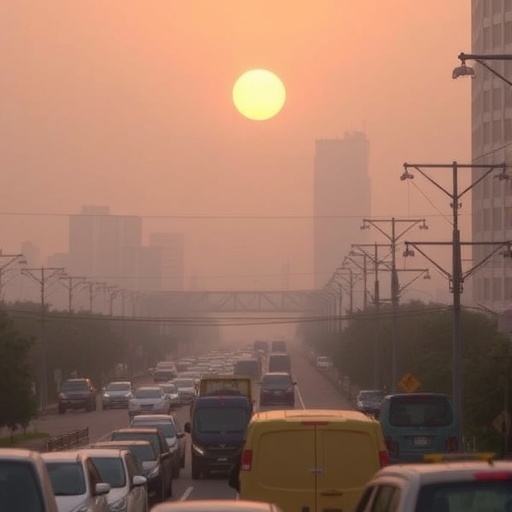
As climate change intensifies over the coming decades, its impact on air quality across the United States is projected to worsen dramatically, according to a new comprehensive international study led by researchers at the University of Waterloo. The latest modeling reveals a disconcerting future in which close to one-third of Americans will regularly inhale air that fails to meet health standards for sensitive populations by the year 2100. This marks an unprecedented sevenfold increase from levels observed at the dawn of the 21st century, signifying a stark escalation in public health risks tied to environmental change.
The research team employed advanced atmospheric models to forecast air quality trends specifically during the critical smog season spanning May through September, a period characterized by elevated levels of ozone and particulate matter—pollutants known for their potent health implications. Their analysis estimates that approximately 100 million residents will inhabit regions where average smog season air quality degrades enough to trigger official alerts. These advisories signal vulnerable groups, including children with asthma, the elderly, and individuals suffering from chronic respiratory or cardiovascular conditions, to reduce outdoor exposure and alter daily activities to mitigate adverse health impacts.
Alarmingly, this figure represents a significant rise from an estimated 14 million people affected in 2000, with the most pronounced growth occurring in urban and suburban areas of California and the eastern United States. The pronounced increase reflects a complex interplay of factors, including rising temperatures that accelerate ozone formation and contribute to atmospheric stagnation, allowing pollutants to accumulate to harmful levels. These climatic shifts exacerbate the production and persistence of smog, compounding existing challenges from industrial emissions and vehicular traffic.
Dr. Rebecca Saari, a professor specializing in civil and environmental engineering and holder of the Canada Research Chair in Global Change, Atmosphere, and Health, emphasized the profound shift in air quality patterns projected by the study. She explained, “Climate change is poised to convert what were once infrequent incidences of poor air quality into a persistent reality.” Her remarks highlight the transition from episodic smog events toward a future where daily exposure to unhealthy air becomes commonplace, fundamentally altering public health landscapes and demands for health advisories.
The study’s projections suggest a grim reality for sensitive populations, who may face nearly a 50% probability of receiving air quality alerts on any given day during smog season by century’s end. This effectively turns daily outdoor activities into a gamble for these groups, confronting them with frequent choices between risking exposure or restricting their mobility and social engagement. Such chronic exposure increases risks for acute exacerbations of asthma, chronic obstructive pulmonary disease (COPD), cardiovascular stress, and could accelerate long-term morbidity and mortality trends, underscoring the urgent need for enhanced public health strategies and infrastructure.
Building on previous work that foresaw a fourfold increase in air quality alerts, the new study incorporates a more holistic assessment by including both ozone and particulate matter pollutants, which jointly account for the vast majority of smog-related health warnings. These pollutants not only impair lung function and exacerbate allergies but are recognized as primary environmental contributors to premature death worldwide. Their combined inclusion yields a more penetrating understanding of future air pollution exposure patterns and their potential public health repercussions.
In addition to detailing the health impacts, the research delves into the economic ramifications of worsening air pollution driven by climate change. The anticipated expansion in the frequency and severity of poor air quality episodes will impose substantial burdens on healthcare systems through increased emergency visits, hospitalizations, and long-term disease management costs. The study also explores how various policy scenarios could modulate these outcomes, illustrating that proactive mitigation of pollution emissions and adaptive strategies such as improved indoor air filtration could significantly reduce these adverse effects and associated economic costs.
One notable insight from the analysis is the differential benefit that poll reductions and adaptive measures confer upon various vulnerable subgroups. Particularly, seniors gain substantially more protection compared to other sensitive individuals when employing measures like wearing masks, remaining indoors during peak pollution episodes, and utilizing enhanced building filtration systems. These findings highlight the necessity of tailoring public health recommendations and adaptation resources commensurate with demographic vulnerabilities to maximize protective outcomes.
Dr. Saari expressed surprise at the scale and frequency with which sensitive populations might encounter air quality deemed unhealthy under future climate scenarios. Her team’s results underscore the urgency of driving ambitious pollution abatement policies while simultaneously investing in resilient infrastructure that guarantees access to clean indoor environments. Such multifaceted approaches are critical to safeguarding public health in the face of escalating environmental stressors and to forestalling the normalization of hazardous daily air quality conditions.
Collaboration was instrumental in achieving the study’s comprehensive scope, incorporating expertise from prestigious institutions including Harvard University, North Carolina State University, and the University of California, Davis. This multidisciplinary partnership enabled robust modeling techniques, extensive data analyses, and nuanced policy evaluations that collectively advance understanding of air quality dynamics under a warming climate.
Published in the peer-reviewed journal Environmental Science and Technology, the study titled “Air Quality Alerts, Health Impacts and Adaptation Implications Under Varying Climate Policy” constitutes a vital contribution to the scientific discourse on environmental health, climate change, and public policy. It provides policymakers, health practitioners, and communities with critical evidence to anticipate emerging challenges and to steer effective interventions in the decades ahead.
As the United States confronts the dual crises of climate change and deteriorating air quality, this research serves as a clarion call for intensified efforts to reduce emissions, bolster adaptive capacities, and prioritize the protection of vulnerable communities. Without substantial action, the projected increase in exposure to unhealthy air will have profound ramifications for human health, economic stability, and societal wellbeing that will ripple well beyond the 21st century.
Subject of Research: Impact of Climate Change on Air Quality and Public Health in the United States
Article Title: Air Quality Alerts, Health Impacts and Adaptation Implications Under Varying Climate Policy
Web References:
- DOI link: https://doi.org/10.1021/acs.est.5c12522
Keywords
Climate change, air quality, ozone pollution, particulate matter, smog season, public health, vulnerable populations, environmental policy, health impacts, indoor air filtration, pollution mitigation, adaptation strategies


