


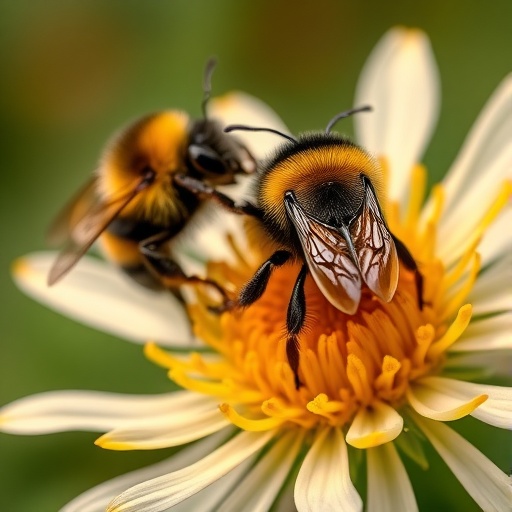
In an exciting revelation in the field of entomology, recent research published in the journal Discover Animal sheds new light on the complex dynamics of mating behaviors among bumblebees, particularly focusing on the species Bombus impatiens. The study, conducted by researchers Spence and Amsalem, investigates how males of this species are attracted to specific, short-range multimodal signals emitted by female gyne bumblebees. This groundbreaking research adds a significant dimension to our understanding of pollinator behaviors and mate selection in competitive environments.
The study commences with a fascinating exploration of the signals that female bumblebees, particularly gynes, utilize to attract male suitors. Females emit a blend of visual and auditory cues that play a crucial role in enabling males to locate them in their natural habitats. This research provides compelling insights into how these signals work in tandem to enhance male attraction. By identifying specific modalities and their influence on male behavior, the study paves the way for further investigations into the evolutionary implications of these interspecies interactions.
Within the framework of bumblebee communication, multimodal signaling encompasses the integration of various forms of signal transmission. In this case, visual cues, such as color and movement, are coupled with auditory signals, such as vibrational sounds produced by wing beats. These multimodal cues not only enhance the chances of male detection but also streamline the mating process under conditions that may otherwise impede successful pair formation, such as environmental noise or proximity to other competing males.
Delving deeper, the researchers employed innovative experimental designs to assess the effectiveness of these signals in attracting male bumblebees. By manipulating the presence and intensity of both visual and auditory signals in controlled settings, they were able to quantify male responses and behaviors in real-time. What emerged was a clear pattern: male bumblebees exhibited a pronounced preference for females that emitted a combination of strong visual and auditory signals, demonstrating the interconnectedness of sensory modalities in driving mating behaviors.
Additionally, the implications of this study resonate beyond the immediate sphere of bumblebees. Understanding the mechanics of attraction in these pollinators provides valuable insights into broader ecological processes, including flower pollination and ecosystem stability. As pollinators face numerous threats from habitat loss and climate change, comprehending their mating mechanisms could inform conservation strategies aimed at safeguarding these essential species.
Interestingly, the research further ties into evolutionary theory, suggesting that the multimodal signaling exhibited by female bumblebees may have evolved through sexual selection. The study presents a compelling argument that males prefer these complex signals because they may be indicative of female vitality and reproductive fitness. This perspective not only enriches our understanding of bumblebee behavior but also aligns with established theories of mate selection seen across various animal species.
To comprehend the intricacies of bumblebee mating behaviors requires a multidisciplinary approach that combines evolutionary biology, ecology, and sensory biology. As more researchers delve into these realms, interdisciplinary insights can pave the way for a more holistic understanding of animal interactions. This study by Spence and Amsalem is a testament to the profound advancements possible when diverse scientific perspectives converge to explore a common theme—in this case, the fascinating world of insect communication.
Furthermore, the findings raise intriguing questions about the role of environmental factors in shaping mating signals. Given the climate crisis and changes in habitat structures, understanding how these factors may modulate the effectiveness of mating signals becomes essential. As the male bumblebees navigate their surroundings, variations in light, sound, and even scent could play a critical role in determining which signals are perceived and prioritized, influencing reproductive success.
In summary, the exploration of male attraction to multimodal gyne signals in Bombus impatiens signifies a breakthrough in the study of insect behavior. Spence and Amsalem’s work highlights not just a unique aspect of bumblebee communication but a broader narrative about the intricacies of life forms on our planet. As science continues to reveal the underlying mechanisms of attraction, the hope is that this knowledge will also encourage a greater appreciation for the delicate ecosystems that support these remarkable creatures.
As the bumblebee populations face unprecedented challenges, understanding their mating behaviors could have far-reaching implications for biodiversity and conservation efforts. The status of these pollinators as key players in our agricultural systems underscores the needs for continuous research in their behavioral patterns. Lessons learned from this study may even translate into improved strategies for pollination management, which is critical for food security in a rapidly changing world.
In conclusion, the research by Spence and Amsalem not only enriches our knowledge of bumblebee behaviors but also opens new avenues for inquiry. Their findings have set a benchmark for future studies aimed at unraveling the complexities of sensory integration in animal communication. As we delve deeper into the intricate world of insects, this study is a shining example of the importance of scientific exploration and its potential to inform conservation and ecological stability strategies moving forward.
Through the lens of Bombus impatiens, we are reminded of the intricate connections that bind species and ecosystems together. The insights garnered from this research could instance a shift in how we perceive and interact with the natural world, fostering a renewed respect for the complex lives of creatures often overlooked in our daily lives. The inadvertently widespread implications of understanding such dynamics echo through the annals of conservation and ecological studies, marking an exciting chapter in biological research.
Cite Scienmag News
Gavin Prescott. (October 27, 2025). Bumblebees Respond to Female Signals in Short Range. Scienmag. https://scienmag.com/bumblebees-respond-to-female-signals-in-short-range/
Gavin Prescott. "Bumblebees Respond to Female Signals in Short Range." Scienmag, 27 October 2025, https://scienmag.com/bumblebees-respond-to-female-signals-in-short-range/. Accessed 4 September 2026.
Gavin Prescott. "Bumblebees Respond to Female Signals in Short Range." Scienmag. October 27, 2025. https://scienmag.com/bumblebees-respond-to-female-signals-in-short-range/


