

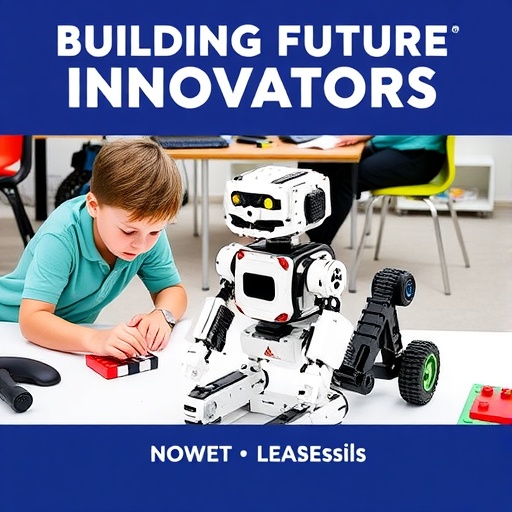
In today’s rapidly evolving educational landscape, the intersection of Science, Technology, Engineering, Art, and Mathematics (STEAM) with Social and Emotional Learning (SEL) is gaining prominence, particularly in early childhood education. A groundbreaking study by Mahiri, Munzer, and Bayazitli explores the integration of these disciplines in a Lego robotics afterschool program specifically designed for four and five-year-olds. This initiative aims to foster a holistic learning environment that nurtures both cognitive and emotional development among young learners.
The researchers embarked on this ambitious project with a clear vision: to investigate how a hands-on learning approach, utilizing Lego robotics, could effectively engage young students while simultaneously enriching their understanding of essential STEM concepts. By focusing on children in early childhood, they sought to leverage their natural curiosity and enthusiasm for play, using it as a vehicle for deeper learning experiences. The study is not only a testament to innovative teaching practices but also highlights the significance of fostering SEL competencies in tandem with academic skills.
This pioneering program involved a structured curriculum where children collaborated to build and program Lego robots, thereby gaining firsthand experience in design, engineering, and problem-solving. As the children worked together, they encountered various challenges that required them to apply critical thinking and creativity. This collaborative environment naturally facilitated the development of social skills, including communication, teamwork, and conflict resolution, which are integral components of SEL.
Furthermore, the Lego robotics program provided a rich context for engaging students in discussions about emotions and interpersonal relationships. Educators integrated SEL-based activities, such as guided reflections and role-playing scenarios, encouraging children to articulate their feelings and empathize with their peers. This dual focus on STEM education and emotional intelligence aimed to create well-rounded individuals who are not only capable of navigating technological landscapes but are also emotionally equipped to engage with others positively.
One of the unique aspects of the study was the emphasis on play as a central element of the learning process. The researchers found that when children are allowed to learn through play, they become more engaged and motivated. This is particularly crucial at this developmental stage, as play serves not just as a method of entertainment, but as a significant avenue for cognitive and social growth. Integrating robotics into playtime allowed children to experiment, fail, and try again in a supportive environment, which reinforces resilience and perseverance.
The study highlights the growing recognition of the importance of SEL in early childhood education. Traditional educational systems have often prioritized academic skills over emotional and social development, but there is now a shift towards a more integrated approach. Through programs like the one designed by Mahiri and his colleagues, educators are beginning to understand that cognitive and emotional development are deeply interconnected. This realization underscores the need for curricula that balance technical proficiency with personal growth.
Noteworthy is the role of educators in this program. They were not merely facilitators of knowledge; rather, they were integral to shaping the learning experience. Educators received training on how to present challenges that would not only test children’s technical skills but also instigate social interactions and emotional processing. The results of this study indicate that when educators are equipped with the right strategies, they can significantly enhance the learning journey of young children.
Moreover, the study sheds light on the impact of such programs on the parents and families of the participants. As children engage in robotics and discuss their experiences at home, parents reported heightened interest in both STEM subjects and emotional wellness. This program becomes a catalyst for discussions that extend beyond the classroom, thereby fostering a home environment conducive to learning and emotional intelligence.
Another compelling aspect of the research is its implications for policy and curriculum design in early childhood education. As evidence mounts around the benefits of integrating SEL with STEM education, policymakers are urged to consider these findings when designing educational frameworks. The implementation of such programs could be a powerful step toward creating resilient future generations equipped with both the technical skills necessary for the modern workforce and the emotional skills needed for thriving relationships.
The researchers are optimistic about the results, emphasizing that the foundations laid in early childhood can have long-lasting effects on individuals as they progress through their educational and professional careers. Building confidence in problem-solving, enhancing emotional intelligence, and fostering collaborative skills at such a young age presents an opportunity to reshape the landscape of education. Students emerge not only as proficient in the principles of STEM but also as compassionate individuals ready to engage with an increasingly complex world.
As the educational community continues to explore the nuances of nurturing young minds, studies like this are instrumental in providing insights and evidence for best practices. The successful integration of robotics and SEL is a promising avenue that invites further exploration and replication across various educational settings.
In conclusion, Mahiri, Munzer, and Bayazitli’s research paves the way for a new paradigm in early childhood education. The Lego robotics afterschool program exemplifies a forward-thinking approach that captures children’s imaginations while simultaneously addressing their emotional and social needs. As more educational institutions look to embrace this integrated model, it stands to transform the lives of countless young learners, preparing them not just for academic success, but for meaningful, emotionally intelligent lives.
Subject of Research: Integration of STEM and SEL in Early Childhood Education
Article Title: STEM and SEL for Four and Five-Year-Olds in a Lego Robotics Afterschool Program
Article References: Mahiri, J., Munzer, A. & Bayazitli, I. STEM and SEL for Four and Five-Year-Olds in a Lego Robotics Afterschool Program. Early Childhood Educ J (2026). https://doi.org/10.1007/s10643-025-02095-3
Image Credits: AI Generated
DOI: https://doi.org/10.1007/s10643-025-02095-3
Keywords: STEM, SEL, Early Childhood Education, Robotics, Lego, Emotional Intelligence


