


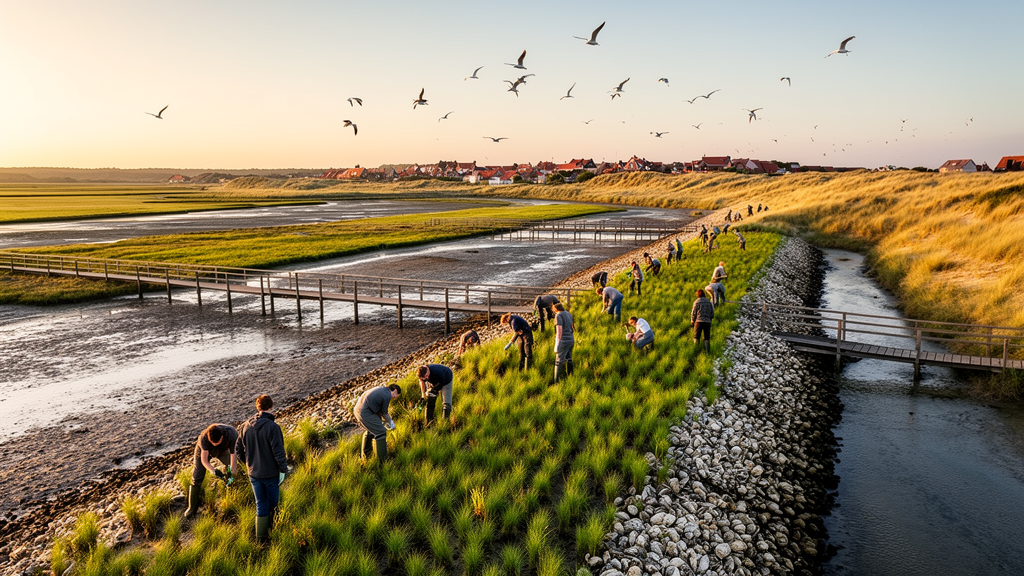
Coastal ecosystems occupy a paradoxical position in the global environmental crisis. They cover only around five percent of the Earth’s surface, yet they shelter nearly one third of the world’s population and generate roughly two thirds of the total value that the planet’s ecosystems provide to humanity. From salt marshes that blunt storm surges to seagrass meadows that scrub nutrients from the water, these narrow ribbons of land and sea punch far above their weight. They are also among the most imperilled environments on Earth, squeezed between rising seas, hardening infrastructure, upstream pollution and the mounting toll of extreme weather. Now, a team of European researchers has unveiled an openly available dataset that could change how coastal restoration is planned at scale, by letting the people who know these coastlines best draw the maps themselves.
The dataset, published in the journal One Ecosystem, emerges from the EU Horizon 2020 REST-COAST project, a consortium spanning science, policy and society that confronts a stubborn problem in modern conservation: pilot projects succeed brilliantly, but they remain isolated success stories. A restored salt marsh here, a replanted seagrass meadow there — each demonstrates what Nature-based Solutions can achieve, yet none easily connects into the landscape-scale adaptation strategies that climate change actually demands. The researchers behind the new work describe this as the central upscaling challenge, and their answer is a framework that treats restoration sites as modular building blocks which can be diagnosed, restored and eventually reassembled into larger coastal mosaics.
The approach, called the Nature-based Building Blocks Framework, rests on two complementary methods. The first, a Participatory Downscaling Approach, guides stakeholders in collaboratively demarcating the physical boundaries of a restoration unit within a larger seascape. Stakeholders position each unit along a land-to-sea continuum — from subtidal and intertidal zones through barrier, hinterland and upstream stretches — and then subdivide the coastline into distinct segments based on natural and social characteristics. The second method, an Input-Process-Output Model, structures the characterisation of each unit into three functionally linked compartments. The input compartment captures the unit’s degraded state through biophysical and socio-economic parameters such as sediment load, wave climate, governance structures and funding availability. The process compartment identifies the specific restoration action selected to address that degradation, whether seagrass restoration, dune revegetation or managed realignment. The output compartment projects the anticipated restored state through ecosystem services and biodiversity indicators.
What makes the resulting dataset unusual is that every Coastal Unit was drawn by stakeholders, not imposed by modellers. Using a bespoke Interactive Web Map built on the Leaflet library and Open Street Map, participants at each pilot site delineated georeferenced polygons and populated structured data sheets capturing locally relevant information. The process unfolded in two phases: initial bilateral workshops preliminarily demarcated units and provisionally characterised them, followed by extended applications in which a focused task force refined the spatial boundaries into operationally precise polygons and enriched the contextual tables with quantitative and qualitative metrics harmonised across sites. Each parameter in the data sheets is documented with its descriptive name, measurement unit following SI standards where applicable, its directional impact on the selected restoration process, and a supporting basis drawn from models, empirical data or literature, each accompanied by a link to the corresponding source.
Three pilot sites, representing radically different geomorphological and socio-ecological contexts, anchor the initial dataset. The first is the Venice Lagoon, the largest lagoon in the Mediterranean, covering approximately 550 square kilometres along the northern Adriatic coast. Within the Millecampi Teneri waterbody, stakeholders identified nine salt marshes spanning roughly 138 hectares as their Coastal Unit, with artificial salt marsh reconstruction as the restoration process. The unit faces lateral edge erosion, sea level rise, dredging and biodiversity loss, and stakeholders outlined a phased implementation concept moving through site cleaning, containment, refilling and naturalisation. Drawing on decades of monitoring and modelling, they catalogued parameters ranging from projected future sea level rise and sediment granulometry to salt marsh morphology, current-wave characteristics, carbon sequestration rates and Water Framework Directive indices for benthic communities.
The socio-economic parameters for the Venice unit are equally revealing. Stakeholders recorded national and EU funding streams, regulatory requirements under the Water Framework Directive, vessel traffic that quantifies boat-induced wave erosion on marsh edges, nutrient loading from regional agriculture and industry, proximity to industrial areas, fishing interests and cultural heritage designations that both constrain and enable restoration. When it came to anticipated benefits, expert-based scoring placed coastal protection — flood risk reduction and erosion reduction — at the highest priority, with climate regulation and water purification receiving moderate scores and food production rated more conservatively. Stakeholder narratives emphasised expected gains for benthic communities, marsh and submerged vegetation, fish and birds, while acknowledging that re-naturalisation proceeds gradually.
The second pilot sits in the Foros Bay, in the innermost section of Bulgaria’s Burgas Bay on the microtidal Black Sea. Connected to the Burgas Wetlands Complex along the Via Pontica migratory bird route, the area is designated as a NATURA 2000 site. Here, stakeholders selected a 39-hectare seagrass meadow dominated by Zostera noltii adjacent to the Poda Protected Area, with seagrass conservation as the restoration process. The parameters they documented include wave energy, wind fetch, current velocity, bottom orbital velocity, substrate type, water temperature, salinity, Secchi depth transparency and nutrient concentrations, alongside seagrass biomass, shoot density, macrozoobenthos diversity and blue carbon storage rates. Anticipated service gains scored highest for water purification, followed by climate regulation — a reflection of the meadows’ role in buffering upstream and port-related pressures. Stakeholders described conserving these rare and endangered meadows as critical for habitat integrity and species diversity under continued anthropogenic stress.
The third pilot takes the framework in an entirely different direction: the Vistula Lagoon, the second largest lagoon in the Baltic Sea, shared by Poland and Russia and stretching about 91 kilometres. The Polish sector is a NATURA 2000 site, and the region endured prolonged socio-economic decline after the 1990s transition. In response, the Polish government financed a strategic plan to excavate a navigation passage through the coastal barrier, connecting the port of Elblag to the Baltic Sea. Rather than discarding the dredged sediments, the plan incorporated an artificial island of approximately 180 hectares designed as managed grassland functioning as a bird sanctuary. Stakeholders identified this artificial bird island as their Coastal Unit, with construction as the restoration process, documented through parameters such as wind forcing reconstructed from historical air pressure maps, modelled wave fields, storm surge records, substrate conditions and biodiversity inventories of birds, fish and macrozoobenthos aligned with NATURA 2000 obligations. Notably, the highest expected service gain was food production — evaluated specifically as ecological food supply for the island’s bird species rather than for direct human use — underscoring the biodiversity-centred orientation of the effort.
The researchers are candid about the dataset’s limitations, which themselves carry scientific weight. Stakeholder involvement was largely dominated by REST-COAST project partners, producing observable disciplinary imbalances: biophysical parameters were generally more detailed and elaborated, while socio-economic parameters persistently lacked comparable resolution and rigour. Data availability also varied across sites, contrasting data-rich Venice with the under-studied Vistula Lagoon. Contextual uncertainties — persistent conflicts, diverging interests, governance variability, resource constraints and physical limitations — may amplify when moving from individual units to landscape-scale restoration. The dataset is explicitly not normative of implementations but functions as a structured blueprint, rendering data, knowledge, assumptions and biases spatially explicit so that decision-making remains evidence-informed while recognising uncertainty.
Even so, the modularity of the Coastal Units is what gives the dataset its upscaling potential. Because every unit, regardless of local ecological context, shares the same Input-Process-Output structure across its biophysical, socio-economic and ecological dimensions, the units become commensurable — they can be positioned alongside one another within a landscape or across geographies not as isolated interventions but as building blocks combined through physical fluxes, institutional cohesion or ecological continuity. The framework and its tools are already being applied beyond REST-COAST, including in the EU WaterLANDS project, and the dataset is designed to grow as further units are identified within existing pilots and new geographies. The spatial data and contextual tables are openly available through Zenodo, with the Interactive Web Map freely accessible online. As Europe’s coasts face accelerating pressures, this portfolio of stakeholder-drawn, systematically characterised restoration units offers something the field has lacked: a common language for turning scattered pilot successes into a connected, landscape-wide mosaic of restored coastal ecosystems.
Subject of Research: Environmental Science
Article Title: A spatially-explicit, participatively derived dataset for Nature-based Building Blocks integrating biophysical, social and ecological characteristics across EU coastal restoration pilots
Article References: A spatially-explicit, participatively derived dataset for Nature-based Building Blocks integrating biophysical, social and ecological characteristics across EU coastal restoration pilots. (n.d.). https://doi.org/10.3897/oneeco.11.e196087
Image Credits: AI Generated
DOI: 10.3897/oneeco.11.e196087
Keywords: Nature-based Solutions, coastal restoration, REST-COAST, Venice Lagoon, Foros Bay, Vistula Lagoon, ecosystem services, participatory mapping, salt marsh, seagrass, biodiversity, climate adaptation
Cite Scienmag News
Gavin Prescott. (October 15, 2026). Building Blocks for Coastal Restoration: New Dataset Maps Europe’s Nature-Based Solutions. Scienmag. https://scienmag.com/building-blocks-for-coastal-restoration-new-dataset-maps-europes-nature-based-solutions/
Gavin Prescott. "Building Blocks for Coastal Restoration: New Dataset Maps Europe’s Nature-Based Solutions." Scienmag, 15 October 2026, https://scienmag.com/building-blocks-for-coastal-restoration-new-dataset-maps-europes-nature-based-solutions/. Accessed 15 October 2026.
Gavin Prescott. "Building Blocks for Coastal Restoration: New Dataset Maps Europe’s Nature-Based Solutions." Scienmag. October 15, 2026. https://scienmag.com/building-blocks-for-coastal-restoration-new-dataset-maps-europes-nature-based-solutions/


