


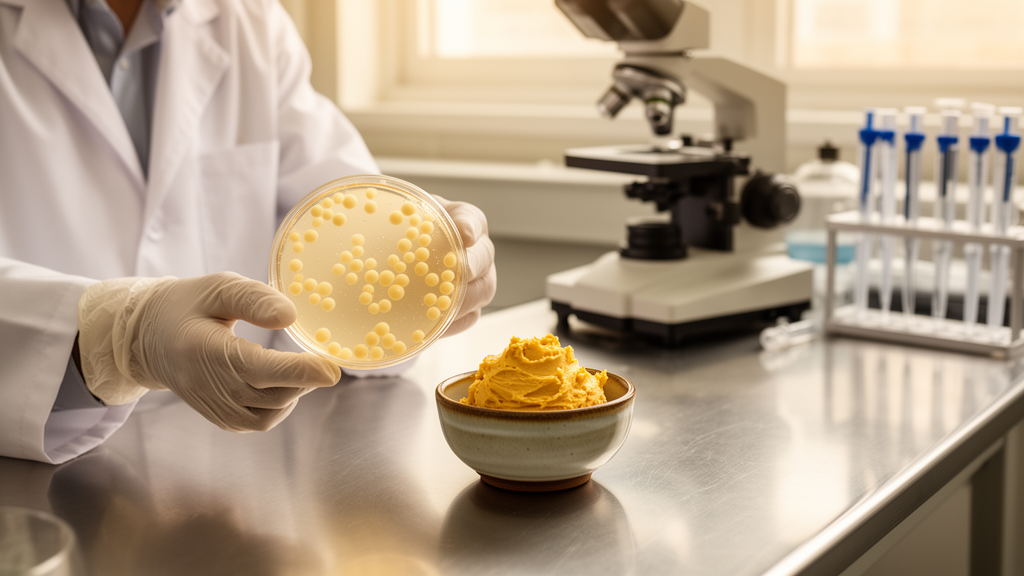
Deep in the microbial world of traditional fermented foods, scientists have uncovered a tiny organism with big potential. Researchers studying yeasts isolated from traditional buffalo butter have identified a strain of Pichia kudriavzevii that could one day change how we think about food preservation and probiotics.
The yeast, which survived a battery of laboratory tests designed to mimic the harsh conditions of the human stomach, demonstrated remarkable resilience. It tolerated acidic environments and bile salts—two obstacles that would kill most microorganisms—suggesting it could survive passage through the digestive tract and potentially deliver health benefits along the way.
But what makes this finding truly exciting is the yeast’s antifungal arsenal. When researchers tested compounds produced by the Pichia kudriavzevii strain against Alternaria species—fungi notorious for spoiling fruits, vegetables, and grains—the yeast’s metabolites created clear zones of inhibition, effectively blocking the spoilage organisms in their tracks.
Safety testing revealed equally promising results. The strain showed no hemolytic activity on blood agar, meaning it does not produce enzymes that damage red blood cells—a critical indicator that the organism is unlikely to be harmful to humans. This biosafety profile, combined with its probiotic potential and antifungal capabilities, positions the yeast as a candidate for natural food preservation.
The implications for the food industry are significant. Synthetic preservatives, while effective, have faced increasing scrutiny from consumers demanding cleaner labels and natural ingredients. A probiotic yeast that can both survive digestive conditions and fight off spoilage fungi offers a dual-purpose solution: it could extend shelf life while potentially delivering probiotic benefits to those who consume the preserved food.
Traditional fermented foods have long been reservoirs of beneficial microorganisms, and this study reinforces their value as sources of novel strains. The buffalo butter environment—rich in fats and shaped by generations of traditional production methods—provided the perfect conditions for this yeast to develop its unique characteristics.
As researchers continue to explore the full capabilities of this Pichia kudriavzevii strain, the food industry watches with interest. If further studies confirm its safety and efficacy in real food systems, this tiny organism could bridge the gap between ancient fermentation wisdom and modern food science, offering a natural alternative to synthetic preservatives.
The strain at the center of this research, designated Y30, was recovered from traditional buffalo butter produced in Hashemabad village in Rezvanshahr, in Iran’s northern Guilan province. It belongs to a broader collection of indigenous yeasts that the research team has assembled from traditional Iranian dairy products, a category of foods that remains underexplored as a source of non-conventional yeasts with technological value. Molecular identification was carried out by sequencing a ribosomal RNA region spanning the partial 18S rRNA gene, the internal transcribed spacer regions ITS1 and ITS2, the 5.8S rRNA gene, and part of the 26S rRNA gene, an approach that provides reliable discrimination at the species level for yeasts where morphological traits alone can be misleading.
The laboratory evaluation of the strain’s probiotic-related characteristics followed a sequence of tests designed to mirror the physiological barriers a microorganism must overcome to survive in the human digestive tract. Gastric tolerance was assessed by exposing cells to YPD broth acidified to pH 2.5 with hydrochloric acid and incubated at 37 degrees Celsius, a temperature chosen to approximate human body temperature. Bile salt tolerance was tested in medium containing 0.3 percent oxgall, a concentration commonly used in probiotic screening because it approximates the bile exposure microorganisms encounter in the small intestine. The researchers went a step further by simulating the full gastrointestinal journey: cells were first suspended in a synthetic gastric fluid containing pepsin and sodium chloride at pH 2.5 for three hours, then transferred into a synthetic intestinal fluid containing pancreatin, potassium phosphate, and bile salts at pH 8.0 for an additional four hours. Survival was quantified at each stage by plating serial dilutions and counting colony-forming units, with survival percentages calculated from logarithmic cell counts before and after each treatment.
Beyond mere survival, the study examined traits that influence whether a yeast can actually interact with the intestinal environment. Cell surface hydrophobicity was measured using the microbial adhesion to hydrocarbons method, in which a yeast suspension is vigorously mixed with xylene and the drop in turbidity of the aqueous phase reflects how strongly cells partition toward the hydrophobic solvent. Auto-aggregation was assessed by holding a standardized cell suspension undisturbed for twenty-four hours and measuring how much of the population settled out of the upper layer, a property linked to the ability of microorganisms to form stable communities on mucosal surfaces. Co-aggregation assays mixed the yeast with suspensions of bacterial pathogens to determine whether the yeast cells physically associate with harmful bacteria, a phenomenon that has been proposed as one mechanism by which beneficial microbes can interfere with pathogen colonization. Biofilm formation was quantified in polystyrene microtiter plates using the classical crystal violet staining approach, in which attached biomass is fixed with methanol, dyed, and solubilized with acetic acid before absorbance is read at 570 nanometers. Adhesion was also tested directly against Caco-2 cells, a human intestinal epithelial cell line widely used as a model of the gut lining, with adherent yeasts recovered after treatment with a mild detergent and enumerated by plating.
Functional evaluation extended to antioxidant activity, measured with the DPPH radical scavenging assay, a colorimetric method in which a stable purple free radical loses absorbance at 517 nanometers when it is neutralized by antioxidant compounds. This assay provides a rapid first indication of whether a microorganism or its metabolites can counteract oxidative reactions, a property of interest both for nutritional applications and for food stability.
The significance of the antifungal findings should be understood against the broader problem of Alternaria contamination. Species of this genus are among the most common fungal spoilers of tomatoes, cereals, fruits, and oilseeds, and several of them produce mycotoxins such as alternariol and tenuazonic acid, compounds that have raised concern because of their documented gastrointestinal and systemic effects in animal studies and their potential to contaminate food chains. Chemical fungicides and preservatives remain the dominant control strategy, but consumer pressure for cleaner ingredient lists has intensified the search for biological alternatives. Lactic acid bacteria have historically dominated this research area, which makes the demonstration of antifungal activity in a yeast strain noteworthy, since yeasts can be incorporated into fermented products without introducing the acidity profiles that bacterial cultures produce.
At the same time, the study is careful to situate its findings within the biosafety context that surrounds this particular species. Pichia kudriavzevii is the teleomorphic state of Candida krusei, an organism classified at Biosafety Level 2 that is recognized as an opportunistic pathogen, particularly in hospital settings where it can cause bloodstream infections in immunocompromised patients. Candida krusei is also notable for its intrinsic resistance to fluconazole, one of the most widely used antifungal drugs, which elevates the clinical importance of this species. These associations do not automatically disqualify food applications, since probiotic and pathogenic behavior is strongly strain-dependent, but they do mean that any practical use requires strain-specific safety evaluation rather than assumptions drawn from species-level taxonomy alone. The absence of hemolytic activity observed in this study is one such strain-level data point, but it represents only a first screening step rather than a complete safety dossier.
The methodological framework used here reflects a growing consensus in probiotic research that candidate strains should be characterized across multiple dimensions simultaneously: survival through digestive stress, capacity to interact with intestinal surfaces, functional activities such as antioxidant or antimicrobial effects, technological performance in food matrices, and safety indicators. No single test is decisive on its own, and the value of this study lies in the breadth of characterization applied to a single indigenous isolate rather than in any one measurement taken in isolation.
Several questions remain open before such a strain could move toward application. Laboratory assays performed in broth cultures and cell lines do not capture the complexity of real food systems, where factors such as water activity, fat content, competing microbiota, and storage temperature all influence whether an antifungal effect translates into actual shelf-life extension. In vivo studies would be needed to confirm that survival through simulated digestion predicts survival in the actual gastrointestinal tract, and that adhesion to Caco-2 monolayers corresponds to meaningful interaction with the human gut. The production of bioactive metabolites responsible for the observed inhibition of Alternaria would also benefit from chemical identification, since knowing the specific compounds involved would clarify both the mechanism of action and any potential sensory impact on treated foods.
What the study ultimately contributes is a documented case of a single indigenous yeast strain that combines digestive resilience, surface-associated traits relevant to gut interaction, antioxidant activity, and demonstrable inhibition of a major food-spoiling fungal genus, all while showing an initial safety profile that does not immediately rule out food use. Traditional buffalo butter from Guilan province, shaped by local production practices and a dairy environment rich in fat, proved to be a productive hunting ground for such organisms. As interest grows in fermented foods as reservoirs of functional microbes, systematic screening efforts of this kind, applied to other traditional products and other regions, are likely to uncover further strains whose combination of probiotic and bioprotective properties could inform the development of foods that preserve themselves while contributing to the health of the people who eat them.
Subject of Research: Probiotic potential and antifungal activity of the indigenous yeast Pichia kudriavzevii Y30 isolated from traditional buffalo milk against Alternaria spp
Article Title: Probiotic potential and antifungal activity of the indigenous yeast Pichia kudriavzevii Y30 isolated from traditional buffalo milk against Alternaria spp
Article References: Mousavi, M., Farahmand, M., Nami, Y., & Larypoor, M. (2026). Probiotic potential and antifungal activity of the indigenous yeast Pichia kudriavzevii Y30 isolated from traditional buffalo milk against Alternaria spp. Current Research in Biotechnology, Article 100422. https://doi.org/10.1016/j.crbiot.2026.100422
Image Credits: AI Generated
DOI: 10.1016/j.crbiot.2026.100422
Keywords: Probiotic, potential, antifungal, activity, indigenous, yeast, Pichia, kudriavzevii, isolated, traditional, buffalo, milk
Cite Scienmag News
Drew Townsend. (October 17, 2026). Buffalo butter yeast shows probiotic power and antifungal potential. Scienmag. https://scienmag.com/buffalo-butter-yeast-shows-probiotic-power-and-antifungal-potential/
Drew Townsend. "Buffalo butter yeast shows probiotic power and antifungal potential." Scienmag, 17 October 2026, https://scienmag.com/buffalo-butter-yeast-shows-probiotic-power-and-antifungal-potential/. Accessed 17 October 2026.
Drew Townsend. "Buffalo butter yeast shows probiotic power and antifungal potential." Scienmag. October 17, 2026. https://scienmag.com/buffalo-butter-yeast-shows-probiotic-power-and-antifungal-potential/


