


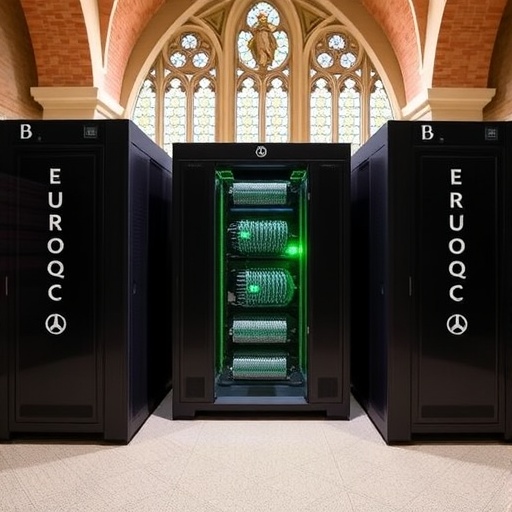
The Barcelona Supercomputing Center – Centro Nacional de Supercomputación (BSC-CNS) has unveiled its latest quantum computing marvel: EuroQCS-Spain, a groundbreaking third quantum computer integrated into the MareNostrum 5 supercomputer. This new system, co-funded by the European Commission and the Government of Spain through the State Secretariat for Digitalization and Artificial Intelligence (SEDIA), represents a pioneering advance in hybrid quantum computing technology. Utilizing analog encoding of information, EuroQCS-Spain introduces a complementary quantum computing paradigm to the existing digital quantum systems at BSC, making it accessible to a broad range of researchers, industries, and public sector entities across Europe. This launch marks a significant step towards the seamless fusion of classical, digital quantum, and analog quantum processing within a single supercomputing ecosystem.
The MareNostrum 5 supercomputer is now one of the first globally to integrate a triad of computing modalities: traditional classical computing partitions, digital quantum computers developed under the Quantum Spain project and SEDIA, and the newly introduced analog quantum machine. This convergence of technologies is housed within the architecturally iconic Torre Girona chapel, which after extensive renovation now balances its neoclassical heritage with ultra-modern quantum computing hardware. This harmonious blend of historical and cutting-edge technology embodies the transformational leap MareNostrum 5 represents for scientific computation in Europe, setting a powerful precedent for future hybrid computational infrastructures.
Integration into the European High Performance Computing Joint Undertaking (EuroHPC JU) places this quantum system at the forefront of continental efforts to build a robust quantum computing infrastructure. The EuroHPC JU operates a network of six procured quantum computers distributed across Europe, with operational units in Poland, Czechia, Germany, and France already launched. EuroQCS-Spain enriches this network and aligns perfectly with the European Quantum Strategy, which has ambitious goals to position Europe as a global leader in quantum technologies by 2030. Central to this strategy is enhancing technological sovereignty, driving industrial competitiveness, and ensuring the security of critical infrastructures through homegrown quantum innovation.
The project’s financial architecture is notable, with an overall investment of approximately €9.8 million shared between the EuroHPC JU and Spanish governmental bodies. The Ministry of Digital Transformation and Public Administration, via SEDIA, has contributed €4.8 million towards this endeavor. The lion’s share of funding, about €8.5 million, was allocated to the physical installation and development of the quantum computers, balanced with integration efforts to synergize the quantum and classical components. Additionally, a cooperative funding umbrella includes a contribution from Portugal, underscoring the pan-European collaboration underpinning this initiative.
After months of meticulous renovations, the once-sacred Torre Girona chapel now stands as a beacon of technological innovation. The space accommodates the three quantum machines that constitute MareNostrum Ona, covering roughly one-third of the chapel’s area. The remainder of the chapel has been adapted to enhance the artificial intelligence capabilities embedded within MareNostrum 5’s classical computing framework. This architectural and functional symbiosis not only promotes scientific progress but also offers an evocative juxtaposition of history and futuristic technology to visitors and researchers alike.
The formal presentation of the new quantum computer at the Torre Girona chapel was a distinguished event, attended by prominent figures from academia, government, and industry. Mateo Valero, Director of BSC, Francesc Torres, Rector Magnificus of UPC, María González Veracruz, Secretary of State for Digitization and AI, alongside other notable dignitaries from Spain and the European Commission, underscored the significance of this scientific milestone. Their presence highlighted the collaborative, interdisciplinary, and multinational nature of the quantum computing leadership evolving within Europe.
Since its inauguration in February 2025, MareNostrum Ona’s quantum partition has established itself as an operational powerhouse, amassing over 4,200 computing hours distributed across 53 diverse research projects. These projects have been facilitated through official calls within the Spanish Supercomputing Network (RES), launched over the past year, reflecting both the growing demand for quantum resources and the infrastructure’s maturity. This robust utilization exemplifies the quantum platform’s readiness to support cutting-edge research applications spanning multiple disciplines.
A fundamental differentiator of the new system is its exclusive use of 100% European technology. The entire design and development lifecycle—from the conception of the quantum chip to the creation of essential programming software—was carried out domestically by the Catalan company Qilimanjaro Quantum Tech in collaboration with Do It Now. Only the physical manufacturing of the chip, executed in Gothenburg, Sweden, was outsourced, ensuring that the core intellectual property remains rooted in European expertise. This achievement not only strengthens regional technological ecosystems but also advances Europe’s quest for technological sovereignty and lessens dependence on international supply lines.
MareNostrum Ona’s quantum computing architecture is unique in combining two digital quantum machines with a newly incorporated analog quantum computer, all leveraging superconducting qubit technologies. The digital quantum units employ Transmon qubits, which manipulate quantum information using discrete, time-specific pulsed operations. In contrast, the newly installed analog quantum system, based on Fluxonium qubits, operates with continuous modulation, representing a fundamentally different approach to information processing. This analog technique is gaining attention for its potential efficiency in tackling specific classes of problems that are dynamically evolving or less suited to stepwise digital computation.
Understanding the distinction between digital and analog quantum computing is critical to appreciating the potential of this new system. While digital quantum computers function akin to ascending a staircase, where information is manipulated in distinct increments or pulses, analog quantum machines resemble traversing a ramp—processing information continuously and fluidly. This difference may seem subtle but has significant implications for the types of computational problems each method can address. Digital quantum systems excel at discrete mathematical problem-solving and cryptographic algorithms, whereas analog quantum devices show promise in optimization, quantum machine learning, and complex AI model training by simulating evolving physical systems more naturally.
By embracing this hybrid quantum computing paradigm, BSC equips itself with a versatile technological toolkit capable of addressing a broader spectrum of scientific and industrial challenges. This dual approach leverages the respective strengths of both digital and analog quantum processing, facilitating innovative solutions that would be difficult or impossible to achieve with a singular approach. As a result, MareNostrum 5’s MareNostrum Ona subsystem serves not just as a research platform but as a testbed for quantum hybridization strategies that could drive transformative progress across quantum computing applications throughout Europe.
This milestone also demonstrates the catalytic role supercomputing centers can play in accelerating quantum technology adoption and maturation. BSC’s successful integration of quantum computers alongside classical HPC resources marks an important blueprint for future infrastructures aiming to harness quantum advantage in a practical and scalable manner. As quantum computing technologies continue to evolve, such hybrid systems will become indispensable for advancing scientific discovery, technological innovation, and competitive industry applications, ensuring Europe’s leadership in the quantum era.
In conclusion, Barcelona Supercomputing Center’s inauguration of the EuroQCS-Spain quantum computer signifies a landmark achievement in the European quest for quantum technological sovereignty. This analog quantum machine enriches the established digital quantum framework of MareNostrum Ona, driving forward cutting-edge research and industry applications while reinforcing Europe’s position at the global quantum technology frontier. Situated within the historic Torre Girona chapel, this fusion of heritage and high technology captures the spirit of innovation, collaboration, and ambition that will define the next decade of quantum computing progress.
News Publication Date: Not explicitly provided in the content; the inauguration event took place in early 2025.
Web References:
- BSC Presents the First Quantum Computer in Spain Developed with 100% European Technology
- European High Performance Computing Joint Undertaking (EuroHPC JU)
- Procured Quantum Computers on EuroHPC JU site
- European Quantum Strategy
Cite Scienmag News
Katie Riggs. (June 2, 2026). BSC Unveils EuroQCS-Spain, Its Third Quantum Computer, in the Newly Renovated Torre Girona Chapel. Scienmag. https://scienmag.com/bsc-unveils-euroqcs-spain-its-third-quantum-computer-in-the-newly-renovated-torre-girona-chapel/
Katie Riggs. "BSC Unveils EuroQCS-Spain, Its Third Quantum Computer, in the Newly Renovated Torre Girona Chapel." Scienmag, 2 June 2026, https://scienmag.com/bsc-unveils-euroqcs-spain-its-third-quantum-computer-in-the-newly-renovated-torre-girona-chapel/. Accessed 4 September 2026.
Katie Riggs. "BSC Unveils EuroQCS-Spain, Its Third Quantum Computer, in the Newly Renovated Torre Girona Chapel." Scienmag. June 2, 2026. https://scienmag.com/bsc-unveils-euroqcs-spain-its-third-quantum-computer-in-the-newly-renovated-torre-girona-chapel/


