


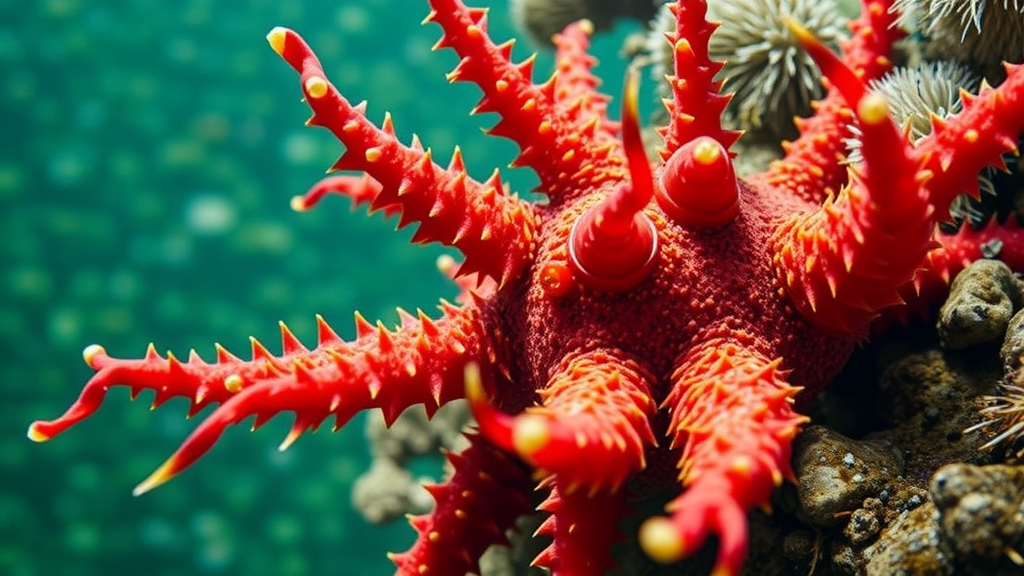
A few days of feast at exactly the wrong—or exactly the right—moment in early life may be all it takes to tip the balance toward one of the most destructive events on the Great Barrier Reef. New laboratory experiments show that larvae of the coral-eating crown-of-thorns seastar (Acanthaster cf. solaris) need only four to five days of abundant phytoplankton food at the very start of their development to dramatically accelerate growth, reach advanced larval stages, and settle successfully onto the reef. The findings, published in the journal Coral Reefs, offer some of the most direct experimental evidence yet that short-lived phytoplankton blooms—triggered by river floods or the upwelling of nutrient-rich deep water—could act as ignition switches for primary outbreaks of the seastar, which has been responsible for up to 42 percent of the observed coral cover decline on the Great Barrier Reef.
Crown-of-thorns outbreaks are not a new phenomenon. Four major outbreaks have swept the Great Barrier Reef since the 1960s, and rising densities detected near Lizard Island suggest a fifth is now underway. What drives these population explosions has long divided researchers, with three broad hypotheses on the table: bottom-up boosts in larval food supply, top-down release from predation on juveniles and adults, and natural population fluctuations. None of these mechanisms is mutually exclusive, but the new study, led by Frances Patel of the Australian Institute of Marine Science together with colleagues at the University of Otago, homes in on the first of them with unusual precision—asking not just whether food matters, but when and for how long.
The researchers conducted five experiments in total, using separate larval cohorts spawned from broodstock collected from mid-shelf reefs near Townsville between 2022 and 2025. All rearing was performed at the National Sea Simulator in Townsville in an automated flow-through feeding system that held food concentrations at tightly controlled levels, a marked improvement over daily manual feeding setups used in most previous crown-of-thorns larval studies. Larvae were fed mixtures of the algae Dunaliella sp. and Tisochrysis lutea at either satiating high food levels—0.6 to 1.7 micrograms of chlorophyll a per litre, corresponding to 2,205 to 3,405 algal cells per millilitre—or limiting low food levels of 0.12 to 0.44 micrograms chlorophyll a per litre. Crucially, these concentrations mirror real conditions: the high food levels match those measured on mid-shelf reefs after nutrient pulses from upwelling or river runoff, while the low levels resemble typical surface waters on the Great Barrier Reef outside flood events.
The first set of experiments tested a long-standing but unverified idea: that crown-of-thorns larvae might harbor photosynthetic microbial symbionts capable of supplementing their nutrition through light-driven metabolite transfer. Such associations have been documented in coral larvae and in larvae of the tropical sea star Mithrodia clavigera, and a microbial study had suggested that crown-of-thorns larvae contain bacteria potentially capable of photosynthesis. If true, light could act as a nutritional lifeline for larvae drifting through the food-poor waters that characterize much of the reef. The result was emphatically negative. Larvae raised under a 12-hour light and 12-hour dark cycle performed no better—or worse—than larvae raised in complete darkness, at both food levels. Food concentration alone drove development: 57 to 62 percent of high-food larvae had reached the brachiolaria stage by day seven, compared with just 5 to 9 percent under low food, and by day fifteen roughly 80 percent of high-food larvae had progressed to mid or late brachiolaria versus about 1 percent of low-food larvae. Settlement success under high food reached 46 to 50 percent, with no influence of light, while no larvae settled at all under low food conditions.
The second set of experiments manipulated the timing of food availability. Larvae were switched between high and low food regimes five days after the onset of feeding, at seven days post-fertilisation. Larvae given high food early and then switched to low food still developed far better than larvae given low food early and then switched to high food. By day eleven, 88 percent of larvae kept on constant high food had reached mid to late brachiolaria stages, compared with 67 percent of the high-to-low group, 26 percent of the low-to-high group, and only 1 percent of larvae on constant low food. This asymmetry reveals a striking developmental plasticity with a clear message: food encountered early in larval life matters far more than food delivered later. Larvae that started well partially recovered when conditions improved, but they never caught up with siblings that had a strong start.
The third experiment delivered the study’s most consequential result by quantifying exactly how many days of high food are needed. Larvae exposed to one to three days of high food showed modest benefits, with 17 to 37 percent reaching advanced stages. But at four days of high food—a threshold response—more than 70 percent of larvae reached mid to late brachiolaria, essentially matching larvae raised on high food for the entire nine-day experiment. Settlement, however, required a slightly longer window: fewer than 1 percent of larvae exposed to only one or two days of high food settled, around 6 percent settled after three to four days, and 34 to 69 percent settled after five to nine days of high food exposure. In other words, a bloom lasting roughly four to five days at the start of the larval phase is sufficient to push most larvae onto a fast developmental track and to lift settlement rates to levels comparable with permanent abundance.
The physiological logic behind this sensitivity lies in the energetics of early development. Crown-of-thorns larvae at about two days old develop a functional gut and begin feeding, but maternal resources in the egg are depleted by the late bipinnaria stage. Marine invertebrate larvae carry lipids as their dominant energy reserve, yet accumulating carbohydrates during the bipinnaria stages may fuel the protein-rich brachiolaria phase and metamorphosis that follow. Previous work on related sea stars has shown that well-fed larvae establish higher carbohydrate concentrations during early development, and that later starvation does not necessarily compromise settlement if early nutrition was adequate. The authors suggest two possible outcomes from the pulse-feeding experiments: larvae that received high food in their first five days accumulated sufficient energy reserves to fuel complete development regardless of later nutrition, while larvae that started on low food accrued inadequate reserves that later abundance could not repay.
These results mesh tightly with what is known about phytoplankton dynamics on the Great Barrier Reef during the seastar’s spawning season. Intense rainfall events push nutrients into coastal waters through river runoff, while intrusions of nutrient-rich upwelled water fertilize deeper layers where larvae have recently been found at depths of up to 30 metres. Phytoplankton can double in abundance one to two times per day, allowing blooms to develop rapidly and persist for days to weeks. One recorded bloom lasting five days reached the reef corridor between Cairns and Lizard Island—the so-called outbreak initiation zone. That duration sits squarely within the four-to-five-day window the new experiments identify as sufficient to dramatically boost larval development, suggesting that even a single episodic bloom coinciding with spawning could amplify the number of larvae surviving to settlement.
The study also carries implications for how reef managers think about water quality. Nutrient enrichment from catchment runoff has long been suspected of feeding crown-of-thorns outbreaks, but the mechanistic link has been difficult to demonstrate because larvae are notoriously hard to sample in the wild. By showing that the critical nutritional window is narrow, early, and quantitatively defined, the research makes the bottom-up hypothesis testable against environmental monitoring data: blooms of sufficient concentration and duration overlapping the spawning season become a concrete, observable trigger to look for. Shorter larval development times may also increase larval retention near source reefs, a process previously proposed to contribute to primary outbreak initiation.
Important caveats remain. Laboratory settlement rates cannot be translated directly into recruitment success, because newly settled juveniles face heavy predation and other mortality in the field, and nutritional carryover effects into the juvenile stage may not be visible at settlement. The light experiments were also conducted under aquarium conditions that may lack the diverse natural microbial communities needed to establish photosynthetic symbionts, so the authors caution that the symbiont question warrants further study with larvae from natural environments. Still, the core conclusion stands: light does not rescue food-limited larvae, but a brief, well-timed pulse of phytoplankton abundance can transform larval fortunes. In the seasonal rhythm of the Great Barrier Reef, where floods and upwelling punctuate an otherwise nutrient-poor sea, those transient windows of plenty may be precisely what turns an ordinary spawning season into the beginning of an outbreak.
Subject of Research: Effects of light and short-term phytoplankton food pulses on larval development and settlement of the coral-eating crown-of-thorns seastar (Acanthaster cf. solaris)
Article Title: Does light and short-term high food availability enhance larval success in the coral eating crown-of-thorns seastar (Acanthaster cf. solaris)?
Article References: Patel, F., McDowell, E., Bastin, L., Gomez Cabrera, M., Lamare, M., & Uthicke, S. (2026). Does light and short-term high food availability enhance larval success in the coral eating crown-of-thorns seastar (Acanthaster cf. solaris)?. Coral Reefs. https://doi.org/10.1007/s00338-026-02962-4
Image Credits: AI Generated
DOI: 10.1007/s00338-026-02962-4
Keywords: crown-of-thorns seastar, Acanthaster cf. solaris, Great Barrier Reef, phytoplankton blooms, larval development, larval settlement, nutrient enrichment, upwelling, river runoff, coral reef decline, population outbreaks, developmental plasticity
Cite Scienmag News
Violet Maxwell. (September 20, 2026). Brief Phytoplankton Blooms Could Ignite Crown-of-Thorns Starfish Outbreaks. Scienmag. https://scienmag.com/brief-phytoplankton-blooms-could-ignite-crown-of-thorns-starfish-outbreaks/
Violet Maxwell. "Brief Phytoplankton Blooms Could Ignite Crown-of-Thorns Starfish Outbreaks." Scienmag, 20 September 2026, https://scienmag.com/brief-phytoplankton-blooms-could-ignite-crown-of-thorns-starfish-outbreaks/. Accessed 5 October 2026.
Violet Maxwell. "Brief Phytoplankton Blooms Could Ignite Crown-of-Thorns Starfish Outbreaks." Scienmag. September 20, 2026. https://scienmag.com/brief-phytoplankton-blooms-could-ignite-crown-of-thorns-starfish-outbreaks/


