


Turbulence is a phenomenon as common as stirring cream into coffee yet as complex as the swirling storms on distant planets. Despite the ubiquity of turbulence, understanding and modeling its behavior remain one of the most challenging problems in fluid dynamics. At the heart of this challenge lies a century-old contradiction between classical theoretical predictions and experimental observations, especially in the context of rotating turbulent systems known as Taylor-Couette (TC) flows. Now, a groundbreaking study from researchers at the Okinawa Institute of Science and Technology (OIST) has resolved this longstanding puzzle, conclusively showing that Kolmogorov’s universal theoretical framework does indeed govern the small-scale behavior of turbulent TC flows. Their findings, published in Science Advances, represent a monumental advance for the field and offer new avenues for exploring turbulence in both natural and engineered systems.
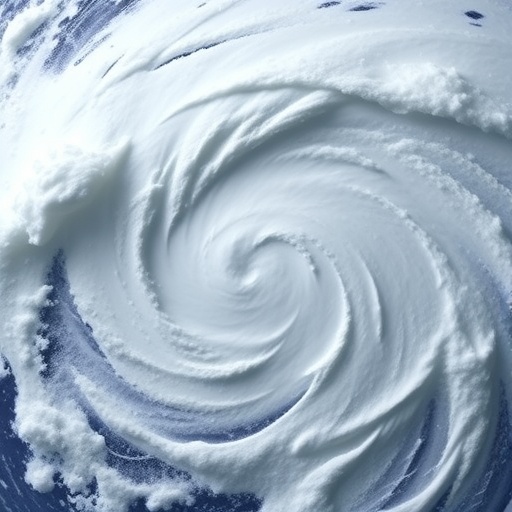
Taylor-Couette flows represent one of the simplest yet most intricate forms of rotating turbulence. These flows form in the narrow gap between two independently spinning, coaxial cylinders. Despite the system’s geometric simplicity, the fluid motion inside exhibits a rich variety of complex, rotating turbulent vortices called Taylor rolls. These rolling currents resemble atmospheric phenomena such as typhoon spirals, combining horizontal rotation with turbulent vertical shafts. Because of their accessibility to experimental manipulation and relevance to many natural rotating fluid systems, Taylor-Couette flows have historically served as a benchmark for illuminating the fundamental characteristics of turbulence.
The cornerstone of understanding turbulence has been Kolmogorov’s theory, first articulated in 1941 by the mathematician Andrey Kolmogorov. His revolutionary insight was the concept of an energy cascade: when a turbulent fluid is stirred at a large scale, energy propagates downward through a hierarchy of progressively smaller vortices until it dissipates into heat at molecular scales. To quantify this cascade, Kolmogorov introduced the celebrated “-5/3 power law,” describing how the turbulent kinetic energy ( E(k) ) varies with wavenumber ( k )—a measure inversely related to eddy size. Within the inertial range of the cascade, this energy spectrum obeys a power law of the form ( E(k) \propto k^{-5/3} ), signaling scale invariance and universality in turbulent flows.
Remarkably, Kolmogorov’s power law has been verified across virtually every turbulent system studied experimentally—from atmospheric boundary layers to pipe flows and ocean currents—cementing its status as a universal descriptor of turbulence. The glaring exception, however, has been Taylor-Couette flows. Experimental data repeatedly failed to align with the -5/3 scaling, throwing a wrench in the otherwise elegant universality of Kolmogorov’s framework. This inconsistency has been a source of perplexity and heated debate for decades, raising discomforting questions about the limits of established turbulence theory.
To confront this paradox, a team led by Professor Pinaki Chakraborty at OIST embarked on a monumental nine-year project to develop a world-class experimental Taylor-Couette setup capable of unprecedented precision and control. The engineering challenges were formidable: the apparatus spins at thousands of revolutions per minute within temperature-controlled, coaxial cylinders, featuring delicate sensors able to withstand extreme shear and turbulence at Reynolds numbers (a dimensionless measure of flow complexity) up to (10^6), among the highest ever achieved in laboratory conditions. This state-of-the-art facility now provides a new gold standard for experimental turbulence research.
Analyzing the energy spectra obtained from this innovative setup with the traditional Kolmogorov inertial-range perspective initially reaffirmed the familiar discrepancy: the data stubbornly resisted fitting the canonical -5/3 power law. But rather than accept this as definitive evidence against Kolmogorov’s universality in TC flows, the researchers expanded their analytical lens. Instead of focusing solely on the inertial range, they considered the full range of small-scale behaviors—including the dissipation scales where energy converts into heat—guided by Kolmogorov’s more general hypotheses.
This broader approach draws upon the refined prediction that when energy spectra are non-dimensionalized using viscosity ( \nu ) and the Kolmogorov dissipation scale ( \eta ), the rescaled spectra should collapse onto a universal function ( F(k \eta) ) across different turbulent flows. In other words, despite varied large-scale behaviors, the small-scale turbulent motions should exhibit a universal pattern once viewed through the correct dimensionless variables. This advanced scaling removes the emphasis from the inertial range alone and incorporates the quantum of dissipation into the framework.
Applying this full rescaling to the Taylor-Couette data yielded a stunning breakthrough: the previously divergent spectra collapsed remarkably well onto the universal curve ( F(k \eta) ), exposing the elusive universality hiding in plain sight. Their evidence compellingly demonstrated that Kolmogorov’s framework holds true for TC flows at small scales as rigorously as for all other turbulent flows, resolving the long-standing contradiction and restoring faith in the theoretical foundation.
This reconciliation revitalizes Taylor-Couette systems as powerful experimental platforms for turbulence research. Because TC setups are closed systems free from external obstructions or pumps, they enable precise control over the fluid medium and additives such as sediments or polymers. This flexibility, combined with the now-verified universal framework, makes TC flows ideal for probing the interplay between turbulence and complex fluid properties, with direct implications ranging from industrial mixing to planetary atmospheres and accretion disks around stars.
Moreover, the OIST setup and the team’s findings provide the fluid dynamics community with a new reference benchmark. Researchers can now confidently apply Kolmogorov scaling laws to interpret TC turbulence data and explore phenomena such as energy transfer rates, vortex dynamics, and dissipation mechanisms under rotation. This deeper understanding can inform improved predictive models for a wide array of engineering and environmental systems characterized by rotational turbulence.
Professor Chakraborty emphasizes the significance: “By bridging this major theoretical gap, we have not only resolved a ‘sore thumb’ inconsistency in turbulence theory but also opened a pathway to systematically investigate complex, rotating turbulent flows. This has profound consequences—from enhancing weather forecasting models to guiding the design of energy-efficient turbines and understanding astrophysical disk formations.”
In summary, the team’s rigorous experimental approach combined with an expanded theoretical framework has successfully demonstrated the universality of Kolmogorov’s turbulence law in Taylor-Couette flows. This milestone underscores the continuing relevance of foundational fluid dynamics theories while showcasing how modern experimental ingenuity can push the boundaries of knowledge. As the scientific community digests these results, the OIST-TC apparatus stands ready to accelerate turbulence research, enabling discoveries that span coffee cups to galaxies.
News Publication Date: 5-Nov-2025
Cite Scienmag News
Reid Dalton. (November 5, 2025). Breakthrough in Rotating Turbulence: World-Class ‘Hurricane-in-a-Lab’ Sheds Light on Long-Standing Paradox. Scienmag. https://scienmag.com/breakthrough-in-rotating-turbulence-world-class-hurricane-in-a-lab-sheds-light-on-long-standing-paradox/
Reid Dalton. "Breakthrough in Rotating Turbulence: World-Class ‘Hurricane-in-a-Lab’ Sheds Light on Long-Standing Paradox." Scienmag, 5 November 2025, https://scienmag.com/breakthrough-in-rotating-turbulence-world-class-hurricane-in-a-lab-sheds-light-on-long-standing-paradox/. Accessed 3 September 2026.
Reid Dalton. "Breakthrough in Rotating Turbulence: World-Class ‘Hurricane-in-a-Lab’ Sheds Light on Long-Standing Paradox." Scienmag. November 5, 2025. https://scienmag.com/breakthrough-in-rotating-turbulence-world-class-hurricane-in-a-lab-sheds-light-on-long-standing-paradox/


