


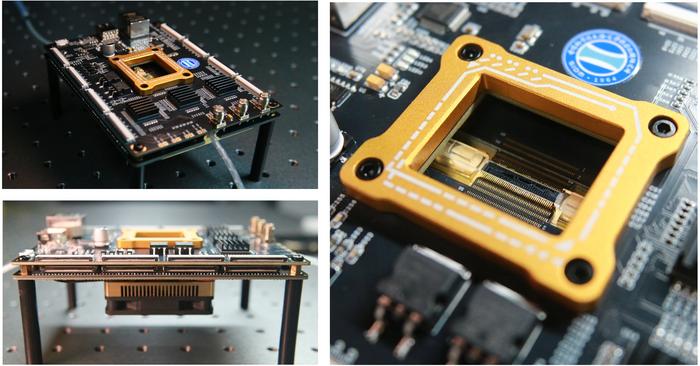
In a remarkable stride toward revolutionizing computational paradigms, researchers have unveiled a new architectural breakthrough in optical computing that promises an unprecedented leap in processing power and energy efficiency. This avant-garde development, led by prominent scientists from the Shanghai Institute of Optics and Fine Mechanics, Chinese Academy of Sciences, and Nanyang Technological University in Singapore, introduces an ultra-high parallel optical computing integrated chip named “Liuxing-I.” This integrated photonic system is designed to harness the power of light to perform complex matrix computations and tensor operations at speeds and scales that dwarf the capabilities of traditional electronic processors.
Optical computing has long been heralded as a promising successor to the traditional von Neumann architectures, chiefly because of its intrinsic advantages of scalability, vast bandwidth, ultra-low power consumption, and inherent parallelism. These qualities make optical computing particularly suited to overcome the challenges posed by the post-Moore era, where advances in electronic transistor miniaturization face fundamental physical and economic bottlenecks. However, previous efforts in optical computing have often hit formidable obstacles in scaling matrix sizes and ramping optical clock frequencies while maintaining precision and minimizing crosstalk, thus limiting real-world application potential.
The “Liuxing-I” system addresses these longstanding hurdles by adopting a holistic and integrative approach, marrying innovations in photonic device fabrication, system design, and error correction methodologies. At its core, this high precision parallel optical computing chip achieves what can be described as a superhighway of data channels — a 256-channel matrix driver array coupled with a microcavity-based optical frequency comb source, all tightly integrated with synchronization and thermal regulation mechanisms. These design choices culminate in the theoretical capability of surpassing 2560 trillion operations per second (TOPS) at an energy efficiency greater than 3.2 TOPS per watt under a modulation frequency of 50 GHz.
One of the pivotal challenges in massively parallel optical computing is mitigating inter-channel interference and spectral dispersion that plague multi-wavelength systems. To counter these, the research team developed a comprehensive physical model for parallel optical operations coupled with innovative universal error correction strategies. These techniques consistently elevate wavelength-channel consistency above 90%, thus ensuring signal integrity and computational accuracy despite the daunting density of optical links. This level of precision is facilitated by a microcomb source that emits hundreds of coherent wavelengths, each acting as an individual computing channel with minimal cross-talk.
The system’s bandwidth and operational robustness owe much to the application of inverse design methodologies in photonic device engineering. By algorithmically optimizing structural parameters at the micro and nanoscale, the researchers achieved broadband response exceeding 40 nanometers, a substantial margin for integrated optics that enhances system tolerance against fabrication imperfections and environmental fluctuations. This robustness also contributes to maintaining high fidelity computation over sustained operational periods, a critical requirement for practical deployment.
Prof. Peng Xie, the principal investigator, eloquently describes the breakthrough: “Our parallel optical computing system capable of 100-wavelength multiplexing transforms the computational landscape. It is akin to converting a narrow, congested highway into a vast superhighway with over a hundred lanes operating simultaneously, dramatically escalating throughput without altering hardware.” This metaphor underscores the transformative paradigm shift initiated by “Liuxing-I,” where scaling is achieved primarily through wavelength-division multiplexing rather than physical scaling of chip size.
The research team’s methodological rigor extends beyond device fabrication. Their “point-to-line-to-surface” research strategy systematically bridges isolated component-level advances toward integrated system realization. This approach facilitated swift progress from theoretical models and individual device validations to a fully operational computing prototype. Such seamless integration exemplifies the maturity of photonic computing technology and its readiness to transition from laboratory curiosities to industry-grade solutions.
Fundamentally, the system’s multi-wavelength architecture enables massively parallel data processing channels, each corresponding to a different wavelength on a tightly packed frequency comb grid. This configuration drastically enhances simultaneous computational throughput, enabling complex calculations, such as high-dimensional tensor multiplications and real-time image processing, to be performed orders of magnitude faster than conventional electronic units. The implications stretch across sectors reliant on vast computations, including artificial intelligence, climate modeling, and bioinformatics.
Moreover, the integration of hybrid photonic-electronic algorithms exemplifies an astute blend of emerging optical technologies with mature electronic systems, capitalizing on the strengths of both domains. By carefully orchestrating signal synchronization and leveraging precise thermal management, “Liuxing-I” mitigates the typically volatile behavior of photonic components under varying operating conditions, thereby ensuring reliability and consistency required for practical applications.
This pioneering research validates the viability of ultra-high parallelism optical computing, transforming theoretical advantages into tangible technological progress. The physical models and error correction paradigms introduced here provide a foundational blueprint for future developments in this domain, guiding enhancements in scalability, accuracy, and system integration. By overcoming fundamental barriers such as channel crosstalk and synchronization delays at scale, “Liuxing-I” brings the photonic computation revolution one step closer to reality.
The consequences of this achievement resonate well beyond academic curiosity. Successfully demonstrating a scalable 100-wavelength multiplexed optical computing system sends a powerful message about the imminent redefinition of computational speeds and energy efficiency benchmarks. As digital infrastructures and AI workloads continue their exponential growth, such technologies will be instrumental in meeting future demands while curbing the escalating energy consumption of data centers worldwide.
Looking ahead, this research lays a fertile ground for further innovations that might include extending wavelength multiplexing capacities, integrating more sophisticated error mitigation techniques, and refining photonic-electronic hybrid algorithms. The possibility to integrate these systems into commercial applications ranging from ultrafast data analytics to next-generation communication networks signals an inflection point for both academia and industry, potentially revolutionizing how computational tasks are executed on a global scale.
In summary, the unveiling of “Liuxing-I” represents a milestone in optical computing — an intricate, highly integrated parallel processor that leverages innovative photonic engineering and comprehensive system design to achieve performance metrics once deemed unattainable. This advancement underscores the maturity of optical computing as a compelling successor to electronic processing, equipped to tackle the complexities of tomorrow’s data-intensive computational challenges with unprecedented speed and efficiency.
Web References:
Cite Scienmag News
Bethany Barker. (June 17, 2025). Breakthrough in Parallel Optical Computing Enables 100-Wavelength Multiplexing. Scienmag. https://scienmag.com/breakthrough-in-parallel-optical-computing-enables-100-wavelength-multiplexing/
Bethany Barker. "Breakthrough in Parallel Optical Computing Enables 100-Wavelength Multiplexing." Scienmag, 17 June 2025, https://scienmag.com/breakthrough-in-parallel-optical-computing-enables-100-wavelength-multiplexing/. Accessed 4 September 2026.
Bethany Barker. "Breakthrough in Parallel Optical Computing Enables 100-Wavelength Multiplexing." Scienmag. June 17, 2025. https://scienmag.com/breakthrough-in-parallel-optical-computing-enables-100-wavelength-multiplexing/


