


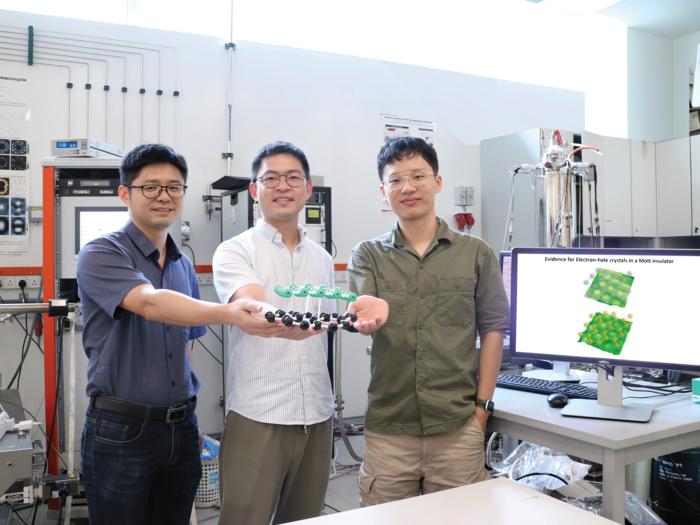
When the number of electrons matches host lattice sites in a material, strong interactions between electrons can cause them to arrange themselves into an orderly pattern, forming what is known as an electron crystal. This phenomenon is fascinating because the electrons start to act collectively, which can be useful for quantum simulations. If both electrons and their positive counterparts, called holes, coexist in one system, they can create even more exotic quantum states with unparalleled properties, such as a special type of counterflow superfluidity, where electron-holes flow in opposite directions without resistance and energy dissipation.

Credit: National University of Singapore
When the number of electrons matches host lattice sites in a material, strong interactions between electrons can cause them to arrange themselves into an orderly pattern, forming what is known as an electron crystal. This phenomenon is fascinating because the electrons start to act collectively, which can be useful for quantum simulations. If both electrons and their positive counterparts, called holes, coexist in one system, they can create even more exotic quantum states with unparalleled properties, such as a special type of counterflow superfluidity, where electron-holes flow in opposite directions without resistance and energy dissipation.
However, it is challenging to keep electron and hole crystals together without them quickly recombining. To solve this, scientists often separate them into different layers or hosts. While this approach has shown electron-hole states in multi-layered structures, finding these states in a single natural material is still a topic of debate. This is because there is not enough solid experimental evidence and it is difficult to find exotic quantum materials that can keep electron-hole crystals together without cancelling each other out.
To address this, a research team from National University of Singapore (NUS) has achieved a breakthrough by creating and directly visualising electron-hole crystals in an exotic quantum material, known as a Mott insulator, made from Alpha-ruthenium(III) chloride (α-RuCl3). This discovery opens new possibilities for exploring quantum excitonic states enabled by coexisting electrons and holes, which could pave the way for new advancements in computing technologies including in-memory computing and quantum computing.
The team was led by Associate Professor Lu Jiong from the NUS Department of Chemistry and Institute for Functional Intelligent Materials (I-FIM), together with Professor Kostya S. Novoselov, Director of NUS I-FIM.
The research was published in the scientific journal Nature Materials on 3 June 2024.
Innovative methodology facilitates the atomic-scale imaging of insulators
The unprecedented findings were made possible using a technique called scanning tunneling microscopy (STM). STM is a powerful tool that uses quantum tunnelling to create real-space images at the atomic level. However, it can only study conductive materials and not insulators. This limitation can be addressed using an innovative setup which combines graphene with the α-RuCl3, Mott insulator. Graphene, as the thinnest conductive film made of a single layer of carbon atoms, allows electrons to pass through and reveal the electronic structure of the Mott insulator beneath it. Additionally, graphene serves as an adjustable electron source, enabling non-invasive and tunable doping of α-RuCl3.
Real-space imaging via STM reveals two distinct ordered patterns at two energy levels, named the lower Hubbard band and the upper Hubbard band energies of α-RuCl3, each with completely different periodicities and symmetries. By tuning the carrier densities in the system through electrostatic gating, researchers can directly visualise the transition of these orderings. The direct visualisation of the gate-tunable transition strongly indicates that the nature of these orderings is due to crystals made of electrons and holes, which spontaneously reorganise when the number of electrons and holes per unit cell is changed by gating.
“Usually, when a Mott insulator is doped, the strong interactions between electrons cause the excess carriers to arrange themselves into an orderly pattern. So, it is not surprising to see new charge orderings in a doped Mott insulator. However, it was quite unexpected to observe two distinct orderings emerging simultaneously. Our work attributes this surprising discovery to the formation of electron-hole crystals in the presence of coexisting electrons and holes,” said Assoc Prof Lu.
Direct visualisation of electron-hole crystals
Directly seeing the electron-hole crystals at the atomic level reveals their shape and structure with incredible clarity, providing insights that were only inferred speculatively in the past mesoscopic studies. These observations highlight that the electron-hole crystal can be unevenly distributed because there are more of one type than the other.
“Moving forward, we want to explore how we can control these crystals using electrical signals in new ways. Finding electron-hole crystals in doped Mott insulators could lead to new ways to make materials that can switch between different states quickly, which has potential in facilitating the development of powerful computers. It also opens up the possibility of creating new materials that could have applications such as simulating quantum physics” added Assoc Prof Lu.
Journal
Nature Materials
Method of Research
Experimental study
Subject of Research
Not applicable
Article Title
Evidence for electron–hole crystals in a Mott insulator
Article Publication Date
3-Jun-2024
Cite Scienmag News
Reid Dalton. (July 30, 2024). Breaking new ground for computing technologies with electron-hole crystals. Scienmag. https://scienmag.com/breaking-new-ground-for-computing-technologies-with-electron-hole-crystals/
Reid Dalton. "Breaking new ground for computing technologies with electron-hole crystals." Scienmag, 30 July 2024, https://scienmag.com/breaking-new-ground-for-computing-technologies-with-electron-hole-crystals/. Accessed 4 September 2026.
Reid Dalton. "Breaking new ground for computing technologies with electron-hole crystals." Scienmag. July 30, 2024. https://scienmag.com/breaking-new-ground-for-computing-technologies-with-electron-hole-crystals/

