


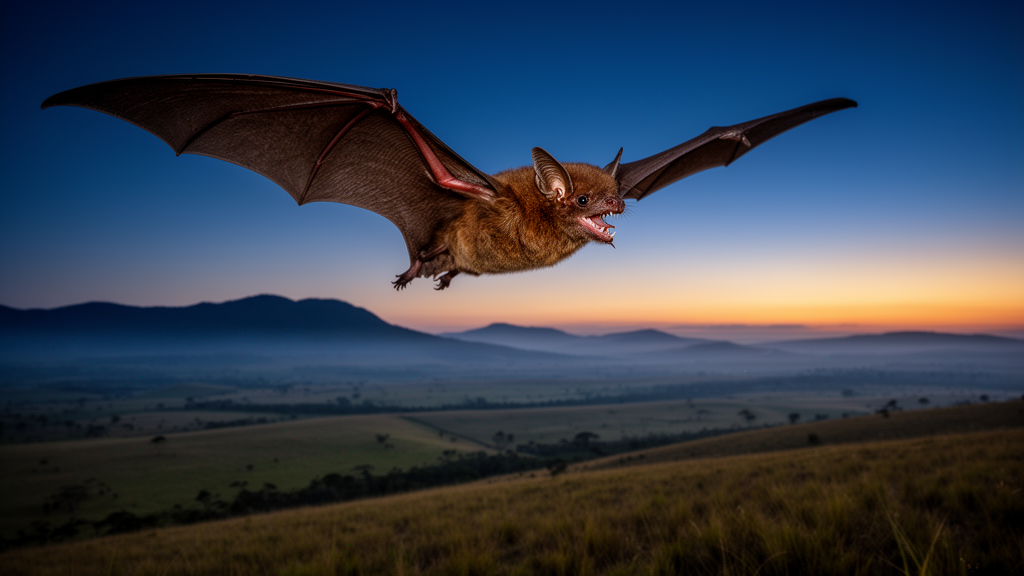
The Brazilian free-tailed bat, Tadarida brasiliensis, is one of the most recognizable aerial insectivores in the Americas, famous for forming colonies that can swell from a few hundred individuals to several million. Yet for the South American subspecies, Tadarida brasiliensis brasiliensis, the question of where the animal actually lives has remained surprisingly unresolved. A new study published in Neotropical Biology and Conservation has now produced the most rigorous predictive map of the subspecies’ potential distribution across the continent, combining 121 confirmed occurrence records with an ensemble of four species distribution modeling algorithms. The results redraw the map in fundamental ways, revealing a vast continuous corridor of suitable habitat in central and eastern South America, an unexpected avoidance of the Amazon, and a striking positive association with human population density.
The research team, led by scientists working on South American bat biogeography, confronted a problem that has long plagued the study of wide-ranging species: sampling gaps. Traditional range maps for T. b. brasiliensis in eastern South America were built by interpolating between the outermost points where the bat had been recorded, a method that is heavily biased toward regions near active research groups or areas surveyed for environmental licensing. In countries like Brazil, where enormous swaths of territory have never been systematically sampled for bats, this approach can produce distribution polygons that are insensitive to real ecological limits or that extend the species’ range into areas where it cannot survive. Compounding the problem, occurrence records are frequently contaminated by misidentification, particularly confusion with Geoffroy’s free-tailed bat, Nyctinomops laticaudatus, a closely related molossid with overlapping morphology.
To overcome these obstacles, the researchers assembled occurrence data from multiple independent sources: bibliographic records of colonies, geographic coordinates of genetic sequences deposited in GenBank, specimens held in South American scientific collections, and craniomandibular analysis of skull samples combined with molecular identification of tissue samples using the D-loop gene. This produced 136 initial locations, which were then verified in QGIS and filtered with the CoordinateCleaner R package to reduce sampling effort problems. A spatial thinning procedure using the spThin package excluded coordinates closer than 10 kilometers to one another, controlling for spatial autocorrelation and sampling bias. The final dataset contained 121 confirmed records of the subspecies, each representing a verified presence of T. b. brasiliensis rather than a potentially misidentified lookalike.
The modeling framework itself was technically sophisticated. The team began with 24 environmental variables at 5 arc-minute spatial resolution, roughly 10 square kilometers per pixel. Nineteen of these were bioclimatic layers from WorldClim v. 2.1, covering temperature and precipitation patterns across the continent. Five additional variables were derived from NASA’s NEO system: land cover, human population density, vegetation index, land surface temperature at night, and topography. Using the Variance Inflation Factor with a threshold below 0.7, the researchers selected the 10 least correlated variables for the final model, including isothermality, precipitation of the driest month, precipitation seasonality, human population density, vegetation index, land surface temperature at night, and topography. Pseudo-absence points, randomly generated across South America except in pixels containing confirmed presences, were paired with the presence data to train the algorithms.
Four algorithms were combined in an ensemble forecasting approach: BIOCLIM, which relies solely on presence records; Support Vector Machines, which constructs a new hyperspace where complex patterns between presences, pseudo-absences, and environmental information can be represented more simply; Generalized Linear Models, fitted using presence and pseudo-absence data; and MaxEnt, which applies the principle of maximum entropy to correlate presence records with background environmental data. Each algorithm was run 20 times with different randomizations, splitting the occurrence data into 70 percent training and 30 percent test subsets, producing 80 distinct predictions. Model performance was evaluated using the Area Under the Curve, which measures the probability of correct classification and ranges from 0 to 1, and the True Skill Statistic, which ranges from -1 to +1 and quantifies how much better a model performs than random assignment. Only predictions exceeding the average AUC and TSS of all fitted models were retained for the ensemble, which was then weighted by TSS values to produce the final suitability map.
The ensemble model achieved excellent performance, with an AUC of 0.90 ± 0.06 and a TSS of 0.79 ± 0.09, indicating strong discrimination between presence and pseudo-absence data. The most influential variable by far was isothermality, contributing 35 percent to the model, followed by human population density at 13.1 percent, topography at 7.4 percent, precipitation of the driest month at 5.7 percent, and vegetation index at 5.1 percent. Response curves revealed that the subspecies shows a positive affinity with regions of higher human population density, rugged topography, lower vegetation index, and greater precipitation in the driest month. Conversely, the model identified a negative relationship with precipitation in the warmest quarter, the austral summer, with greater affinity for neutral values of this variable.
Geographically, the model painted a picture of a subspecies occupying a broad continuous belt of suitable habitat across central and eastern South America. High environmental suitability was identified in the south and southeast of Brazil, extending continuously into neighboring countries and reaching Peru in its northern portion. Uruguay emerged as broadly suitable across its entire territory. In Argentina, the subspecies is more likely to occur in the north, northeast, and west, with no suitable regions identified in the south of the country. Chile showed a wide area of suitable habitat on the western side of the Andes, separated from the eastern corridor by the mountain chain itself. Along the eastern face of the Andes, the model identified a corridor toward Central America that narrows and fragments in its northern portion along the borders of Ecuador, Colombia, and Venezuela. Critically, the Amazon region emerged as highly unsuitable, a finding that contradicts some earlier assumptions about the subspecies’ range.
The positive association with human population density corroborates the well-documented habit of T. b. brasiliensis of roosting in human structures such as roofs, ceilings, and crevices, in addition to natural shelters like caves. The affinity for areas of undergrowth or mosaic forest-fields landscapes reflects the morphological and behavioral adaptations of the Molossidae family, which is specialized for foraging in open environments using high-speed flight. The negative relationship with summer precipitation could relate to reduced bat activity on rainy nights, probably due to the reduced efficiency of echolocation in wet conditions and the effects of rain on thermoregulation. Such a reduction during the austral summer could impose an energy deficit precisely during the period of greatest energetic demand, when females are pregnant, lactating, or raising young on their first flights. In related insectivorous species, energetic deficits during pregnancy and lactation have been shown to produce weight loss and reduced survival capacity in offspring, making this seasonal precipitation pattern a potentially critical determinant of reproductive success.
Perhaps the most consequential finding of the study concerns the barriers that fragment the subspecies’ distribution. The model identified major discontinuities in the equatorial region and in the high-altitude areas of the Andes Mountain Chain, with the Chilean population separated from the eastern South American population by Andean deserts, snowy peaks, and high-altitude passes. Although T. brasiliensis is capable of overcoming major geographic barriers through flight, the study’s authors note that environmental discontinuities remain the primary impediment to gene flow. The Atacama Desert, previously identified as unsuitable habitat within the subspecies’ distribution polygon, was reaffirmed as a barrier, probably due to its extreme environmental conditions. These barriers raise important phylogeographic questions about whether the fragmented populations represent genetically distinct groups requiring further investigation, and they reinforce the need for integrated taxonomic and population studies alongside distribution modeling.
The study also delivered a sobering warning about the reliability of occurrence databases. When the researchers reviewed specimens previously identified as T. b. brasiliensis from the Brazilian state of Bahia, examining external dental and morphological characteristics of seven museum specimens, they discovered that all were actually Nyctinomops laticaudatus. These misidentified records had propagated across multiple online platforms, potentially contaminating other distribution studies. The authors emphasize that the real northeastern limit of the subspecies in Brazil likely lies in Minas Gerais, not Bahia, and they recommend caution with internet occurrence databases. They further recommend that future distribution studies first consider genetic groups and use only reliable presence information, such as colony records and specimens with genetic confirmation, since environmental niche differences between genetic groups must be accounted for before modeling. As climate change may expand suitable habitat toward the poles while reducing it in equatorial regions, the southern limits of the subspecies’ range in Patagonia, where only solitary individuals have been recorded, may shift in the coming decades, making continued monitoring of this remarkable aerial insectivore more important than ever.
Subject of Research: Species distribution modeling of the Brazilian free-tailed bat subspecies in South America
Article Title: Where do they live? Predictive geographic distribution of Tadarida brasiliensis brasiliensis ( Chiroptera , Molossidae ) in South America
Article References: Amaral, I. S. D., Bandeira Pereira, J., Vancine, M. H., Morales, A. E., Althoff, S. L., Gregorin, R., Pereira, M. J. R., Valiati, V. H., & Rosa de Oliveira, L. (2023). Where do they live? Predictive geographic distribution of Tadarida brasiliensis brasiliensis (Chiroptera, Molossidae) in South America. Neotropical Biology and Conservation, 18(3), 139-156. https://doi.org/10.3897/neotropical.18.e101390
Image Credits: AI Generated
DOI: 10.3897/neotropical.18.e101390
Keywords: they, live, Predictive, geographic, distribution, Tadarida, brasiliensis, Chiroptera, Molossidae, South, America, scientific research
Cite Scienmag News
Drew Townsend. (October 19, 2026). Brazilian free-tailed bat’s South American range mapped with surprising gaps. Scienmag. https://scienmag.com/brazilian-free-tailed-bats-south-american-range-mapped-with-surprising-gaps/
Drew Townsend. "Brazilian free-tailed bat’s South American range mapped with surprising gaps." Scienmag, 19 October 2026, https://scienmag.com/brazilian-free-tailed-bats-south-american-range-mapped-with-surprising-gaps/. Accessed 19 October 2026.
Drew Townsend. "Brazilian free-tailed bat’s South American range mapped with surprising gaps." Scienmag. October 19, 2026. https://scienmag.com/brazilian-free-tailed-bats-south-american-range-mapped-with-surprising-gaps/


