


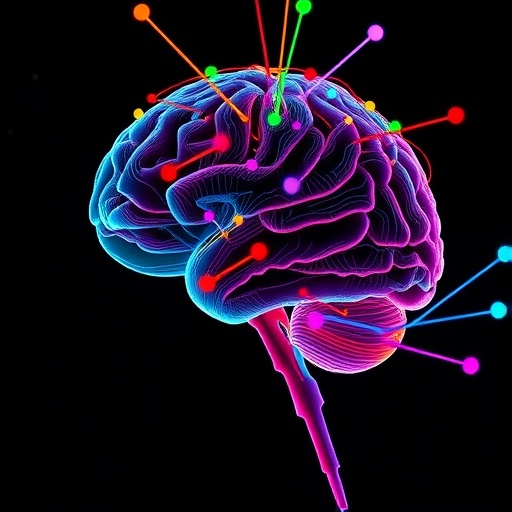
In a groundbreaking study that pushes the boundaries of our understanding of how the brain encodes movement, researchers have unveiled an intricate and structured organization of movement encoding across and within brain areas. This comprehensive brain-wide analysis sheds new light on the fundamental neural coding strategies underlying motor functions, offering unprecedented insights into the dynamic orchestration of neural networks during movement execution.
The study, led by Wang, Kurgyis, Chen, and colleagues, employed innovative techniques to map movement-related activity at an extraordinary scale and resolution. By capturing simultaneous neuronal activity across multiple brain regions, the researchers sought to unravel how different zones contribute distinctly yet cooperatively to the generation and control of movements. Their approach embraced the complexity of brain circuits, moving beyond isolated regional analyses to depict a holistic picture of movement encoding.
Central to the investigation was the exploration of hierarchical and parallel processing streams that encode movement parameters. The team discovered that specific patterns of neural activity are not randomly dispersed but rather structured across the brain’s landscape, reflecting an organized architecture that supports the fluid execution of motor commands. This hierarchical structuring suggests that while some areas specialize in encoding generalized movement features, others hone in on more detailed parameters such as direction, speed, or timing.
Intriguingly, the research illuminated the presence of both shared and unique coding schemes within individual brain areas. Within a single region, subpopulations of neurons were found to encode multiple aspects of a movement concurrently while maintaining distinct identities in the encoding space. This dual nature of encoding within brain areas challenges traditional views of strict modularity and reveals a rich tapestry of functional specialization interwoven with integrated processing.
To achieve these findings, the team harnessed cutting-edge imaging and electrophysiological tools capable of recording from thousands of neurons simultaneously. This massive data collection required sophisticated computational models and dimensionality reduction techniques to tease apart the intricate relationships embedded in the neuronal activity patterns. The computational approaches enabled the distillation of complex datasets into interpretable encoding manifolds reflecting movement variables.
By analyzing the encoding geometry across cortical and subcortical regions, the researchers revealed consistent motifs of neural representation, suggesting conserved principles that govern how movement is encoded throughout the brain. This conserved geometrical structure implies that despite anatomical and functional diversity, brain areas adhere to common coding frameworks, which may be crucial for seamless integration and coordination across the motor hierarchy.
A striking aspect of the study is its identification of neural population dynamics that underpin movement execution. The researchers demonstrated that transient trajectories of neuronal activity through the encoding manifold correspond tightly with movement onset and progression. These dynamic patterns showcase how the brain flexibly transitions between different neural states to orchestrate precise motor acts.
The findings also resonate with theoretical models positing that neural populations encode information in low-dimensional subspaces. By mapping movement variables onto these subspaces, the study provides empirical support for the notion that the brain employs efficient coding strategies that reduce complexity while preserving essential information for behavior. This reduced dimensionality may facilitate rapid computations and error correction during movement.
Crucially, the research holds implications for understanding motor disorders. By elucidating the structured encoding schemes across neural populations, the study offers potential biomarkers for disrupted motor control in conditions such as Parkinson’s disease, stroke, or dystonia. Furthermore, the insights gained could inspire next-generation brain-machine interfaces that leverage the brain’s natural encoding geometry, enabling more precise and intuitive control of prosthetics or assistive devices.
Beyond clinical applications, this work contributes fundamentally to neuroscience by bridging the gap between single-neuron activity and large-scale brain function. It highlights the importance of considering both microcircuit heterogeneity and macro-scale network integration when deciphering the neural basis of behavior. The study’s integrative framework opens new avenues for exploring other complex cognitive functions beyond motor control.
Another notable aspect is the multidimensionality of the encoding space, which reflects the brain’s capacity to represent multiple movement parameters simultaneously without interference. This multiplexed encoding ensures robustness and flexibility, enabling the brain to adaptively modulate movements in response to environmental demands or internal goals.
Methodologically, the research stands out for combining anatomical tracing with functional recordings, offering a spatially resolved and dynamic view of motor encoding. This synergistic approach enhances the precision of mapping neuronal populations to their functional roles, fostering a deeper understanding of the circuit mechanisms driving behavior.
Importantly, the study addresses longstanding debates about the degree of specificity versus redundancy in motor encoding. By revealing the coexistence of both unique and overlapping coding strategies, it reconciles seemingly contradictory observations from previous research, positioning the field toward a more nuanced conceptual framework.
In summary, this landmark brain-wide analysis not only catalogues where movement is encoded but also deciphers how encoding is structured within and across brain regions. It paints a compelling picture of the brain as a finely tuned orchestra where diverse neuronal ensembles harmonize through spatially and temporally organized activity patterns to generate coherent movement. These insights usher in a new era of understanding motor control with broad implications for neuroscience, medicine, and technology.
As future studies build upon this foundation, integrating even richer datasets and advanced modeling, we can anticipate further unraveling of the brain’s sophisticated strategies for representing behavior. The comprehensive mapping of movement encoding architecture demonstrated by Wang and colleagues exemplifies the power of interdisciplinary approaches in illuminating the neural code governing one of our most fundamental abilities—movement.
Cite Scienmag News
Cassandra Pierce. (November 18, 2025). Brain-wide Study Uncovers Structured Movement Encoding. Scienmag. https://scienmag.com/brain-wide-study-uncovers-structured-movement-encoding/
Cassandra Pierce. "Brain-wide Study Uncovers Structured Movement Encoding." Scienmag, 18 November 2025, https://scienmag.com/brain-wide-study-uncovers-structured-movement-encoding/. Accessed 4 September 2026.
Cassandra Pierce. "Brain-wide Study Uncovers Structured Movement Encoding." Scienmag. November 18, 2025. https://scienmag.com/brain-wide-study-uncovers-structured-movement-encoding/


