


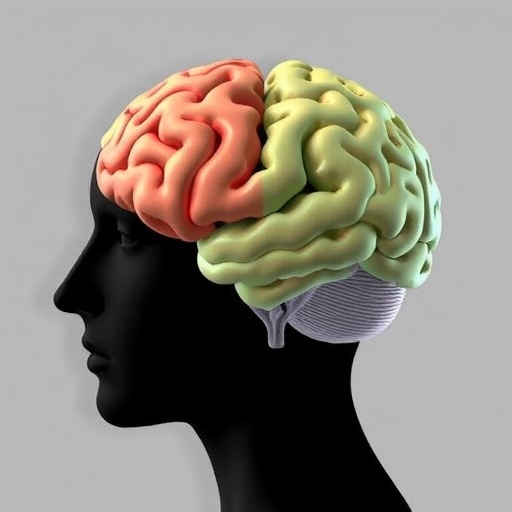
In a groundbreaking study published in 2025, researchers have uncovered distinct neuroanatomical signatures associated with different dimensions of formal thought disorder (FTD) within the complex schizophrenia spectrum. By delving deeply into the cortical structures underlying positive, negative, and linguistic control FTD dimensions, this research delineates a compelling portrait of how divergent brain morphology patterns map onto these symptom domains. What emerges is a nuanced understanding that challenges prior one-size-fits-all models of schizophrenia pathology, giving rise to new hypotheses about distinct mechanistic pathways driving varying symptom presentations.
Fundamentally, this investigation leverages advanced neuroimaging markers to interrogate the relationships between cortical morphology and FTD symptoms, emphasizing the role of local gyrification—a measure reflecting early neurodevelopmental processes—as a particularly sensitive indicator. This insight shifts the spotlight onto early brain folding patterns as a critical neuromorphological substrate underpinning thought disorder manifestations. Importantly, it was observed that local gyrification alterations align with disparate FTD dimensions differently, signposting developmental aberrations that may specifically predispose individuals to certain symptom clusters rather than others.
The study confirms the heterogeneity of formal thought disorder in schizophrenia, a critical consideration often obscured by broad classifications that treat FTD as a monolithic construct. By identifying dimension-specific structural correlates, it becomes evident that not all manifestations of thought disorder share equivalent neuropathological roots. Positive FTD symptoms, which involve disorganized, pressured, or tangential speech, associate most robustly with alterations in the frontal and temporal cortices—regions historically implicated in language processing and semantic control. These findings harmonize with the dyssemantic hypothesis, proposing that semantic memory disruptions underlie such positive thought disturbances.
Conversely, negative FTD symptoms—characterized by impoverished speech, thought blocking, or alogia—show distinct cortical involvement, predominantly in occipito-parietal and occipito-temporal regions. This finding diverges from the classical language-centric framing of thought disorder and hints at alternative neurobiological underpinnings, potentially involving networks responsible for visuo-spatial integration and attentional control. While partially aligning with the dysexecutive hypothesis, which implicates frontal-executive dysfunction in FTD, the negative dimension’s unique neuroanatomical footprint demands re-evaluation of existing theoretical frameworks.
Intriguingly, the linguistic control dimension of FTD, conceptualized as disruptions to the regulatory mechanisms governing language output, demonstrates yet another specific cortical signature. Alterations across cortical surface area (CSA), cortical thickness (CT), and local gyrification converge in both language-related and non-language-related brain regions, including the orbitofrontal cortex (OFC) and occipital lobes. This convergence suggests that linguistic control abnormalities arise from a complex interplay between distributed cortical systems, underscoring the importance of integrating multiple morphological metrics in understanding schizophrenia’s cognitive disturbances.
The methodological rigor of the study is noteworthy, employing comprehensive morphological assessments rather than relying on single structural proxies. This multi-dimensional approach reveals that the choice of neuroanatomical marker—be it gyrification, cortical thickness, or surface area—profoundly influences the patterns of brain-behavior correlations uncovered. For example, local gyrification, linked to cortical folding complexities formed prenatally and in early infancy, proves exceptionally sensitive to deviations in language-related networks among positive and linguistic control FTD dimensions. In contrast, cortical thickness and surface area metrics bring to light complementary nuances in other regions, signaling the necessity for multifaceted imaging strategies in psychiatric research.
These distinctions are not merely academic; they implicate divergent developmental trajectories and potential pathophysiological mechanisms behind the various FTD dimensions. The prominence of early neurodevelopmental aberrations in local gyrification impacting positive and linguistic control symptoms suggests that interventions targeting brain maturation processes might hold therapeutic promise. Meanwhile, the occupancy of non-language-related areas in negative FTD may reflect later-stage neurodegenerative or connectivity deficits that could require different clinical approaches.
Beyond revealing heterogeneity within FTD, the results broaden our understanding of schizophrenia’s complex neurobiology by extending the implicated brain regions beyond classical language centers. The involvement of non-language areas such as the orbitofrontal and occipital cortices challenges traditional models focused narrowly on frontotemporal language circuits. This expansion prompts a reevaluation of cognitive and perceptual dysfunction in schizophrenia, positioning FTD as a multi-domain phenomenon encompassing executive function, semantic memory, and potentially sensory integration deficiencies.
The clear dissociation between positive and negative FTD dimensions in terms of their structural correlates is particularly illuminating. It underscores the need to disentangle these symptom clusters in both research and clinical practice, rather than conflating them under a singular diagnostic umbrella. Such precision is essential for developing targeted interventions tailored to the unique neural substrates that drive these differential manifestations of thought disorder.
Moreover, the alignment of positive and linguistic control dimensions with the dyssemantic and dysexecutive hypotheses provides compelling neuroanatomical validation for these cognitive theories. The dyssemantic hypothesis posits that disruptions in semantic memory processing engender thought disorganization—a notion now supported by cortical alterations in key language nodes. Similarly, the dysexecutive hypothesis, centered around frontal-executive control deficits, finds backing in morphological changes within regulatory regions implicated across linguistic control and positive FTD dimensions. In contrast, the negative dimension’s partial compatibility only with the dysexecutive hypothesis invites further scrutiny and potential refinement of these models to encompass broader neural circuitry.
Collectively, this comprehensive investigation represents a crucial step forward in schizophrenia research, illuminating the complex and heterogeneous nature of formal thought disorder through a finely grained neuroanatomical lens. It also highlights the imperative to incorporate multiple morphological markers and consider developmental timing in elucidating the etiology of psychiatric symptoms. The findings open new avenues for biomarker development, early diagnosis, and individualized therapy designs that respect the multidimensional character of schizophrenia’s cognitive disturbances.
The implications of this research extend beyond academic circles into clinical realms. Enhanced understanding of structural brain correlates specific to FTD dimensions could inform neuroimaging-guided interventions, allowing clinicians to predict symptom profiles, monitor disease progression, and tailor cognitive therapies more precisely. Furthermore, recognizing the distinct neurodevelopmental versus maturational bases of various FTD features may encourage preventative strategies targeting at-risk populations during critical windows of brain development.
As neuroscience continues to unravel the intricate fabric of schizophrenia, studies like this exemplify the paradigm shift toward dissecting mental illnesses into their constituent neurobiological components. Shedding light on the layered cortical architecture underpinning diverse symptom dimensions promises not only to refine diagnostic categories but also to pave the way for novel, mechanism-based treatments that can improve functional outcomes for those afflicted by this complex disorder.
In essence, the delineation of differential cortical structural correlates associated with positive, negative, and linguistic control formal thought disorder dimensions in schizophrenia represents a milestone achievement. It embodies a synthesis of developmental neuroscience, advanced neuroimaging, and clinical psychopathology, forging a path toward a more precise, biologically grounded understanding of schizophrenia’s enigmatic cognitive symptoms.
Cite Scienmag News
Cassandra Pierce. (July 31, 2025). Brain Structure Differences Linked to Schizophrenia Thought Disorders. Scienmag. https://scienmag.com/brain-structure-differences-linked-to-schizophrenia-thought-disorders/
Cassandra Pierce. "Brain Structure Differences Linked to Schizophrenia Thought Disorders." Scienmag, 31 July 2025, https://scienmag.com/brain-structure-differences-linked-to-schizophrenia-thought-disorders/. Accessed 3 September 2026.
Cassandra Pierce. "Brain Structure Differences Linked to Schizophrenia Thought Disorders." Scienmag. July 31, 2025. https://scienmag.com/brain-structure-differences-linked-to-schizophrenia-thought-disorders/


