


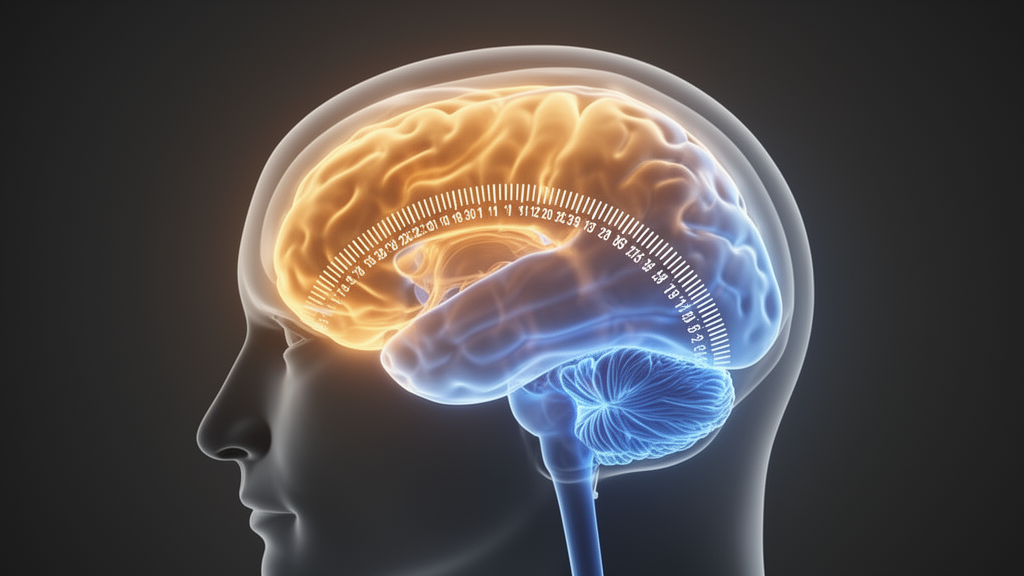
When people compare numbers, their brains appear to arrange numerical values along an organized spatial map, according to a brain-imaging study published on October 22nd in the open-access journal PLOS Biology. A team led by Stanislas Dehaene, Ph.D., and Daniela Valério, Ph.D., at the INSERM-CEA Cognitive Neuroimaging Unit (Unicog) in France used functional MRI to scan adults as they viewed integers and fractions, and found structured patterns of activity in a region long associated with numerical processing. The study addressed one of the central questions in neuroscience: how the brain represents complex, abstract concepts.
One influential theory holds that the brain groups related concepts together, with similar concepts represented by nearby patterns of neural activity. The network of these distances is often called a semantic map. Numbers offer an unusually clean test of this idea, because their values have a universally understood arrangement, from smaller to larger.
In the experiment, 20 native French speakers were shown a series of integers and fractions and asked whether each number was bigger or smaller than the previous one. While they performed this comparison task, the researchers measured their brain activity with functional MRI, tracking how patterns of activation changed as participants judged numbers of different sizes. The scans revealed an organized pattern of activity in the intraparietal sulcus, a region of the brain known to be involved in numerical processing.
As participants compared numbers, the activity patterns changed in a structured way, suggesting that this region contains a spatial map of numerical magnitude extending from smaller to larger values. Analyses of individual participants showed that integers and fractions were processed differently at the level of local activity patterns. However, when participants compared different types of numbers, the neural scans indicated that numerical magnitude was represented within a shared, organized system, bringing fractions and integers together along a common scale.
Participants made more errors when ordering numbers from low to high values when fractions were involved, and they responded more slowly when two fractions were close together in value. These performance effects are consistent with the idea that fractions, despite being processed distinctly, are placed on the same internal magnitude scale as whole numbers. "Our study shows that when we focus on the magnitude of numbers, the brain organizes quantities into a highly structured internal map," the authors said.
"This map brings fractions and integers together along a shared mental number line, allowing us to represent and compare different kinds of numbers within the same system. This organization may help us process quantities and make mathematical decisions more efficiently." The findings, reported in the paper "A cortical semantic Map integrates fractions and integers in the human brain," support the semantic map hypothesis for at least one class of abstract concepts, showing that the brain's representation of numerical magnitude is spatially structured rather than arbitrary.
The work was supported by the European Research Council under the MathBrain grant, and the authors declared no competing interests. Because the study involved a small group of 20 adults performing a single comparison task, the results describe how numerical magnitude was organized in this setting, and further work would be needed to extend the map's role to other mathematical operations.
Subject of Research: A functional MRI study of how the human intraparietal sulcus organizes integers and fractions into a shared spatial map of numerical magnitude
Article Title: Your brain maps out numbers, including integers and fractions
Article References: Your brain maps out numbers, including integers and fractions. Original publication (Bibliographic details unavailable.)
Image Credits: AI Generated
DOI: Not provided
Keywords: numerical cognition, semantic map, intraparietal sulcus, fMRI, fractions, integers, mental number line, PLOS Biology, cognitive neuroscience, number magnitude, Your, brain
Cite Scienmag News
Cassandra Pierce. (October 23, 2026). Brain scans reveal a shared spatial map for integers and fractions. Scienmag. https://scienmag.com/brain-scans-reveal-a-shared-spatial-map-for-integers-and-fractions/
Cassandra Pierce. "Brain scans reveal a shared spatial map for integers and fractions." Scienmag, 23 October 2026, https://scienmag.com/brain-scans-reveal-a-shared-spatial-map-for-integers-and-fractions/. Accessed 23 October 2026.
Cassandra Pierce. "Brain scans reveal a shared spatial map for integers and fractions." Scienmag. October 23, 2026. https://scienmag.com/brain-scans-reveal-a-shared-spatial-map-for-integers-and-fractions/


