


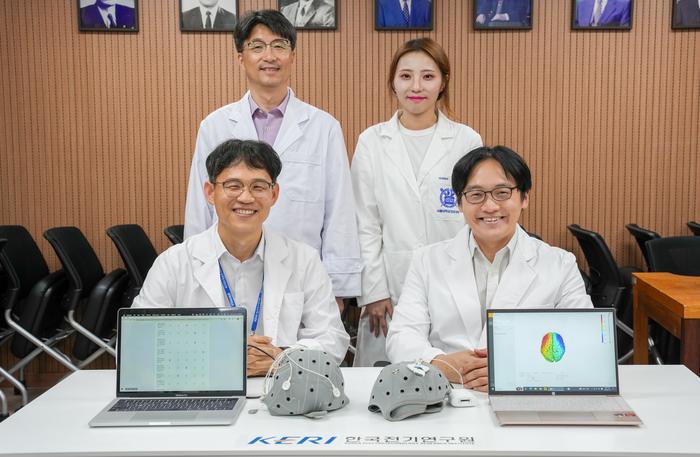
The R&D on neuromodulation technology for the treatment and management of metabolic syndrome conducted by a team led by Dr. Ki-young Shin of Human Care Electro-Medical Device Research Center, Electro-Medical Equipment Research Division of KERI is underway smoothly.
![[Figure1]](https://scienmag.com/wp-content/plugins/wp-fastest-cache-premium/pro/images/blank.gif)
Credit: Korea Electrotechnology Research Institute(KERI)
The R&D on neuromodulation technology for the treatment and management of metabolic syndrome conducted by a team led by Dr. Ki-young Shin of Human Care Electro-Medical Device Research Center, Electro-Medical Equipment Research Division of KERI is underway smoothly.
Metabolic syndrome is a complex of multiple metabolic abnormalities, including obesity, high blood pressure, and high triglycerides, often caused by poor diet and lack of exercise. According to the World Health Organization (WHO), one in eight people worldwide is overweight, making obesity treatment one of the most prominent markets currently.
There are various types of obesity treatments including drug injections and pharmaceuticals, but such chemical treatments often come with potential side effects when taken over for a long period. Accordingly, the team led by Dr. Shin of KERI has proposed a novel approach which is to suppress appetite by stimulating cerebral cortex electrically through scalp.
The official name of the electrical stimulation technique is transcranial random noise stimulation (tRNS). Through years of research, the team identified the possibility that non-invasive electrical stimulation of the dorsolateral prefrontal1) cortex2) with tRNS technology could induce appetite suppression.
1) The frontal lobe is located in the front of the brain and consists of three parts: the medial prefrontal lobe (motivation, initiation and maintenance of behavior), the dorsolateral prefrontal cortex (execution function, planning, flexibility, and abstract thinking), and the orbitofrontal cortex (impulse control and detecting danger).
2) Cortex: A collection of nerve cells covering the surface of the cerebrum.
Three key technologies are required for such studies. ▲ A technology that can accurately deliver the right electrical stimulation to the specific area of interest, ▲ an electrode technology that can penetrate into the space between the hairs and make contact with the scalp, and ▲ a monitoring technology that can confirm that the electrical stimulation has been delivered to the target point and has triggered a change in brain activity. All of these are currently under development by Dr. Shin’s team and the team possesses an advanced level of technologies.
KERI conducted a clinical trial with professor Hyung-jin Choi’s team at Seoul National University Hospital to demonstrate the clinical utility of tRNS stimulation using commercially available electrical stimulators. The goal of the clinical trial was to prove that tRNS stimulation is effective in reducing appetite. The trial included 60 female volunteers, 30 in the tRNS group and 30 in the active sham group. The trial consisted of six sessions of electrical stimulation with two to three days of interval for two weeks. The electrical stimulation utilized a barely perceptible current of 2 mA for 20 minutes per session.
The results showed that the tRNS treatment group was effective in reducing appetite, willingness to eat, and hunger compared to the placebo group. The clinical trial also showed that tRNS can help treat emotional eating, meaning that the tendency to eat to process or relieve emotions such as stress, depression, anxiety, and joy was significantly reduced. As the trial was conducted only for two weeks, long-term weight loss effect was not confirmed but participants reported significant appetite suppression.
Dr. Shin said, “Although the technology is not yet complete and needs further research and verification, if this electrostimulation treatment equipment with far fewer side effects than existing obesity treatments is commercialized and can be used at home instead of in hospitals, it will provide an easy and simple method for daily appetite suppression management.“ He added, “Especially when people are under stress or difficulty, many people eat food due to emotional hunger, and if digital healthcare technology that combines electrostimulation treatment and exercise therapy is introduced, it will enhance weight loss effects and help individuals manage their health more effectively.“
The research team is scheduled to complete the first phase of the project (2022-2024) this year, and aims to validate the developed technology academically and clinically through follow-up research, including the second phase of the project, and promote technology transfer to companies.
<KERI is a government-funded research institute under the National Research Council of Science and Technology of the Ministry of Science and ICT.>
Cite Scienmag News
Daisy Hatcher. (August 12, 2024). Brain electrical stimulation suppresses appetite. A new frontier in obesity treatment? Scienmag. https://scienmag.com/brain-electrical-stimulation-suppresses-appetite-a-new-frontier-in-obesity-treatment/
Daisy Hatcher. "Brain electrical stimulation suppresses appetite. A new frontier in obesity treatment?" Scienmag, 12 August 2024, https://scienmag.com/brain-electrical-stimulation-suppresses-appetite-a-new-frontier-in-obesity-treatment/. Accessed 3 September 2026.
Daisy Hatcher. "Brain electrical stimulation suppresses appetite. A new frontier in obesity treatment?" Scienmag. August 12, 2024. https://scienmag.com/brain-electrical-stimulation-suppresses-appetite-a-new-frontier-in-obesity-treatment/

