


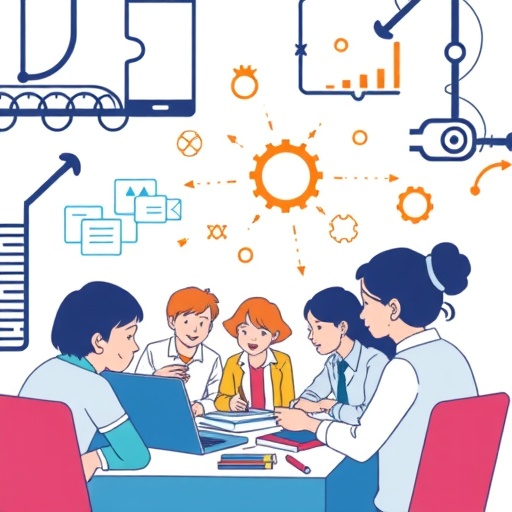
In a groundbreaking study that could redefine the landscape of STEM education, researchers have revealed compelling evidence that teaching engineering principles to future elementary school teachers significantly enhances their engineering-related knowledge and positively shapes their beliefs about the subject. This novel approach promises to transform how engineering concepts are integrated into early education, potentially inspiring a new generation of students to engage with STEM from a young age.
At the heart of this research lies a critical issue: elementary preservice teachers often enter their training programs with limited understanding or confidence regarding engineering content. This gap can inadvertently perpetuate a cycle where engineering is sidelined in early education, even as global demand for STEM professionals soars. By embedding engineering principles directly into teacher education, the researchers aimed to equip these future educators with the tools and mindset necessary to foster curiosity and critical thinking in their classrooms.
The methodology employed was rigorous, combining quantitative assessments with qualitative explorations of belief systems. Participants underwent targeted instruction that integrated practical engineering activities alongside theoretical knowledge. This dual approach helped demystify engineering, presenting it not as an esoteric or overly technical domain but as an accessible, problem-solving mindset applicable in everyday contexts and teaching scenarios.
One of the study’s most striking revelations was the measurable improvement in preservice teachers’ conceptual grasp of engineering ideas. Before the intervention, many participants exhibited uncertainty about core engineering principles and their relevance. Post-instruction evaluations demonstrated significant gains in understanding, indicating that even brief, well-designed educational experiences can substantially bolster knowledge levels. This challenges the assumption that extensive, specialized training is a prerequisite for competent engineering education delivery at the primary level.
Beyond knowledge acquisition, the research delved deeply into how beliefs about engineering and teaching it evolved. Initial skepticism or indifference gave way to increased appreciation and enthusiasm. Many participants reported a newfound awareness of engineering’s interdisciplinary nature and its potential to engage young learners in hands-on, meaningful inquiry. Such shifts in attitude are critical, as teachers’ beliefs profoundly influence their instructional choices and the learning environment they create.
The study also emphasized the importance of contextualizing engineering instruction within broader educational goals. By framing engineering as an integral part of problem solving, creativity, and collaboration, rather than a siloed technical discipline, educators can connect it to the diverse learning styles and interests typical of elementary classrooms. This approach respects the developmental needs of young students while addressing educators’ concerns about content complexity.
Another hallmark of the research was the use of authentic engineering tasks that mirrored real-world challenges. Participants engaged in active problem solving, design thinking, and iterative testing. This experiential learning model not only deepened content understanding but also modeled pedagogical strategies that preservice teachers could emulate. Experiencing engineering firsthand helped solidify confidence in teaching the subject, dispelling myths about its inaccessibility.
Importantly, the findings highlighted a reciprocal relationship between knowledge and beliefs. As preservice teachers became more informed, their beliefs about the feasibility and value of teaching engineering became more positive. This synergy suggests that effective professional development should address both cognitive and affective dimensions to foster lasting change in instructional practice.
The implications for curriculum design in teacher education programs are profound. Programs willing to innovate by incorporating engineering content stand to produce educators better prepared to meet 21st-century educational demands. By nurturing early exposure to engineering pedagogies, these programs can help dismantle traditional barriers that have limited STEM access and equity, especially in under-resourced communities.
Moreover, as the workforce increasingly prioritizes skills like critical thinking, adaptability, and technical literacy, embedding engineering education at the elementary level has strategic significance. Preschool years and primary education form the foundation for lifelong learning attitudes. Equipping teachers with engineering expertise not only enhances student learning but also catalyzes systemic improvements in how STEM fields are perceived and pursued.
This research also opens avenues for further studies exploring how integrated STEM instruction can evolve with emerging technologies and pedagogical innovations. Longitudinal studies tracking teacher practices and student outcomes would be invaluable in validating and extending these promising findings. Additionally, examining intersections with social-emotional learning could offer insights into holistic education frameworks that prepare students for complex problem solving in diverse environments.
The study’s collaborative authorship, involving experts from multiple disciplines, underscores the interdisciplinary nature of advancing STEM education. By blending insights from engineering, education, psychology, and curriculum design, the team crafted a multifaceted intervention grounded in theory and practice. This model of cross-sector collaboration could serve as a blueprint for future initiatives aiming to bridge gaps between research and classroom realities.
In the current global context, where technological advancement and innovation are accelerating at unprecedented rates, fostering early fluency in engineering concepts is critical. This research demonstrates that such fluency begins not with students alone but with the educators who inspire and guide them. Empowering preservice teachers with engineering knowledge and positive beliefs is a strategic investment in the future STEM ecosystem.
The resonance of this study extends beyond elementary education. It challenges educational policymakers, curriculum developers, and teacher training institutions to reconsider their approaches to STEM preparation. By underscoring the transformative potential of targeted engineering education for preservice teachers, the research advocates for systemic reforms that elevate engineering as a fundamental component of early childhood education.
In conclusion, the study reveals that engineering instruction for beginning elementary preservice teachers can dramatically improve their content knowledge and shape constructive beliefs about the discipline. These effects are essential for effective teaching and for cultivating a robust pipeline of STEM-literate individuals. As educational landscapes evolve to meet the challenges of the 21st century, such foundational research offers a beacon guiding the integration of engineering into early education, ultimately inspiring future innovators from the very start of their academic journeys.
Cite Scienmag News
Denise Maddox. (November 27, 2025). Boosting Future Teachers’ Engineering Knowledge and Beliefs. Scienmag. https://scienmag.com/boosting-future-teachers-engineering-knowledge-and-beliefs-2/
Denise Maddox. "Boosting Future Teachers’ Engineering Knowledge and Beliefs." Scienmag, 27 November 2025, https://scienmag.com/boosting-future-teachers-engineering-knowledge-and-beliefs-2/. Accessed 4 September 2026.
Denise Maddox. "Boosting Future Teachers’ Engineering Knowledge and Beliefs." Scienmag. November 27, 2025. https://scienmag.com/boosting-future-teachers-engineering-knowledge-and-beliefs-2/


