


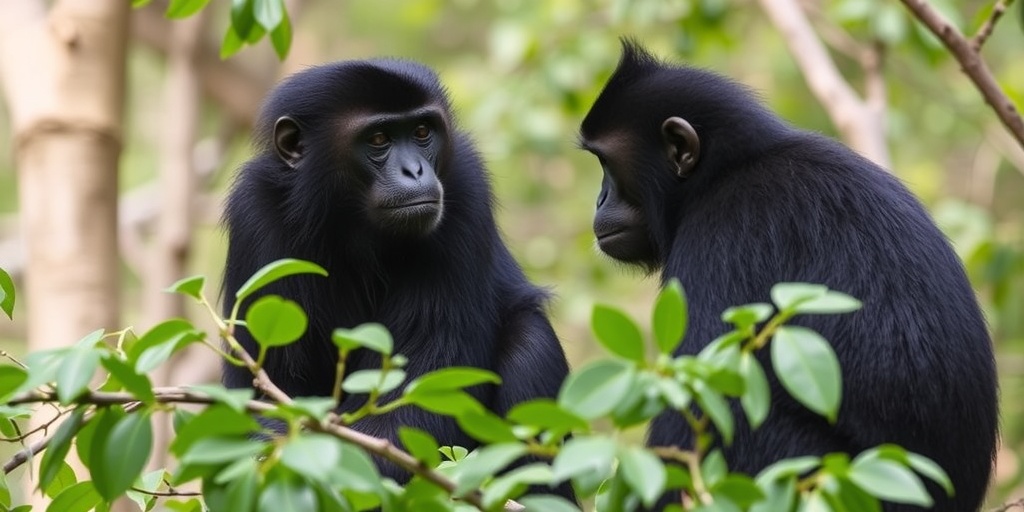
A groundbreaking study has emerged, revealing that wild bonobos, closely related to humans, exhibit a sophisticated form of vocal communication that challenges existing paradigms about the nature of language. This research indicates that bonobos utilize compositional structures similar to those found in human language, suggesting that the capacity for complex communication may not be unique to humans.
Historically, researchers have posited that human language possesses distinct qualities, such as the capacity for compositionality, a hallmark that enables the creation of meaningful utterances through the combination of smaller language units called morphemes. In human language, this principle allows us to craft intricate sentences by arranging words in a structured manner. These structures can be classified into two categories: trivial and nontrivial compositionality. Trivial compositionality maintains that individual words retain their independent meanings, while nontrivial compositionality suggests a more complex relationship where the overall meaning transcends mere aggregation.
Although studies have demonstrated that certain avian and primate species can engage in trivially compositional communication, previous research had not provided visible evidence of nontrivial compositionality in animal language. The current study, conducted by Mélissa Berthet and her collaborators, fills this critical gap in the body of knowledge. The researchers meticulously analyzed 700 vocal recordings of bonobos, observing how these animals articulate their messages within various contexts.
To unravel the intricate web of bonobo communication, Berthet and her team documented over 300 contextual features associated with each call. This approach highlighted the significance of situational context in interpreting vocalizations, revealing patterns that suggest a depth of meaning behind the calls. Using techniques sourced from distributional semantics—a linguistic framework focused on the meaning similarities between words—they meticulously compared these contextual features to infer the meanings of individual vocalizations.
Employing a robust multi-step methodology derived from previous studies of human language, the researchers investigated whether bonobo call combinations adhered to compositional principles. To their astonishment, the analysis uncovered distinct patterns in the way bonobo calls are structured. It became evident that these vocalizations are not mere random assortments of sounds but rather integrate into four identifiable compositional frameworks.
Three of these frameworks exhibited a nontrivial compositionality consistent with the sophisticated nature of human language. This revelation indicates a remarkable similarity in the communication structures of bonobos and humans, suggesting that the evolutionary trajectory of communication may be more intertwined than previously thought. Such findings prompt a reevaluation of the parameters that define language and communication across species.
The process of comprehending bonobo communication is further enhanced by an understanding of their social structures. Living in family groups, bonobos engage in various social interactions that influence their vocal behaviors. These complex social dynamics may play a crucial role in how they form and convey meanings through vocalizations. The nuanced relationships and interactions between bonobos not only provide insight into their communication but also offer a window into the evolutionary aspects of language development.
The implications of this research extend beyond just the field of linguistics. It encourages interdisciplinary discussions that bridge fields such as anthropology, psychology, and evolutionary biology. As scientists delve deeper into the cognitive abilities of non-human primates, the distinctions between animal communication and human language are increasingly blurred. The study prompts questions about the cognitive processes that enable both bonobos and humans to utilize compositional structures in their respective communications.
Although these findings primarily focus on bonobos, they raise intriguing possibilities concerning other species. The study opens up avenues for further exploration into whether similar complexities in vocal communication exist among other primate species. Such inquiries could lead to a broader understanding of the environmental and cognitive factors that influence the evolution of communication systems in various animal taxa.
Moreover, these revelations challenge deeply ingrained beliefs regarding humanity’s linguistic superiority. The notion that complex language is exclusively human becomes increasingly questionable as we uncover layers of sophistication within the communication systems of non-human animals. Understanding the traits shared between humans and bonobos could foster greater appreciation for the cognitive capabilities of all species and their evolutionary significance.
As researchers continue to study bonobos and their vocalizations, the discussions surrounding the nature and definition of language will undoubtedly evolve. With additional empirical evidence, the boundaries that once demarcated human and animal communication may dissolve, leading to a holistic understanding of language’s evolutionary pathways.
This pivotal research contributes to a growing body of work dedicated to understanding the roots of human language and communication. By unearthing the complexities inherent within bonobo vocalizations, Mélissa Berthet and colleagues have not only shed light on the communication behaviors of a fascinating species but have also initiated a transformative dialogue on the essence of language across the animal kingdom.
By exploring these intricate communication structures, scientists may ultimately uncover deeper insights into the cognitive abilities of not just bonobos but various other species. The study serves as a testament to the intricacies of animal communication, suggesting that the quest for understanding language’s origins is more profound and nuanced than previously imagined.
As the field of linguistics progresses, this research stands as a prime example of how interdisciplinary approaches can yield insights that challenge existing narratives. The interplay between language, cognition, and social behavior will remain critical topics for researchers aiming to unravel the complexities of communication in all living beings.
The findings underscore the importance of continued exploration and underline how the study of animal communication can inform our understanding of human language. The road ahead is rich with potential, and as researchers delve further into the vocal worlds of bonobos and beyond, the lines blurring between human and animal communication are poised to inspire further reflection on the nature of language itself.
Cite Scienmag News
Courtney Benton. (April 3, 2025). Bonobo Communication Exhibits Compositional Traits Similar to Human Language. Scienmag. https://scienmag.com/bonobo-communication-exhibits-compositional-traits-similar-to-human-language/
Courtney Benton. "Bonobo Communication Exhibits Compositional Traits Similar to Human Language." Scienmag, 3 April 2025, https://scienmag.com/bonobo-communication-exhibits-compositional-traits-similar-to-human-language/. Accessed 4 September 2026.
Courtney Benton. "Bonobo Communication Exhibits Compositional Traits Similar to Human Language." Scienmag. April 3, 2025. https://scienmag.com/bonobo-communication-exhibits-compositional-traits-similar-to-human-language/


