

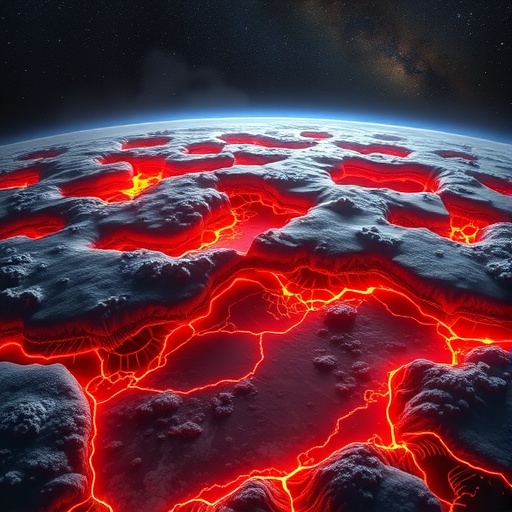
The outer Solar System harbors a fascinating assortment of icy satellites, many of which conceal vast oceans beneath thick, frozen shells. These subsurface oceans have intrigued planetary scientists for decades, as they present compelling environments that may harbor conditions suitable for life. Yet, the dynamic relationship between the icy crust and the hidden ocean remains a subject of intense research and debate. A recent study sheds new light on how changes in the ice shell thickness can dramatically influence the underlying oceans, leading to outcomes that vary widely depending on the size of these enigmatic worlds.
As these icy satellites evolve, their frozen outer layers do not remain static. The thickness of their ice shells can fluctuate due to a variety of processes including heat flow variations, tidal heating, and cryovolcanism. These fluctuations result in the phase transition between liquid water and solid ice within the shell-ocean system. Importantly, this phase change is accompanied by volumetric shifts that impose stresses on the ice shell and alter the pressure conditions in the ocean below. Understanding these changes is crucial, as they govern the tectonic activity observed on the surfaces of these moons and influence the stability of their subsurface oceans.
One of the key revelations from this research is the nature of the stress regimes that emerge when the ice shell thins. Contrary to intuitive expectations, thinning doesn’t simply relieve stress but actually creates compressive forces in the cold, elastic ice near the surface. Simultaneously, the pressure within the underlying ocean diminishes. This combination of compressive stress and pressure reduction sets the stage for two distinct evolutionary pathways for icy satellites, largely controlled by their size.
For the smaller icy worlds, such as Saturn’s moon Mimas, Enceladus, and Uranus’s Miranda, the scenario plays out with a unique twist. As the ice shell thins, the pressure drop in the ocean beneath can reach a critical threshold whereby the liquid water meets its boiling point. This phenomenon can lead to the generation of buoyant water vapor alongside exsolved gases. Crucially, this boiling occurs even when the compressive stresses remain below the critical strength of ice, meaning the ice shell remains intact without fracturing. This mechanism provides a compelling explanation for why these smaller moons can harbor an emerging or growing ocean beneath their surfaces without displaying the expected compressive tectonic features on their exteriors.
In contrast, the larger icy bodies, particularly those with radii exceeding approximately 300 kilometers such as Titania and Iapetus, confront a different fate when their ice shells thin by a comparable margin—around ten percent. For these more massive worlds, the induced compressive stresses surpass the failure threshold of the ice shell, resulting in compressional tectonic activity. This tectonic failure becomes a key driver for the formation of tectonic features observable on their surfaces, including folds and thrust faults. These features stand as geological markers of the dynamic interplay between the ice shell and the subsurface ocean.
This size-dependent divergence in outcomes highlights the critical role played by the mechanical properties of ice and the interplay between pressure and temperature conditions in shaping icy satellite evolution. The research effectively bridges the gap between geophysical modeling and observational geology, providing a theoretical framework that explains why some moons exhibit robust tectonic surface expressions whereas others remain geologically quiet despite showing evidence for subsurface oceans.
A deeper implication of this work touches on the thermal history and geological evolution of these satellites. While present-day observations can still capture tectonic features or lack thereof, these tell only part of the story. The genesis and evolution of oceans beneath icy shells may have been episodic or relatively recent in geological time, with earlier ocean formation signatures potentially being masked or erased by subsequent impact cratering or resurfacing events. This temporal complexity suggests that interpreting the presence and status of subsurface oceans requires careful consideration of both current tectonic activity and the moon’s cratering record.
More broadly, the study invigorates discussions about habitability on icy moons. The finding that even relatively small satellites can develop boiling oceans beneath their ice shells raises intriguing questions about chemical transport processes and energy fluxes. The formation of buoyant water vapor and gases within these subsurface oceans could facilitate the cycling of nutrients and energy, possibly creating microenvironments that might support life or prebiotic chemistry. Such dynamic internal processes could have far-reaching implications for future exploration and astrobiological missions targeting these icy worlds.
Furthermore, the relationship between ocean pressure and tectonic stress elucidated here provides a new lens through which to interpret remote sensing data and geological mapping. Future missions, such as NASA’s Europa Clipper and ESA’s JUICE, could leverage measurements of tectonic features and surface stresses to infer internal ocean dynamics indirectly. This model’s predictive power extends to characterizing other less-studied moons, supplementing observational gaps and refining our understanding of the Solar System’s icy frontier.
Scientists were able to derive these insights through sophisticated modeling that incorporates elastic behavior of the ice shell and thermodynamic principles of water phase changes under varying pressures. By simulating scenarios of ice shell thinning across different moon sizes, they pinpointed the thresholds where phase transitions induce pressure drops sufficient to trigger boiling or mechanical failure. These models underscore the subtle balance between thermal gradients, mechanical stresses, and phase states intrinsic to icy ocean systems.
One remarkable aspect of this research lies in its explanatory power regarding enigmatic observations such as the geological youth and surface cracking seen on moons like Enceladus, which also actively vents plumes of water vapor. The possibility that boiling subsurface oceans generate gases and vapor that percolate upward fits well with spacecraft data revealing tectonic inactivity but ongoing plume activity. It also rationalizes why compressive tectonic features are notably sparse on these smaller moons despite active internal processes.
Conversely, the presence of compressional tectonic features on larger moons like Titania aids in cataloging their geophysical behavior relative to their internal ocean evolution. As the mechanical failure mode dominates, these moons provide natural laboratories for studying how lithospheric deformation and ocean evolution interact. This connection broadens the planetary science narrative, reinforcing the importance of moon size and geophysical context in driving tectonic and oceanic outcomes.
The study also hints at evolutionary pathways that might be cyclic or punctuated rather than continuous. Ice shell thinning could progress incrementally, alternating between phases of brittle failure and pressure-induced boiling, with the resultant geological and oceanic signatures potentially overlapping in complex ways. Understanding such time-dependent processes is key to unraveling the past and present states of icy satellites, encouraging cross-disciplinary research combining geology, geophysics, and planetary thermodynamics.
Ultimately, this research opens new horizons in the quest to understand ocean worlds beyond Earth. It challenges traditional views that focus mainly on ice shell stability or ocean persistence without considering the nuanced feedbacks between mechanical stress and phase transitions. By elucidating how boiling oceans and compressional tectonics emerge and vary according to moon size, it sets the stage for innovative strategies in planetary exploration and aids in prioritizing celestial bodies for future scientific investigations.
As humanity prepares to probe the outer Solar System’s icy moons with ever more sophisticated instruments, findings like these underscore the complexity and diversity of extraterrestrial ocean worlds. They remind us that beneath frozen surfaces lie processes as dynamic and varied as those shaping Earth’s own geology, each telling a story of planetary evolution, potential habitability, and cosmic intrigue. The next generation of explorations will not only test these hypotheses but may uncover yet undiscovered phenomena in the mysterious depths of these alien oceans.
Subject of Research:
The geophysical and thermodynamic consequences of ice shell thinning on subsurface oceans within icy satellites in the outer Solar System.
Article Title:
Boiling oceans and compressional tectonics on emerging ocean worlds.
Article References:
Rudolph, M.L., Manga, M., Rhoden, A.R. et al. Boiling oceans and compressional tectonics on emerging ocean worlds. Nat Astron (2025). https://doi.org/10.1038/s41550-025-02713-5
Image Credits:
AI Generated


