


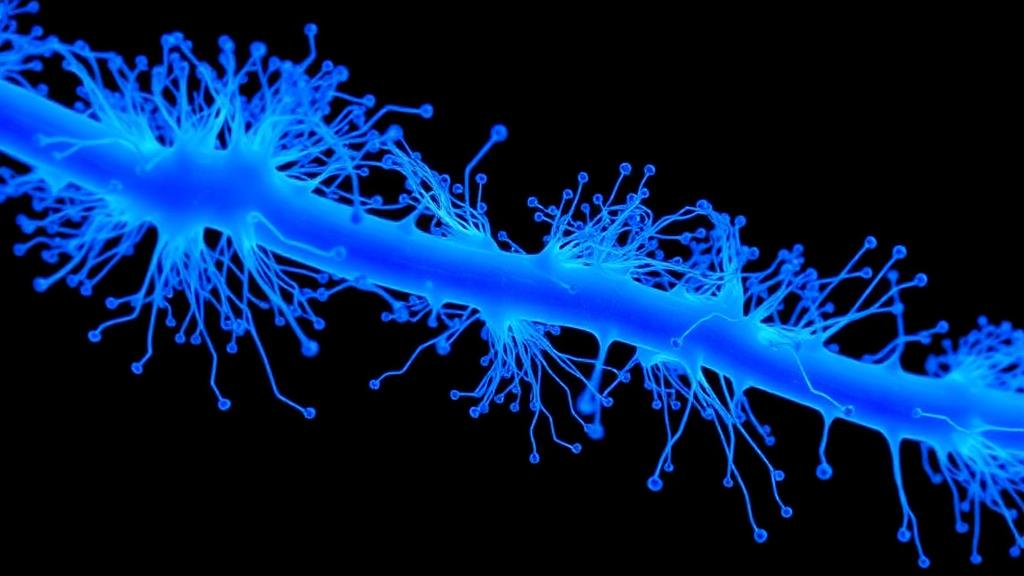
Cyanobacteria are among the most adaptable organisms on Earth, and a new study has revealed just how finely tuned that adaptability can be. Researchers at the HUN-REN Balaton Limnological Research Institute in Tihany, Hungary, have shown that the model cyanobacterium Synechocystis sp. PCC 6803 can flip between a free-floating, planktonic lifestyle and the formation of dense cell aggregates and biofilms depending entirely on the color of light it receives. The findings, published in the journal Microbial Ecology, demonstrate that light is not merely a source of energy for these photosynthetic microbes but an active regulatory signal that governs how they organize themselves into communities and how their photosynthetic machinery copes with life inside those communities.
Biofilm formation is a crucial survival strategy for cyanobacteria living in natural environments where light conditions shift constantly. In lakes and shallow waters, the spectral composition of sunlight changes with depth, time of day, weather, and the presence of dissolved organic matter that absorbs certain wavelengths. Being able to sense these changes and respond by sticking together, encasing themselves in protective slime, and adjusting their photosynthetic apparatus gives cyanobacteria a significant ecological advantage. The Hungarian team, led by Mariann Kis together with Attila W. Kovács and Gábor Bernát, set out to quantify exactly how different wavelengths of light shape this transition in the GT-L strain of Synechocystis, a widely used laboratory model with a fully sequenced genome and well-characterized genetics.
The researchers cultivated planktonic cultures and developing biofilms under a carefully controlled range of light conditions, including higher irradiance levels of 250 to 400 micromoles of photons per square meter per second and distinct spectral bands spanning the visible spectrum. Using differential interference contrast microscopy and distribution analysis, they tracked how individual cells and microcolonies in the planktonic phase gave way to cell aggregates of remarkable size heterogeneity in the developing biofilms. The results were striking: aggregate areas increased under higher irradiance overall, but the response was strongly wavelength dependent. Aggregation reached its maximum under blue-greenish light in the range of 460 to 510 nanometers, while yellow-orange wavelengths between 560 and 590 nanometers produced the smallest aggregates.
Central to this lifestyle switch is the production of extracellular polysaccharides, or EPS, the sticky sugar-based polymers that cyanobacteria secrete to glue themselves together and to surfaces. The study found that EPS production closely followed the aggregation pattern. Biofilm cultures produced significantly higher levels of EPS than their planktonic counterparts, and among all the light treatments, cultivation under blue light at 460 nanometers induced the highest accumulation of these extracellular polymers. This tight coupling between the spectral quality of light and the secretion of adhesive molecules suggests that Synechocystis possesses photoreceptors or light-sensing mechanisms that directly or indirectly regulate the machinery of EPS synthesis, effectively telling the cells when it is time to build a community.
Perhaps the most compelling evidence for active regulation came from experiments in which the researchers switched the cultivation light between red at 630 nanometers and blue at 460 nanometers. When the light color changed, both EPS production and aggregate formation responded reversibly, demonstrating that the process is not a one-way developmental program but a dynamic, continuously adjusted response to the prevailing light regime. Cells that had been floating freely began to aggregate and produce EPS when shifted to blue light, while aggregated communities relaxed their adhesive output when moved back to red. This reversibility underscores the physiological plasticity that makes cyanobacteria such successful colonizers of variable aquatic habitats.
Intriguingly, growth and adhesion pull in opposite directions. Cultures grown under 630 nanometer red light exhibited the highest growth rates and minimal EPS secretion, essentially prioritizing rapid cell division over community building. Cultures grown under 460 nanometer blue light showed the lowest growth rates but maximal EPS secretion, investing their resources in aggregation and biofilm infrastructure instead. This trade-off implies that under blue light, the cells face a photosynthetic or energetic challenge that makes collective living advantageous, even at the cost of slower proliferation. In nature, blue-green light penetrates deepest into clear water columns, so this response may help cyanobacteria anticipate conditions where surface attachment and dense packing offer protection or better light harvesting.
To understand what was happening inside the photosynthetic apparatus of aggregated versus free-living cells, the team employed chlorophyll fluorescence analysis based on OJIP curves, a sensitive technique that tracks the flow of energy through photosystem II, the water-splitting engine of oxygenic photosynthesis. The parameters derived from these curves painted a detailed picture of acclimation. Biofilm-associated cells had a smaller pool of electron acceptors beyond the primary quinone, denoted S_M, a reduced maximum photochemical efficiency of photosystem II, denoted φP_O, an increased apparent antenna size per reaction center, denoted ABS/RC, and enhanced energy dissipation per reaction center, denoted DI_O/RC, relative to planktonic cells.
These changes indicate that cells embedded in aggregates experience a distinct light environment, likely shaped by self-shading, scattering, and the optical properties of the EPS matrix, and that they remodel their photosynthetic machinery accordingly. A larger functional antenna with more dissipation suggests that aggregate-dwelling cells capture less light per reaction center and must shed excess energy as heat, a classic sign of acclimation to shaded conditions. Yet the story took a fascinating turn when the researchers compared the two lifestyles under violet-green wavelengths between 430 and 540 nanometers. Under these spectral conditions, biofilm-associated cells maintained relatively high φP_O along with reduced ABS/RC and DI_O/RC, whereas planktonic cells showed signs of excitation-induced stress. In other words, the aggregated, biofilm mode of life actually protected the photosynthetic apparatus under the very wavelengths that harmed free-floating cells.
This protective effect has important implications for understanding why cyanobacteria form biofilms in the first place. The aggregate structure, with its dense packing and extracellular matrix, appears to buffer the cells against light stress, distributing and attenuating the incoming photons so that individual cells within the community avoid the over-excitation that plagues solitary cells under the same illumination. The biofilm is thus not just a passive pile of cells but an optically and physiologically integrated system in which the community architecture itself contributes to photoprotection. Combined with the wavelength-dependent control of aggregation, this suggests a sophisticated feedback loop: light quality triggers community formation, and community formation in turn reshapes how the cells experience and respond to light.
The study, funded through Hungary’s National Multidisciplinary Laboratory for Climate Change project under the European Union’s Recovery and Resilience Facility, adds a significant piece to the puzzle of how microbial communities assemble and function. Because Synechocystis sp. PCC 6803 is a workhorse of cyanobacterial research, these results provide a framework for dissecting the molecular pathways that connect light sensing to EPS synthesis and photosynthetic acclimation. They also carry practical weight: cyanobacterial biofilms are central to microbial mats, soil crusts, water quality dynamics, and emerging biotechnological applications ranging from biofuel production to bioremediation. Understanding that the color of light alone can steer these organisms between solitary growth and collective living opens new avenues for managing harmful blooms, engineering productive phototrophic communities, and appreciating the remarkable sensitivity of some of Earth’s oldest photosynthesizers to the subtle spectral texture of their world.
Subject of Research: Light-regulated biofilm formation and photosynthetic acclimation in the cyanobacterium Synechocystis sp. PCC 6803
Article Title: Light-Dependent Aggregate Formation and Photosynthetic Acclimation During Biofilm Development in Synechocystis sp. PCC 6803
Article References: Kis, M., Kovács, A. W., & Bernát, G. (2026). Light-Dependent Aggregate Formation and Photosynthetic Acclimation During Biofilm Development in Synechocystis sp. PCC 6803. Microbial Ecology. https://doi.org/10.1007/s00248-026-02889-x
Image Credits: AI Generated
DOI: 10.1007/s00248-026-02889-x
Keywords: cyanobacteria, Synechocystis sp. PCC 6803, biofilm, extracellular polysaccharides, photosystem II, chlorophyll fluorescence, OJIP curves, light quality, cell aggregation, photoprotection, microbial ecology, photosynthetic acclimation
Cite Scienmag News
Morgan Morrow. (September 30, 2026). Blue Light Makes Cyanobacteria Stick Together, Study Finds. Scienmag. https://scienmag.com/blue-light-makes-cyanobacteria-stick-together-study-finds/
Morgan Morrow. "Blue Light Makes Cyanobacteria Stick Together, Study Finds." Scienmag, 30 September 2026, https://scienmag.com/blue-light-makes-cyanobacteria-stick-together-study-finds/. Accessed 4 October 2026.
Morgan Morrow. "Blue Light Makes Cyanobacteria Stick Together, Study Finds." Scienmag. September 30, 2026. https://scienmag.com/blue-light-makes-cyanobacteria-stick-together-study-finds/


