


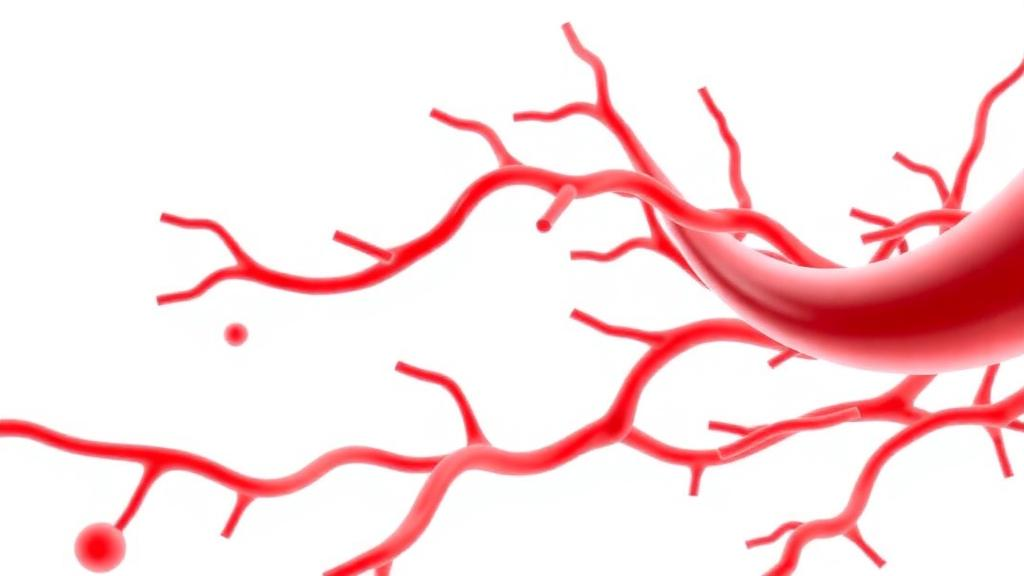
Getting a cancer drug to stay exactly where it is needed, and nowhere else, remains one of medicine’s most stubborn challenges. Pills and injections flood the whole body with medication, producing side effects that can sometimes rival the disease itself. A new theoretical study published in the journal Results in Engineering suggests that the geometry of blood vessels themselves — their curvature, their stretchiness, and the porous tissue surrounding them — may hold clues about how to keep drug particles pinned near a target site long enough to do their work. The research, led by M. John Pisho and colleagues, builds a detailed mathematical model of blood-like fluid flowing through an exponentially curved, stretching channel, and the results point to a counterintuitive conclusion: slowing the flow down may be exactly what a targeted drug delivery system needs.
The team modeled the working fluid as a Casson fluid, a mathematical description famously suited to blood. Unlike water or air, which begin to flow the instant any force is applied, a Casson fluid behaves like a solid until the applied stress crosses a critical threshold known as the yield stress. Only after that barrier is breached does it begin to move, and even then the relationship between stress and deformation is nonlinear. This yield-stress behavior captures a real feature of blood, which resists deformation in small vessels in ways that ordinary Newtonian models cannot reproduce. The Casson parameter in the model expresses the ratio of yield stress to plastic viscosity, and it turns out to be one of the most powerful levers controlling how fast fluid moves near the vessel wall.
The geometry at the heart of the study is deliberately idealized. Rather than simulating a full network of branching arterioles, venules, and capillaries, the researchers represented a segment of micro-vessel as a curved sheet that stretches exponentially along its length. This choice isolates two effects the authors consider critical for near-wall transport: the curvature of the cross-section, which alters pressure and shear stress distributions, and the distending motion of the wall, which mimics the pulsing and deformation that real vessels experience with every heartbeat. The authors are careful to stress that the model is not a physiologically resolved simulation of the microvascular system. It is a boundary-layer formulation designed to reveal qualitative trends, not to compute precise drug-delivery efficiencies.
Into this curved, stretching environment the researchers packed an unusually complete set of physics. The fluid is electrically conducting and subjected to a transverse magnetic field, which generates a Lorentz force that opposes the motion. The channel walls bound a porous medium described by both Darcy resistance, which dominates at low speeds, and Forchheimer inertia, which adds extra momentum loss when the fluid pushes faster through the porous structure. Heat transport includes thermal radiation treated through the Rosseland approximation, viscous dissipation captured by the Brinkman number, and the cross-diffusion effects of Brownian motion and thermophoresis that characterize nanoscale particle transport. The concentration field incorporates Arrhenius activation energy, the concept proposed by Svante Arrhenius in 1889, which sets the minimum energy barrier molecules must overcome before a chemical reaction can proceed. Finally, the model tracks motile microorganisms — living, swimming carriers — whose collective drifting, known as bioconvection, is included as a stand-in for biological drug-delivery vehicles navigating toward hypoxic tumor regions.
Solving the resulting equations is no small feat. The governing partial differential equations for momentum, energy, concentration, and microorganism density are coupled and nonlinear, and the curvature terms make them more complex than their flat-plate counterparts. The authors applied similarity transformations to collapse the partial differential equations into ordinary differential equations, then handed the system to MATLAB’s BVP4C boundary-value solver. The higher-order equations were rewritten as a system of ten first-order equations, and the solver iterated until the boundary conditions were satisfied to a precision of one part in a million. As a check on accuracy, the team compared their computed skin friction coefficients against previously published results for a special case with no magnetic field and effectively infinite Casson parameter, finding agreement to within roughly one part in ten thousand across a range of curvature values.
The velocity results carry the study’s most direct message for drug delivery. Increasing the magnetic parameter strengthens the Lorentz force, which decelerates the fluid and keeps drug particles lingering close to the vessel wall rather than sweeping away downstream. Raising the Darcy permeability parameter — which in this formulation represents greater resistance from the porous medium — likewise diminishes the velocity profile and thins the hydrodynamic boundary layer. The Forchheimer parameter, capturing inertial drag at higher flow speeds, produces the same retarding trend. Even the Casson parameter itself reduces velocity as it increases, meaning that changes in the yield-stress character of blood can alter how long particles remain near a capillary wall. In the drug-delivery framing, all of this resistance is potentially useful: a slower, wall-hugging flow gives pharmaceutical particles more opportunity to adhere to or penetrate the intended target tissue, particularly in tumor regions where distribution occurs through permeable biological material.
The thermal findings are equally consequential. The Brinkman number, which measures heat generated by viscous friction relative to heat conducted away, raises the temperature field as it increases — more fluid friction means more built-in warmth. The thermal Biot number, the ratio of surface heat-transfer resistance to internal fluid resistance, also elevates temperature when it grows, indicating stronger thermal exchange at the wall and, by extension, enhanced interaction between drug particles and the vessel surface. Thermal radiation amplifies the effect further, intensifying the temperature throughout the boundary layer, with the strongest influence closest to the curved stretching surface. Since drug absorption and penetration at a target site depend on local thermal conditions, these parameters describe how the flow itself could shape the environment a drug particle encounters.
On the mass-transport side, the activation energy parameter widens the concentration profile, meaning that a higher energy barrier for chemical reactions leaves more of the dissolved drug intact in the fluid rather than consumed by reaction. Brownian motion and thermophoresis work in the opposite direction, narrowing the concentration profile while boosting the Sherwood number, the dimensionless measure of mass transfer from the surface into the fluid. Thermophoresis, in particular, drives particles from warmer toward cooler regions, a mechanism the authors note could actively steer medication through temperature gradients. Meanwhile, the bioconvective parameters govern the microorganisms: a higher bio-Schmidt number suppresses the spreading of the swimming carriers, confining them near the wall where they are easier to localize, while the bio-convective Peclet number balances convective sweeping against random diffusive dispersal, with higher values reducing microorganism density in the outer field.
The authors are candid about the limits of what they have built. Real microvascular networks branch and taper asymmetrically, generating secondary flows that a two-dimensional curved sheet cannot capture. Physiological blood flow is pulsatile and unsteady, driven by the cardiac cycle, whereas the model assumes steady conditions. Blood itself is treated as a single-phase homogeneous Casson fluid, ignoring the discrete nature of red blood cells and the cell-free layer that forms near vessel walls. The team proposes in vitro validation using biomimetic curved microfluidic channels and blood-analogue fluids as the necessary next step, along with extending the framework to fully three-dimensional, pulsatile formulations. Until then, the model should be read as a mechanistic map rather than a clinical prescription.
Even with those caveats, the study offers a genuinely useful synthesis. By combining, for the first time in a single boundary-layer model, an exponentially curved stretching geometry with Darcy–Forchheimer porous resistance, Arrhenius activation energy, magnetohydrodynamics, and oxytactic bioconvection, the work identifies permeability and the Casson parameter as the most influential levers on near-wall particle residence. That insight could eventually inform the design of stents, catheters, and other curved microvascular devices engineered to influence how long therapeutic particles linger at a treatment site. The message is elegant in its simplicity: in the narrow, curving world of the microvasculature, the physics of resistance — magnetic, porous, and yield-stress alike — may be the very tool that keeps a drug where it belongs.
Subject of Research: Numerical boundary-layer modeling of magnetohydrodynamic Casson fluid flow with Arrhenius activation energy and bioconvection over an exponentially curved stretching sheet for targeted drug delivery
Article Title: Numerical analysis of Casson fluid flow past an exponentially curved stretching sheet with arrhenius activation energy: implications for targeted drug delivery
Article References: Pisho, M. J., Shankar, G., Siva, E., & Loganathan, K. (2026). Numerical analysis of Casson fluid flow past an exponentially curved stretching sheet with arrhenius activation energy: implications for targeted drug delivery. Results in Engineering, 32, Article 113049. https://doi.org/10.1016/j.rineng.2026.113049
Image Credits: AI Generated
DOI: 10.1016/j.rineng.2026.113049
Keywords: Casson fluid, targeted drug delivery, magnetohydrodynamics, Arrhenius activation energy, bioconvection, porous medium, Darcy-Forchheimer, stretching sheet, boundary layer, thermal radiation, microvasculature, BVP4C
Cite Scienmag News
Denise Maddox. (October 2, 2026). Blood-Like Fluid Model Reveals How Curved Vessels Could Trap Drug Particles. Scienmag. https://scienmag.com/blood-like-fluid-model-reveals-how-curved-vessels-could-trap-drug-particles/
Denise Maddox. "Blood-Like Fluid Model Reveals How Curved Vessels Could Trap Drug Particles." Scienmag, 2 October 2026, https://scienmag.com/blood-like-fluid-model-reveals-how-curved-vessels-could-trap-drug-particles/. Accessed 4 October 2026.
Denise Maddox. "Blood-Like Fluid Model Reveals How Curved Vessels Could Trap Drug Particles." Scienmag. October 2, 2026. https://scienmag.com/blood-like-fluid-model-reveals-how-curved-vessels-could-trap-drug-particles/


