


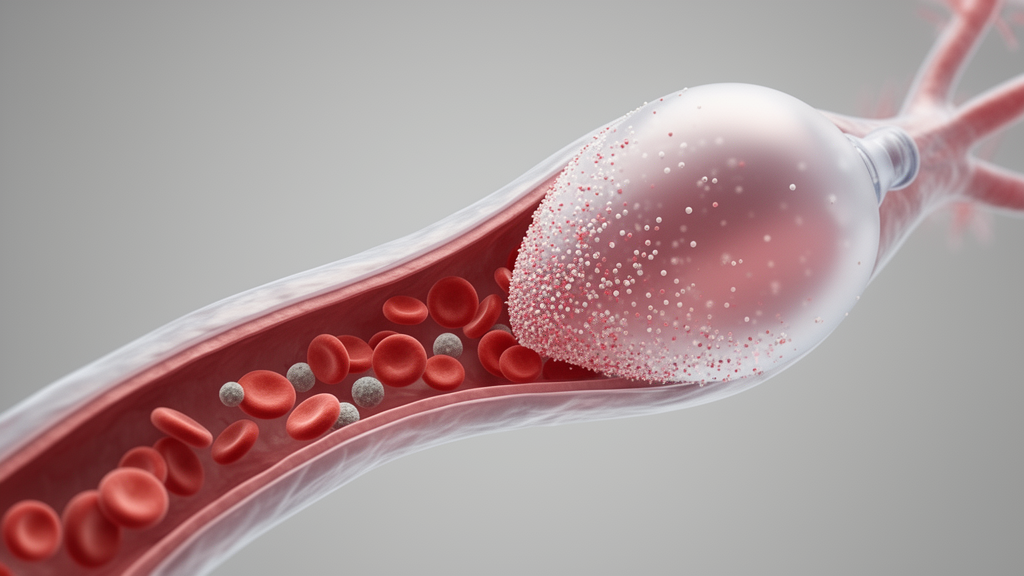
A new retrospective cohort study from China offers a partial answer, reporting that the number of previous balloon procedures, the length of the narrowed segment, the blood flow achieved immediately after treatment, and even a routine blood count measure are associated with how long a drug-coated balloon-treated fistula stays open. The study, conducted at a single center, followed 357 patients treated with drug-coated balloon angioplasty for recurrent stenosis of their autogenous arteriovenous fistulas between February 2023 and May 2026. The researchers tracked the time from the index procedure to a clinically driven reintervention at the treated lesion, the standard measure of primary patency in this field.
Because the design was retrospective and there was no comparison group treated with conventional balloons, the findings describe associations within this selected population rather than proof that any factor causes restenosis. The immediate technical results were striking. Mean brachial artery flow rose from 288.98 ± 139.37 mL/min before the procedure to 980.92 ± 174.66 mL/min afterward, while the minimal luminal diameter of the vessel expanded from 1.52 ± 0.50 mm to 5.21 ± 0.63 mm, both differences statistically significant.
These numbers confirm that the procedure itself did what it was designed to do: restore flow through a critically narrowed segment of the fistula circuit. Durability, however, eroded steadily over the following year. Kaplan–Meier analysis showed primary patency of 95.24% at three months, 84.03% at six months, 68.90% at nine months, and 55.40% at twelve months.
In other words, nearly half of the treated lesions required a clinically driven reintervention within a year, a figure consistent with the recurring nature of the stenosis that brought these patients to the procedure in the first place. To identify which patients fared worst, the team fitted an extended Cox proportional hazards model using data from 338 patients in whom 191 reintervention events occurred. Each additional prior percutaneous transluminal angioplasty raised the hazard of losing patency by a factor of 1.129, and each additional centimeter of lesion length raised it by 1.105.
Conversely, higher postprocedural flow was protective, with each additional 100 mL/min associated with a hazard ratio of 0.889, and higher red blood cell count was likewise associated with lower hazard, at 0.804 per 10¹²/L. The red blood cell finding is where the inflammation question enters. Recurrent fistula stenosis arises in a vascular environment where injury, neointimal hyperplasia and inflammation coexist, and the authors asked whether routine inflammatory or hematological markers might carry prognostic information.
The association between red blood cell count and patency provides an exploratory, inflammation-related clinical context, but the study did not measure patient-level inflammatory pathways directly, and the authors are explicit that no specific inflammatory biomarker has been validated by these data. Beyond the survival analysis, the researchers built a separate logistic model to predict failure within twelve months, using the 356 patients with complete model data. Cross-validated with five folds, the model achieved an area under the receiver operating characteristic curve of 0.706.
That is a modest level of discrimination, useful for flagging risk in a clinical setting but far from a decision-grade tool, and it has not been tested on patients outside this single center. The practical message for dialysis populations is a layered one. Patients arriving with a long history of prior angioplasties and long lesions appear to be on a steeper downhill trajectory after drug-coated balloon treatment, while those leaving the procedure with robust flow and healthier hematological profiles tend to hold their patency longer.
The authors are careful about the boundaries of what their data can support. As a single-center retrospective cohort with no non-drug-coated balloon comparator and no molecular measurements, the study can identify associations but cannot establish inflammatory mechanisms, cannot rule out confounding by unmeasured clinical variables, and cannot claim that red blood cell count is a validated biomarker of restenosis risk. Independent validation in other centers, together with direct patient-level inflammatory measurements, is what the researchers say is required before these associations could guide care.
For now, the 55.40% one-year patency figure and the four associated factors stand as an observational snapshot from one center, awaiting confirmation before they change practice.
Subject of Research: Inflammation-associated prognostic factors and primary patency after drug-coated balloon angioplasty for recurrent arteriovenous fistula stenosis
Article Title: Inflammation-associated clinical prognostic factors and primary patency after drug-coated balloon angioplasty for recurrent autogenous arteriovenous fistula stenosis: a single-center retrospective cohort study
Article References: Su, C., Dang, C., Wu, H., Jiang, Y., Yan, Y., Wang, L., Chen, G., Liu, L., Chen, Y., Liu, Z., Zhao, B., & Chen, Y. (2026). Inflammation-Associated Clinical Prognostic Factors and Primary Patency After Drug-Coated Balloon Angioplasty for Recurrent Autogenous Arteriovenous Fistula Stenosis: A Single-Center Retrospective Cohort Study. Frontiers in Cell and Developmental Biology, 14, 1977789. https://doi.org/10.3389/fcell.2026.1977789
Image Credits: AI Generated
DOI: 10.3389/fcell.2026.1977789
Keywords: arteriovenous fistula, drug-coated balloon, restenosis, primary patency, inflammation, red blood cell count, angioplasty, hemodialysis, retrospective cohort, prognostic factors, Kaplan-Meier, Cox regression
Cite Scienmag News
Jerry Hayes. (October 27, 2026). Blood Cell Count and Flow Predict How Long Dialysis Fistulas Stay Open After Drug-Coated Balloons. Scienmag. https://scienmag.com/blood-cell-count-and-flow-predict-how-long-dialysis-fistulas-stay-open-after-drug-coated-balloons/
Jerry Hayes. "Blood Cell Count and Flow Predict How Long Dialysis Fistulas Stay Open After Drug-Coated Balloons." Scienmag, 27 October 2026, https://scienmag.com/blood-cell-count-and-flow-predict-how-long-dialysis-fistulas-stay-open-after-drug-coated-balloons/. Accessed 27 October 2026.
Jerry Hayes. "Blood Cell Count and Flow Predict How Long Dialysis Fistulas Stay Open After Drug-Coated Balloons." Scienmag. October 27, 2026. https://scienmag.com/blood-cell-count-and-flow-predict-how-long-dialysis-fistulas-stay-open-after-drug-coated-balloons/


