


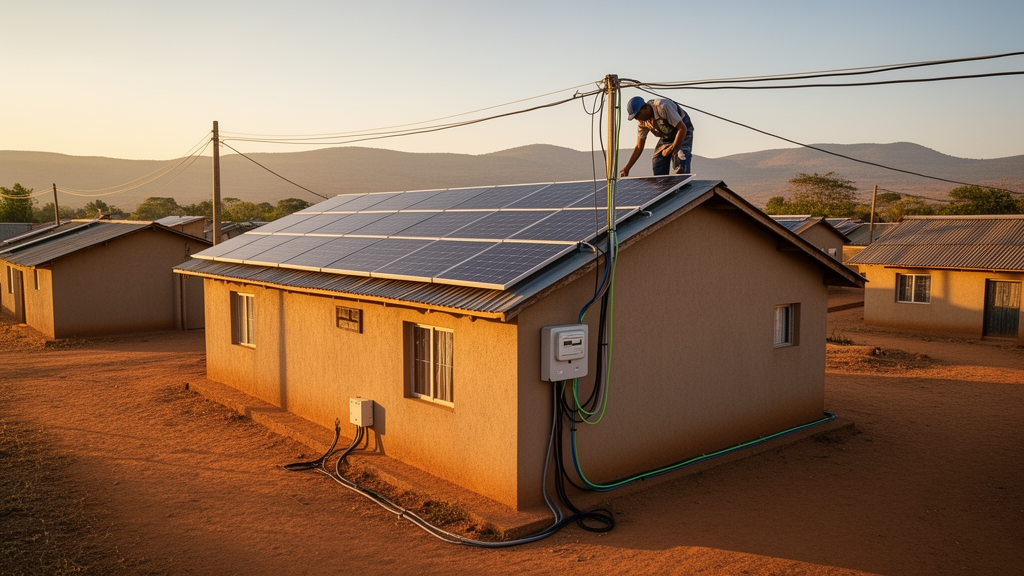
A conceptual framework published in Frontiers in Blockchain argues that blockchain technology could transform energy markets across emerging economies by slashing transaction costs, enabling peer-to-peer electricity trading, and opening energy investment to millions of people currently locked out of both power grids and financial systems. The review, authored by David Mhlanga of the University of South Africa, synthesizes interdisciplinary academic literature, institutional reports, and documented pilot applications to explain how decentralised digital ledgers, smart contracts, and renewable-energy tokenisation may simultaneously improve market efficiency, financial inclusion, and environmental sustainability in developing regions.
The study responds to a persistent structural problem. Energy markets in emerging economies remain dominated by centralised, vertically integrated systems controlled by state-owned or tightly regulated utilities. According to the analysis, these architectures have historically enabled large-scale infrastructure development but now constrain innovation, reduce system flexibility, and limit participation by decentralised energy producers, particularly in rural and underserved regions. The result is a landscape marked by high technical and non-technical losses, pricing distortions, inadequate cost recovery, and deep inequalities in electricity access, with substantial segments of the population lacking reliable power despite national capacity expansions.
Blockchain enters this picture as more than a secure transaction platform. The framework describes it as a governance mechanism: a decentralised digital ledger that records transactions across distributed networks in a transparent, immutable manner, validated through consensus mechanisms that reduce the risk of manipulation or fraud. Smart contracts, self-executing agreements embedded within the blockchain, automatically enforce predefined rules and conditions, cutting the need for manual verification and significantly lowering transaction costs. Tokenisation converts physical or intangible energy assets into digital tokens, enabling fractional ownership and broader participation in energy markets. Together, these features allow producers and consumers, or prosumers, to transact directly through automated digital platforms, improving market efficiency and enabling dynamic, real-time pricing mechanisms that reflect actual supply and demand conditions.
The theoretical foundation draws on three complementary perspectives. Transaction Cost Economics, rooted in the work of Oliver Williamson, posits that organisations structure themselves to minimise the costs of exchange, including search, negotiation, and enforcement. Blockchain, through automation and disintermediation, has the potential to reduce these costs substantially. Institutional Theory, associated with Douglass North, emphasises that formal and informal institutions shape economic behaviour; in emerging economies with weak governance frameworks, blockchain can partially substitute for institutional deficiencies by embedding trust and transparency into technological systems. Innovation Diffusion Theory, articulated by Everett Rogers, explains how new technologies spread, with adoption influenced by perceived relative advantage, complexity, compatibility, and institutional readiness.
Empirical evidence from pilot projects and institutional reports suggests the technology delivers measurable gains, though the review is careful to frame these as indicative rather than definitive. Available estimates indicate blockchain-enabled systems could reduce transaction and administrative costs in energy trading by approximately 20 to 40 percent, primarily through eliminating intermediaries and automating contractual processes. Blockchain-based payment and settlement systems have been shown to reduce transaction processing times from several days to near real-time, improving liquidity in energy markets. Pilot studies suggest peer-to-peer trading platforms may improve price discovery and allocative efficiency by 10 to 25 percent relative to centrally administered pricing, though these figures derive from controlled environments and simulation-based analyses.
Real-world implementations illustrate the practical feasibility. Powerledger has deployed peer-to-peer energy trading systems in India and Thailand involving more than 1,000 participants, demonstrating decentralised energy exchange and dynamic pricing. The Sun Exchange in South Africa applies blockchain to enable crowd-funded solar investments, allowing individuals to purchase fractional ownership of solar assets and earn returns through energy leasing. Blockchain network analytics from platforms such as Ethereum and Solana indicate settlement costs can fall below 1 to 2 percent of transaction value where processes are fully automated. The global peer-to-peer energy trading market was valued at approximately USD 9.3 billion in 2025, with the Asia-Pacific region accounting for around 38.4 percent of global market share.
Crucially, the framework includes an important technical caveat: blockchain does not transmit electricity. In grid-connected peer-to-peer markets, buyers and sellers may transact directly at the contractual and settlement levels, but electricity continues to flow through shared network infrastructure managed by distribution or transmission system operators responsible for network access, metering, system balancing, congestion management, reliability, and safety. Blockchain primarily reduces reliance on transactional and administrative intermediaries, reconfiguring rather than completely eliminating intermediation. Greater physical decentralisation is possible through microgrids and off-grid systems, though these arrangements still require infrastructure ownership, technical operation, and governance.
The analysis identifies significant moderating factors that determine whether blockchain delivers on its promise. Institutional capacity, regulatory clarity, and digital infrastructure all shape adoption outcomes. Regulatory uncertainty remains one of the most significant barriers, as existing energy policies in many emerging economies are designed around centralised systems and lack provisions for decentralised technologies. Scalability constraints, latency, interoperability challenges, and concerns about the energy consumption of proof-of-work consensus mechanisms further complicate large-scale deployment. Limited internet connectivity and low digital literacy in rural areas may constrain adoption, highlighting the need for complementary investments in infrastructure and capacity building.
The review proposes seven theoretically informed propositions for future empirical validation, linking blockchain-enabled smart contracts to transaction efficiency, peer-to-peer trading to market efficiency, tokenisation to financial participation, decentralised trading to energy access, transparent energy tracking to environmental sustainability, with regulatory clarity and digital infrastructure strengthening these relationships. The author recommends that policymakers develop adaptive regulations covering peer-to-peer trading, smart contracts, data governance, consumer protection, and digital assets; establish regulatory sandboxes; support public-private pilot projects; and invest in digital and decentralised energy infrastructure to ensure rural communities, low-income households, and other underserved groups can participate meaningfully in blockchain-enabled energy systems.
As a conceptual review, the framework is derived from secondary literature and has not been empirically validated through primary data, experimentation, or statistical analysis. The proposed relationships are theoretically informed rather than empirically confirmed, and the author acknowledges that much of the available evidence comes from pilot projects, modelling studies, and institutional reports rather than large-scale longitudinal datasets. Future research, the study concludes, should test the propositions through surveys, comparative case studies, experiments, blockchain transaction data, econometric analysis, or mixed-methods studies across diverse emerging economies to determine whether blockchain can fulfil its transformative potential in the world’s fastest-growing energy markets.
Subject of Research: Blockchain-enabled energy markets in emerging economies: a conceptual framework for efficiency, inclusion, and sustainability
Article Title: Blockchain-enabled energy markets in emerging economies: a conceptual framework for efficiency, inclusion, and sustainability
Article References: Mhlanga, D. (2026). Blockchain-enabled energy markets in emerging economies: a conceptual framework for efficiency, inclusion, and sustainability. Frontiers in Blockchain, 9, Article 1872161. https://doi.org/10.3389/fbloc.2026.1872161
Image Credits: AI Generated
DOI: 10.3389/fbloc.2026.1872161
Keywords: blockchain, energy markets, emerging economies, peer-to-peer energy trading, smart contracts, tokenisation, financial inclusion, renewable energy, sustainability, regulatory sandboxes, transaction costs, decentralised energy
Cite Scienmag News
Faith Mcneil. (October 16, 2026). Blockchain Could Rewire Energy Markets in Emerging Economies, New Framework Finds. Scienmag. https://scienmag.com/blockchain-could-rewire-energy-markets-in-emerging-economies-new-framework-finds/
Faith Mcneil. "Blockchain Could Rewire Energy Markets in Emerging Economies, New Framework Finds." Scienmag, 16 October 2026, https://scienmag.com/blockchain-could-rewire-energy-markets-in-emerging-economies-new-framework-finds/. Accessed 16 October 2026.
Faith Mcneil. "Blockchain Could Rewire Energy Markets in Emerging Economies, New Framework Finds." Scienmag. October 16, 2026. https://scienmag.com/blockchain-could-rewire-energy-markets-in-emerging-economies-new-framework-finds/


