


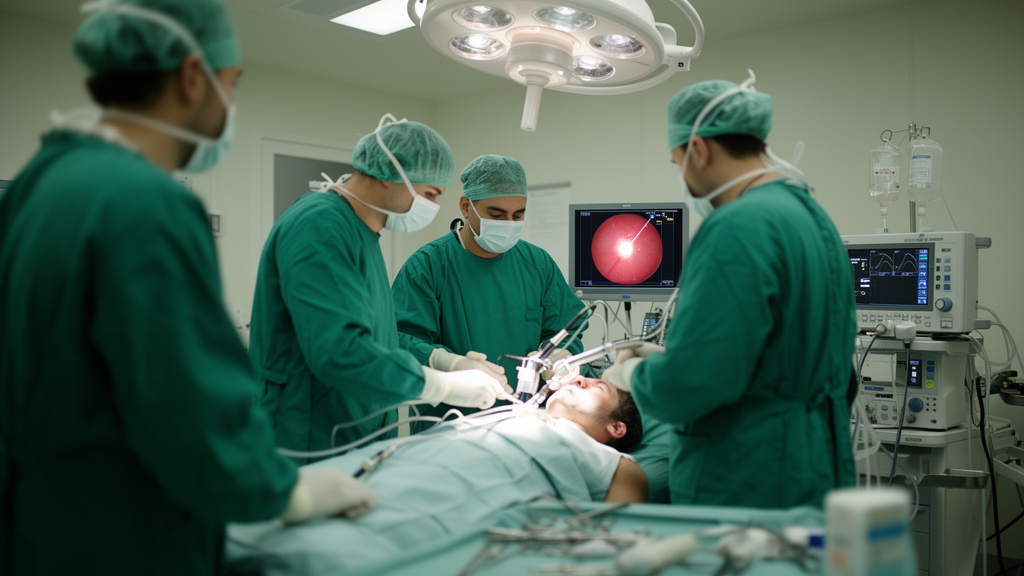
Surgeons in Chongqing, China, have documented one of the rarest and most dramatic complications in urological surgery: a gas explosion inside a patient’s bladder that tore the organ open during what should have been a routine laser procedure for an enlarged prostate. The case, published in Frontiers in Urology, describes a 50-year-old man whose operation ended with a loud popping sound from his lower abdomen, an emergency laparoscopic repair of three full-thickness bladder lacerations, and an 11-day stay in intensive care. The report is a stark reminder that even well-established, minimally invasive procedures can harbor unexpected dangers.
The patient had arrived with a three-month history of progressive urinary retention, hesitancy, a weak urine stream, and nocturia. His International Prostate Symptom Score was 25, indicating severe lower urinary tract symptoms, and laboratory tests showed a prostate-specific antigen level of 4.33 ng/mL alongside an elevated serum creatinine of 237.1 µmol/L, well above the normal range of 45 to 105. Abdominal ultrasonography revealed a benignly enlarged prostate with an estimated volume of 125 grams and a markedly overdistended bladder, though the bladder wall itself appeared intact, with no diverticula, stones, or upper urinary tract dilatation.
After catheterization for acute urinary retention, the surgical team proceeded with GreenLight laser vaporization of the prostate, a technique that uses a 532-nanometer potassium-titanyl-phosphate or lithium triborate laser to ablate prostatic tissue with excellent hemostatic properties. The team employed a third-generation GreenLight system at a vaporization power of 160 watts, maintaining continuous irrigation with 0.9 percent normal saline through a 26 French continuous-flow resectoscope sheath. Initial cystoscopy confirmed a markedly enlarged, trilobar prostate with patent ureteral orifices and grossly normal bladder mucosa showing only mild trabeculation.
Vaporization began at the elevated bladder neck and proceeded systematically through the median lobe and both lateral lobes, carried down to the prostatic capsule. But significant bleeding from the prostatic tissue compromised visualization, forcing the surgeons to switch techniques. They deployed a plasma resectoscope system equipped with a loop electrode, set to a coagulation power of 60 watts and a cutting power of 80 watts, to achieve hemostasis. Small tissue fragments were harvested for intraoperative frozen-section examination, and after evacuation of debris with an Ellik evacuator, scattered small air bubbles were observed at the 12 o’clock position of the prostatic fossa near the bladder neck. Those bubbles would prove ominous.
Approximately 15 minutes into the hemostasis phase, a sudden loud popping sound emanated from the patient’s lower abdomen, followed by ejection of irrigation fluid through the urethra. The patient immediately reported discomfort and dyspnea, his heart rate climbing to 126 beats per minute and his blood pressure rising to 159/102 mmHg. Emergency cystoscopic examination revealed rapidly blood-tinged, progressively turbid irrigating fluid that severely compromised visualization. A brief view showed extensive mucosal disruption and a large defect on the anterior bladder wall, through which what appeared to be peritoneal fat was transiently visible, raising immediate suspicion of full-thickness bladder rupture.
Progressive lower-abdominal distension with percussion dullness followed. After removal of the resectoscope, a 22 French three-way Foley catheter was placed for compression, yet hematuria persisted. Bedside ultrasound demonstrated massive intra-abdominal free fluid, and fine-needle paracentesis yielded pale-red fluid. The diagnosis of intraperitoneal bladder rupture was made based on the sudden intraoperative event, the abdominal findings, and the temporal relationship between the explosion and the injury. The total operative time before the explosion had been approximately 100 minutes, including roughly 15 minutes of plasma electrocoagulation.
Laparoscopic exploration via a three-port transperitoneal approach confirmed the damage. After evacuating approximately 800 milliliters of blood-tinged fluid, the surgeons identified three full-thickness lacerations: a 4.0-centimeter irregular, stellate-shaped tear on the anterior wall near the bladder dome with ragged hemorrhagic margins; an approximately 3.0-centimeter oblique linear laceration on the right lateral wall with relatively smooth margins; and an approximately 2.5-centimeter irregular laceration on the posterior wall superior to the trigone. No active bleeding came from the laceration edges, and no devitalized tissue required debridement. The ureteral orifices and prostate capsule were confirmed intact. The bladder was repaired with a two-layer closure using 2-0 polyglactin, combining continuous mucosal approximation with interrupted seromuscular reinforcement, and both a transurethral Foley catheter and a suprapubic cystostomy tube were inserted.
The mechanism behind such explosions is well established in the surgical literature, even if the events themselves are vanishingly rare. Tissue pyrolysis during endoscopic procedures generates combustible gases, primarily hydrogen, methane, and carbon monoxide. Diathermy alone produces insufficient oxygen for ignition; instead, atmospheric oxygen, roughly 21 percent, enters the bladder through the resectoscope sheath, improper use of the Ellik evacuator, or the irrigation system. Once introduced, this oxygen mixes with accumulated hydrogen to form an explosive gaseous mixture. The electrical spark from a diathermy loop or coagulation electrode then triggers a sudden exothermic reaction. Although GreenLight laser differs fundamentally from monopolar or bipolar resection, the subsequent plasma electrocoagulation in this case could generate precisely the kind of electrical spark needed to ignite a gas-rich environment.
Reported cases of intravesical gas explosion have predominantly been associated with transurethral resection of the prostate, the long-standing gold standard for surgical management of benign prostatic hyperplasia, with an incidence reported between 0.01 and 0.02 percent. GreenLight laser vaporization is generally considered a safer alternative, associated with shorter catheterization and hospitalization times, lower rates of bleeding-related complications and sexual dysfunction, and demonstrated safety even in patients on anticoagulant therapy or with prostates exceeding 80 grams. Yet rare serious complications have been documented, including prostatic capsular perforation with urinary extravasation and bladder perforation resulting in rhabdomyolysis and acute renal failure. The present case extends that spectrum, showing that explosion risk may exist even in procedures presumed to be low-risk.
The authors emphasize that the observation of gas bubbles before electrosurgical coagulation may offer a critical window for prevention. Their recommended strategies include literature-supported measures such as using a closed bladder irrigation system, applying moderate electrocautery power settings, and promptly evacuating visible air bubbles, supplemented by institutional practices like limiting total operative time to under 90 minutes, Trendelenburg positioning, and effective surgeon-anesthesiologist communication. In practice, this means any visible gas bubbles should be actively evacuated before activating the coagulation electrode, particularly when the electrode sits within or immediately adjacent to the gas-containing area. The authors acknowledge limitations: without intraoperative gas analysis, the source of the flammable gases cannot be attributed to either the laser or the electrocoagulation alone, and no intraoperative images were captured due to the emergent nature of the repair. Postoperative histopathology ultimately revealed an unexpected finding, a low-grade leiomyosarcoma of prostatic origin, and at one-year follow-up the patient’s catheter had been successfully removed, though a bladder diverticulum with calcification and right hydronephrosis had emerged on CT imaging. The case stands as a powerful argument for intraoperative vigilance in even the most routine of procedures.
Subject of Research: Intravesical gas explosion after sequential greenlight laser prostate vaporization and plasma electrocoagulation: a case report and literature review
Article Title: Intravesical gas explosion after sequential greenlight laser prostate vaporization and plasma electrocoagulation: a case report and literature review
Article References: Intravesical gas explosion after sequential greenlight laser prostate vaporization and plasma electrocoagulation: a case report and literature review. (n.d.). https://doi.org/10.3389/fruro.2026.1845524
Image Credits: AI Generated
DOI: 10.3389/fruro.2026.1845524
Keywords: GreenLight laser vaporization, bladder rupture, intravesical gas explosion, benign prostatic hyperplasia, transurethral surgery, plasma electrocoagulation, surgical complication, urology, case report, tissue pyrolysis, hydrogen gas, patient safety
Cite Scienmag News
Ophelia Keating. (October 16, 2026). Bladder Explosion During Laser Prostate Surgery: Rare Case Sounds Alarm. Scienmag. https://scienmag.com/bladder-explosion-during-laser-prostate-surgery-rare-case-sounds-alarm/
Ophelia Keating. "Bladder Explosion During Laser Prostate Surgery: Rare Case Sounds Alarm." Scienmag, 16 October 2026, https://scienmag.com/bladder-explosion-during-laser-prostate-surgery-rare-case-sounds-alarm/. Accessed 16 October 2026.
Ophelia Keating. "Bladder Explosion During Laser Prostate Surgery: Rare Case Sounds Alarm." Scienmag. October 16, 2026. https://scienmag.com/bladder-explosion-during-laser-prostate-surgery-rare-case-sounds-alarm/


