


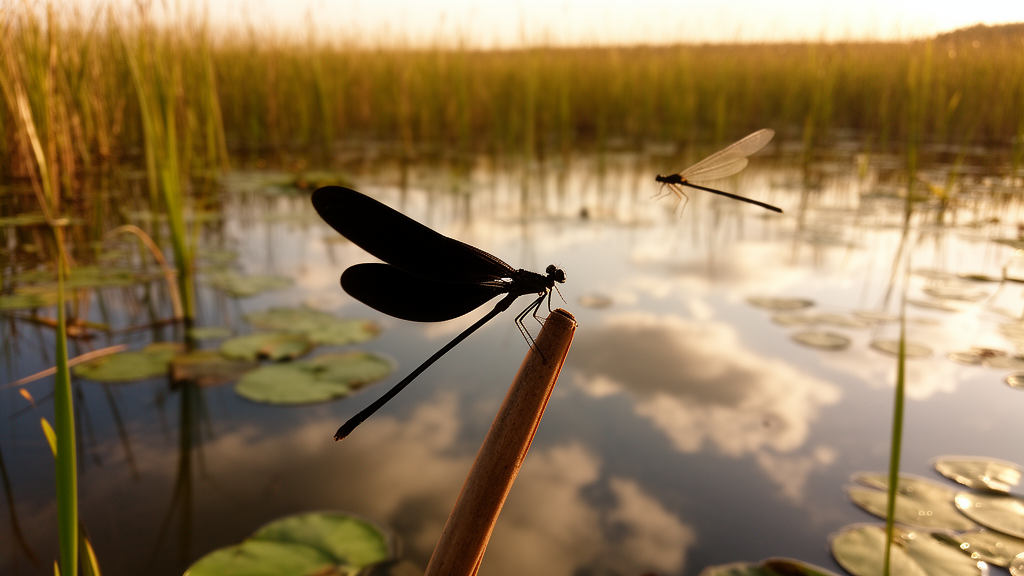
The Black Pennant dragonfly, a striking insect long confined to the sun-baked landscapes of the Mediterranean and the semi-arid Iranoeremian region, has quietly staged one of the most remarkable northward expansions documented among European insects. In a study published in the journal Evolutionary Systematics, researchers report the discovery of an established breeding population in central Hungary at 47.3262°N — the northernmost breeding population of this species anywhere in the world. The finding, based on five years of field observations and citizen science data, confirms for the first time that the Black Pennant is not merely passing through the Carpathian Basin but is reproducing there successfully, a milestone that carries significant implications for how scientists track the shifting ranges of insects in a warming world.
Selysiothemis nigra, the sole member of its genus, belongs to the dragonfly family Libellulidae and has traditionally been considered an Iranoeremian faunal element, native to regions stretching from North Africa and southern Europe through the Middle East to South Asia. Its scattered distribution extends from Morocco in the west to Central Asia and China in the east, and from the Arabian Peninsula in the south to the southern Urals in the north. Within Europe, the species has historically been restricted mainly to the Mediterranean Basin, often hugging coastal areas in Spain, Italy, and the Balkans. Because most of its range lies in semi-arid habitats, the Black Pennant is famous among odonatologists for its nomadic and migratory behaviour, which allows individuals to travel enormous distances from any resident population. This trait complicates the interpretation of isolated records, as the species frequently turns up far from known breeding sites in low numbers.
From the 2000s onward, however, something changed. The Black Pennant began a pronounced northward expansion clearly distinguishable from occasional vagrant specimens, prompting reports from countries it had never been observed in before. It has been documented in Bulgaria, Portugal, Slovenia, Albania, Bosnia and Herzegovina, continental France, and most recently Serbia. As part of this ongoing latitudinal range shift, the species was recorded in the Carpathian Basin for the first time in 2020, when a single female was captured in Hungary near Káptalantóti. Based on its colouration and general appearance, that specimen was most likely freshly emerged, suggesting that local reproduction may have occurred in the area prior to the observation. Yet no additional individuals were detected during the fieldwork, and no further evidence of a local population had been reported since — until now.
The new study, led by Ádám Mészáros and colleagues, combined traditional field observations collected between 2020 and 2025 with data harvested from citizen science platforms, including iNaturalist, the Hungarian website ízeltlábúak.hu, and thematic Facebook groups popular among amateur entomologists. The researchers documented 39 new occurrences of the species in Hungary, including multiple swarms consisting of more than one hundred individuals. The pattern of observations shows a steadily accelerating trend: in the first three years, only three sightings were made, all around Lake Balaton; in 2023 and 2024, six sightings were reported each year, all involving single individuals. In 2025, however, the situation changed drastically, with 25 sightings recorded — exceeding the total of all earlier years combined — including six observations of ten or more individuals at a single site and three swarms estimated at over one hundred individuals at once.
The decisive breakthrough came at a site in the outskirts of Dunaharaszti, south of Budapest, where numerous copulating adults had previously been observed. Based on these observations, the team surveyed the surrounding area to identify potential larval habitats and examined two adjacent gravel pit ponds created by gravel extraction activities. Pond 1, formed in 2009 as an elongation of the older Pond 2, covers approximately 3.3 hectares and is bordered by a shoreline dominated by coarse substrate of large pebbles and gravel. Pond 2, formed between 2004 and 2008, spans roughly 12 hectares with a similar shoreline structure, though the substrate at the sampling site is more silted. Emergent vegetation along the pond margins is dominated by common reed, while submerged and floating-leaved macrophytes are largely absent at the sampling locations, resulting in mostly open, unvegetated littoral zones — precisely the kind of habitat the Black Pennant favours for reproduction outside its native range.
On 19 October 2025, the team found a total of 11 naiads — immature dragonfly larvae — of Selysiothemis nigra at the Dunaharaszti gravel pits, six in Pond 1 and five in Pond 2. The larvae were captured alive from the littoral substrate using a hand net with fine mesh, after disturbing the bottom substrate and dislodging stones with rubber boots, then sieving the resuspended material. Identification under a stereomicroscope was based on established field guides and morphological keys. Naiads of the species can be clearly distinguished from all other odonate larvae occurring in Hungary by a distinctive combination of traits: the head is triangular, the eyes are small and elongated longitudinally, and the abdominal segments bear mid-dorsal spines except for the ninth segment, which lacks any spine. Other odonate species collected at the site included the Scarlet Dragonfly, the Emperor and Blue-Eyed Hawkers, the Black-tailed Skimmer and its close relatives, and the Common Bluetail — a community typical of warm, recently formed lowland water bodies.
The presence of the Black Pennant at Dunaharaszti had already been confirmed by adult observations, with the first sighting recorded in 2024. The following year, slightly more than two and a half months before the discovery of the naiads, multiple mating adults were observed at the site. The continuous presence of adults over at least two consecutive years, combined with the observation of mating pairs and direct evidence of successful reproduction, confirms that an established population is present. Previously, the northernmost breeding of the species had been reported from northeastern Italy along the northern Adriatic coast at a latitude of 45.8764°N. The new record at 47.3262°N therefore represents the northernmost autochthonous population in the world known to date, and simultaneously the first established population documented in the Carpathian Basin. All collected specimens are preserved in the Hungarian Natural History Museum in Budapest.
A second population may exist in the Balaton Uplands, given that the earliest Hungarian records originated from that region. Notably, the gravel pit lakes near Salföld are located close to these records and are very similar in character to the Dunaharaszti site, suggesting that a local population could have developed there as well in the early 2020s, potentially serving as the source of some of the observed individuals. However, further evidence is needed to confirm this, as no swarming, mating pairs, or naiads have yet been documented there. Speculating about the route of the expansion, earlier researchers suggested that the Black Pennant, alongside another Mediterranean dragonfly, the Violet Dropwing, likely utilized existing river corridors through Serbia to colonize new sites, spreading along the Morava–Danube–Tisza rivers. Although the first Hungarian records were made away from these rivers near Lake Balaton, most of the subsequent observations, including the confirmed autochthonous population, come from the Danube–Tisza Interfluve, which could have been reached by following those river corridors.
Two major explanations have been proposed in the literature for the drivers of the Black Pennant’s expansion: the formation of numerous artificial water bodies and the effect of climate change. As far back as 1960, researchers suggested that the 25 °C July isotherm may represent the northern limit of the species’ distribution, implying that recent warming could be facilitating its northward shift. On the other hand, some researchers have argued that artificial habitats play a bigger role, noting that the species expanded its range in the Sea of Azov region during a period of decreasing average annual temperatures. In the new study, the Black Pennant was found predominantly in and around artificial lakes rather than in the ephemeral waters typically used for reproduction in the Mediterranean region. Yet satellite imagery indicates that most of the ponds in the area were created between 2005 and 2010, more than a decade before the first record of the species in Hungary. This could suggest that climatic factors may be more influential than habitat availability in driving the expansion in the Carpathian Basin, though the specific climatic variables involved require further investigation.
The Black Pennant is not the first odonate species of southern origin recently added to the Hungarian fauna. An established population of the Goblet-marked Damselfly has been reported in southeastern Hungary, and single specimens of the Violet Dropwing and the Red-veined Darter have also been recorded in the country in recent years, their spread strongly linked to warming climate. The new study’s dataset documenting the spread and establishment of the Black Pennant in the Carpathian Basin drew heavily on citizen science platforms, which the authors emphasize as essential tools for monitoring distributional changes across large areas with minimal spatial gaps. Integrating citizen science data with targeted field investigations, they argue, is the most effective way to track ongoing and potentially accelerating shifts in species distributions. For the Black Pennant, the message is clear: the species is established and increasingly widespread in the Carpathian Basin, and confirmed breeding populations — not just occasional adults — are what truly reveal the advancing frontier of its range.
Subject of Research: Northernmost recorded breeding of the Black Pennant Selysiothemis nigra (Vander Linden, 1825) shows further spread in the Carpathian Basin (Odonata, Libellulidae)
Article Title: Northernmost recorded breeding of the Black Pennant Selysiothemis nigra (Vander Linden, 1825) shows further spread in the Carpathian Basin ( Odonata , Libellulidae )
Article References: Székely, Á., Kollár, L., & Mészáros, Á. (2026). Northernmost recorded breeding of the Black Pennant Selysiothemis nigra (Vander Linden, 1825) shows further spread in the Carpathian Basin (Odonata, Libellulidae). Evolutionary Systematics, 10(1), 21-29. https://doi.org/10.3897/evolsyst.10.178055
Image Credits: AI Generated
DOI: 10.3897/evolsyst.10.178055
Keywords: Northernmost, recorded, breeding, Black, Pennant, Selysiothemis, nigra, Vander, Linden, shows, further, spread
Cite Scienmag News
Drew Townsend. (October 17, 2026). Black Pennant dragonfly reaches northernmost breeding ground in Carpathian Basin. Scienmag. https://scienmag.com/black-pennant-dragonfly-reaches-northernmost-breeding-ground-in-carpathian-basin/
Drew Townsend. "Black Pennant dragonfly reaches northernmost breeding ground in Carpathian Basin." Scienmag, 17 October 2026, https://scienmag.com/black-pennant-dragonfly-reaches-northernmost-breeding-ground-in-carpathian-basin/. Accessed 17 October 2026.
Drew Townsend. "Black Pennant dragonfly reaches northernmost breeding ground in Carpathian Basin." Scienmag. October 17, 2026. https://scienmag.com/black-pennant-dragonfly-reaches-northernmost-breeding-ground-in-carpathian-basin/


