


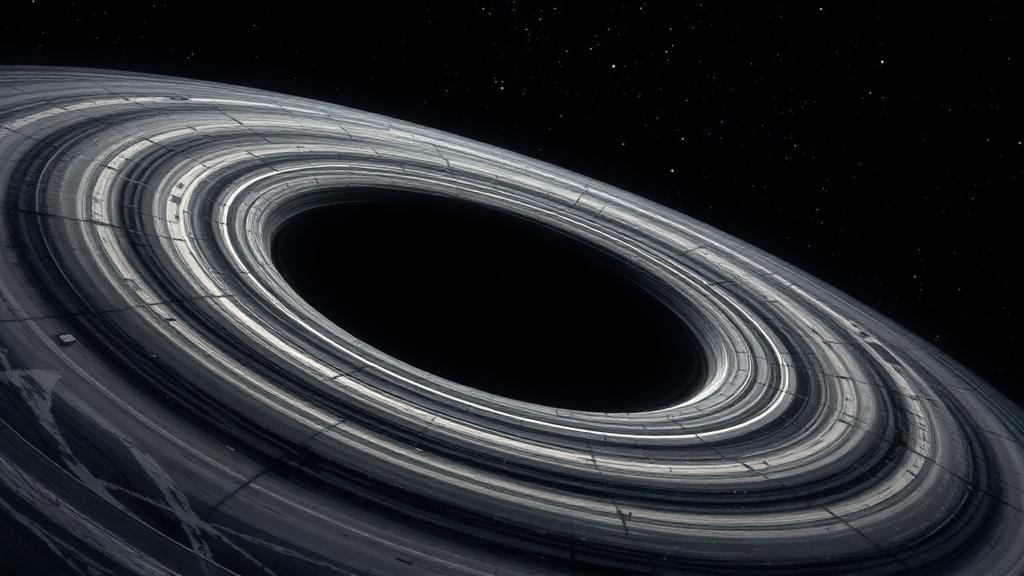
In the classical picture of falling into a black hole, the ending is always the same: tidal forces stretch an infalling body lengthwise, squeeze it sideways, and ultimately tear it apart in the process vividly nicknamed spaghettification. A new theoretical study suggests that this fate is not written in stone. Mohammad Ali S. Afshar and J. Sadeghi of the University of Mazandaran, writing in The European Physical Journal C, have analyzed what happens to neutral particles falling into exotic black holes predicted by Einstein gravity coupled to nonlinear electrodynamics, a framework in which spacetime can host not just one or two horizons but three or even four. Their results reveal a landscape of bouncing particles, forbidden zones, and tidal forces that flip sign repeatedly on the way down.
The work builds on black hole solutions found by Chao Gao and colleagues, in which the electromagnetic field is described not by Maxwell’s linear theory but by a nonlinear electrodynamics Lagrangian, a type of effective theory that often emerges when quantum corrections to ordinary electromagnetism become important in ultra-strong fields. When such fields are coupled to gravity, the resulting metric function departs from the familiar Reissner-Nordström form and acquires additional inverse-power terms in the radial coordinate. These extra terms allow the spacetime to develop multiple horizons, and, remarkably, to retain an event horizon even when the black hole’s charge exceeds its mass, a regime where the standard Reissner-Nordström solution would shed its horizon and expose a naked singularity.
Tidal forces are exquisitely sensitive to the geometry of spacetime. In general relativity they are described by the geodesic deviation equation, which measures how nearby freely falling particles accelerate relative to one another as they ride the curvature produced by the Riemann tensor. For a static, spherically symmetric black hole, the radial tidal component is governed by the second derivative of the metric function, while the angular component depends on its first derivative. In the Schwarzschild spacetime of an uncharged black hole, the radial component is always positive, meaning stretching, and the angular component always negative, meaning compression, everywhere outside the singularity. Adding electric charge in the Reissner-Nordström solution changes this: the tidal components can cross zero and change sign, so a falling body may briefly be squeezed radially and stretched sideways before the forces diverge at the center.
Afshar and Sadeghi found that nonlinear electrodynamics multiplies this richness several times over. In the three-horizon configuration, as the black hole’s charge increases, the radial tidal force passes through distinct behavioral regimes. At low charge it behaves in a Schwarzschild-like way, always stretching, though with local wiggles introduced by the nonlinear terms. Beyond a critical charge of about 0.547 in the dimensionless units of the study, the radial force develops two zero crossings, so an infalling body experiences stretching, then compression, then stretching again before the force diverges near the singularity. The angular component follows a similar pattern with its own threshold, near 0.624. Crucially, these tidal thresholds arrive before the horizons themselves change: the additional pair of horizons only appears once the charge exceeds roughly 0.75.
The most dramatic discovery concerns the radial equation of motion. A particle released from rest far away conserves its energy, and the square of its radial velocity equals the difference between that energy and the metric function evaluated at its current position. In a Schwarzschild spacetime this quantity stays positive all the way down, so nothing stops the fall. In the nonlinear electrodynamics black holes, however, once the charge crosses about 0.8223, the radial equation develops two bounce-back points: radii where the particle’s infall is arrested and it reverses direction. Between these turning points lies a classically forbidden region where the radial velocity squared is negative, meaning no classical trajectory can pass through. In the three-horizon case these turning points sit between the intermediate and innermost horizons, entirely outside the Cauchy-like horizon, so the reversal happens within the same spacetime rather than requiring the exotic continuation into another universe found in the maximal extension of the Reissner-Nordström geometry.
This forbidden region acts as what the authors call an effective dynamical barrier. Unlike regular black hole models such as the Bardeen or Hayward solutions, where the central singularity is smoothed away by construction, the singularity in this model remains. Yet for the class of radial trajectories studied, it becomes kinematically unreachable, because the particle bounces before getting there. The consequence for tidal forces is striking: since the divergent tidal region lies beyond the forbidden zone, a falling particle never experiences infinite stretching or compression. Within these trajectories, the nonlinear electromagnetic field effectively shields infalling objects from spaghettification altogether.
The super-extremal regime, where charge exceeds mass, adds an even more surprising layer. In a window of charge-to-mass ratios, roughly between one and ten for a particle released from a hundred times the horizon scale, the classically forbidden region expands outward past the event horizon. A neutral particle dropped from rest at a large distance then rebounds at a radius outside the horizon, for example around 2.04 times the mass parameter for a charge of two, never crossing into the black hole at all. The tidal force itself also develops an outer zero crossing at about six mass units, flipping from stretching to compression at a finite, bounded value. The combination amounts to a dual protective mechanism: the particle avoids both the horizon and any divergent tidal stress. But the protection is not unlimited. Beyond a charge-to-mass ratio of about ten, the outer turning point migrates all the way back to the release point and disappears, reopening a clear path toward the hole.
The four-horizon configuration, controlled by an additional nonlinear coupling parameter, reproduces the same qualitative choreography with shifted thresholds. There the radial tidal force first changes behavior at a charge near 0.373, the angular component near 0.424, the extra horizons appear near 0.54, and the bounce-back points emerge near 0.561. For both geometries the critical charges obey a strict hierarchy: tidal zero crossings appear first, then the horizon restructuring, then the dynamical turning points. This ordering implies that the tidal environment of such a black hole responds to changing charge before its causal structure does, hinting that tidal observables could serve as early indicators of deeper structural changes. The authors also note that the sudden appearance of new roots at precise charge values resembles the saddle-node bifurcations familiar from nonlinear dynamical systems, though a formal identification would require a separate stability analysis.
The study is careful about its limits. The analysis covers neutral test particles released from rest along radial paths, and the protective shield is a statement about classical accessibility along those specific trajectories, not a proof that the inner horizons are stable. Charged black holes with Cauchy horizons are widely expected to suffer mass-inflation instabilities, and assessing whether the multi-horizon structure survives such perturbations remains future work. Nor did the authors model an actual tidal disruption event; a realistic calculation of how an extended star responds to these oscillating tidal fields is left to follow-up studies.
Even with those caveats, the results expand the known repertoire of black hole behavior. They show that a central singularity need not be removed to render it inaccessible, that nonlinear gauge fields coupled to gravity can bounce particles outward and keep tidal forces finite along their paths, and that a charged black hole can remain a black hole even when its charge violates the classical extremality bound. If nature realizes such nonlinear electrodynamics in the strong-field regime, the interiors of charged black holes, and the fates of anything falling toward them, could be far stranger, and far gentler, than the spaghettification textbook story suggests.
Subject of Research: Tidal forces and radial geodesic motion of neutral test particles in multi-horizon black hole spacetimes arising from Einstein gravity coupled to nonlinear electrodynamics
Article Title: Beyond the bounce: multiple tidal sign reversals and turning-point bifurcations in multi-horizon black holes
Article References: Afshar, M. A. S., & Sadeghi, J. (2026). Beyond the bounce: multiple tidal sign reversals and turning-point bifurcations in multi-horizon black holes. The European Physical Journal C, 86(9), Article 1043. https://doi.org/10.1140/epjc/s10052-026-16293-9
Image Credits: AI Generated
DOI: 10.1140/epjc/s10052-026-16293-9
Keywords: black holes, tidal forces, nonlinear electrodynamics, event horizons, geodesic deviation, spaghettification, super-extremal charge, Reissner-Nordström, Cauchy horizon, bounce-back points, general relativity, forbidden regions
Cite Scienmag News
Grant Pearson. (October 12, 2026). Black Holes With Extra Horizons Could Shield Falling Objects From Deadly Tidal Forces. Scienmag. https://scienmag.com/black-holes-with-extra-horizons-could-shield-falling-objects-from-deadly-tidal-forces/
Grant Pearson. "Black Holes With Extra Horizons Could Shield Falling Objects From Deadly Tidal Forces." Scienmag, 12 October 2026, https://scienmag.com/black-holes-with-extra-horizons-could-shield-falling-objects-from-deadly-tidal-forces/. Accessed 12 October 2026.
Grant Pearson. "Black Holes With Extra Horizons Could Shield Falling Objects From Deadly Tidal Forces." Scienmag. October 12, 2026. https://scienmag.com/black-holes-with-extra-horizons-could-shield-falling-objects-from-deadly-tidal-forces/


