


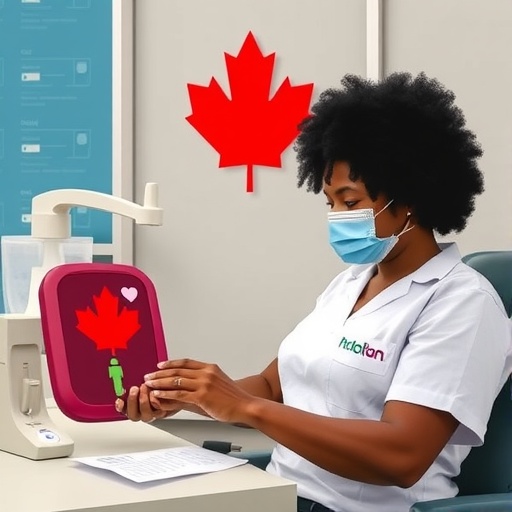
Canada’s blood supply is confronting a paradox: patients with sickle cell disease urgently need transfusions from a more ethnically diverse donor pool, yet many Black people who want to donate encounter policies, institutional practices and historical experiences that discourage or prevent them from doing so. A new qualitative study published in the Canadian Medical Association Journal reports that these obstacles extend well beyond individual eligibility decisions. They are embedded in the rules governing donation, in interactions with health-care institutions and in a deep mistrust shaped by anti-Black racism. The researchers argue that unless Canadian blood-collection agencies address these issues directly, the country will continue to lose potential donors while patients remain exposed to shortages of precisely matched blood.
Sickle cell disease is an inherited disorder caused by a mutation affecting haemoglobin, the protein red blood cells use to transport oxygen. Under low-oxygen conditions, abnormal haemoglobin can cause red blood cells to become rigid and assume a characteristic sickle shape. These misshapen cells can block small blood vessels, producing severe pain, organ damage, stroke and life-threatening complications. Repeated red blood cell transfusions are used to prevent or treat some of these complications, particularly in patients at high risk of stroke or those experiencing severe anaemia. Because transfusions expose recipients to red blood cell antigens—molecular markers that can trigger an immune response—patients often require blood matched beyond the basic ABO and RhD blood-group systems. Matching additional antigens can reduce the risk of alloimmunisation, in which a patient develops antibodies against transfused cells and later becomes difficult to transfuse safely.
The need for more donors from Black communities is linked to the genetic diversity of blood-group antigens. People with African ancestry are more likely to carry blood-group variants that are uncommon among donors of European ancestry. For patients with sickle cell disease, who may receive transfusions repeatedly over many years, finding units with compatible antigen profiles can be particularly important. A donor whose red blood cells share these less common characteristics may provide a closer match and help reduce transfusion reactions. Although blood can be safely donated by people from every racial and ethnic background, a broader donor base increases the likelihood that hospitals can locate compatible units for patients whose blood-group profiles are underrepresented in existing inventories. Canada’s limited supply of donors from many racialized communities therefore has consequences that are both logistical and clinical.
To examine why Black adults may be reluctant or unable to donate, researchers at the Interdisciplinary Centre for Black Health at the University of Ottawa conducted a qualitative study involving 42 Black adults in Canada. Most participants had completed at least a bachelor’s degree, and 57 percent identified as women. Rather than measuring donation rates alone, the study explored participants’ experiences, perceptions and explanations for choosing—or declining—to donate blood. This approach allowed the researchers to identify barriers that may not appear in standard surveys, such as the emotional effects of disrespectful treatment, uncertainty about eligibility rules and concerns that blood-collection settings may reproduce inequalities experienced elsewhere in the health-care system.
One prominent concern involved Canada’s eligibility policies, particularly restrictions related to previous malaria infection or time spent in regions where malaria is endemic. The researchers noted that people who have been deferred from donating in Canada may be eligible under rules used in other G7 countries. Malaria-related deferrals are based on the possibility that a donor may carry Plasmodium parasites in the bloodstream without symptoms. Because transfused blood can transmit malaria in rare circumstances, blood services use travel and residence histories to manage that risk. However, the study suggests that participants viewed some Canadian restrictions as overly broad, especially when they did not appear to reflect current evidence, individual testing or policies adopted elsewhere. For potential donors whose family histories or childhood residences are connected to malaria-endemic regions, these rules can feel like a racialized exclusion rather than a carefully explained safety measure.
The participants also described institutional and systemic racism in health care as a major source of distrust. Experiences of being dismissed, stereotyped or treated unfairly in medical settings influenced expectations about what might happen at a blood-donation clinic. Even when donation staff were not directly responsible for previous incidents, the blood system was perceived as part of the same broader health-care environment. This distinction matters because donation depends on voluntary cooperation and confidence: donors must believe that staff will listen to them, protect their privacy, respect their bodies and explain eligibility decisions transparently. When people anticipate humiliation, suspicion or unequal treatment, the practical act of making an appointment can become an emotionally costly decision.
Historical experiences further intensified that mistrust. Anti-Black racism in medicine has included the exploitation of Black bodies, the denial of care and the use of racist theories to justify unequal treatment. In Canada, as elsewhere, these histories continue to shape how institutions are perceived, even when contemporary policies are presented as neutral. The study’s participants described fears of rejection, devaluation or harm during donation, suggesting that trust cannot be created simply through advertisements encouraging people to “give blood.” A campaign that ignores historical memory may fail to reach the people it is intended to engage, particularly if it presents low donation rates as a problem within Black communities rather than examining how institutions have contributed to those rates.
The findings also challenge the idea that increasing donations is primarily a matter of public education. Participants may already understand that blood is needed for surgery, trauma care and chronic diseases such as sickle cell disease. What remains unresolved is whether the donation system is prepared to change the conditions under which people are asked to participate. The researchers call on Canadian Blood Services, which operates outside Quebec, and Héma-Québec, which manages blood collection in Quebec, to review restrictive policies, improve communication and engage Black communities in ways that acknowledge cultural values and the history of oppression. Such engagement could include sustained partnerships with community organizations, transparent explanations of deferral criteria, better training in anti-racist care and mechanisms for reporting and addressing discriminatory treatment.
Policy reform must preserve transfusion safety while ensuring that restrictions are proportionate to evidence. Modern blood systems already use detailed donor questionnaires, laboratory screening and pathogen-testing technologies to reduce infectious risks. These measures do not eliminate every danger, but they can support more individualized approaches than blanket assumptions based on race, birthplace or travel history. Researchers and blood agencies could also examine whether additional testing or revised deferral periods would allow more people to donate without compromising recipients’ safety. Any change would require rigorous validation, because blood transfusion is a complex system in which a small error can have serious consequences. But safety and inclusion should not be treated as opposing goals when scientific tools may permit both.
The study arrives as Canada seeks more reliable access to blood for patients whose transfusion needs are frequent, specialized or difficult to meet. Its central message is that donor diversity cannot be increased without confronting the policies and experiences that shape people’s confidence in the system. For individuals with sickle cell disease, a culturally and genetically diverse donor pool may improve the chances of finding antigen-compatible units and reduce complications associated with repeated transfusions. For potential donors, meaningful participation requires more than an invitation; it requires evidence that they will be treated fairly. By linking blood shortages to structural racism, the researchers place responsibility on institutions to rebuild trust—and suggest that the future resilience of Canada’s blood supply may depend on whether those institutions are willing to change.
News Publication Date: 24-Aug-2026
Web References: https://www.cmaj.ca/lookup/doi/10.1503/cmaj.250123
References: Canadian Medical Association Journal, DOI: 10.1503/cmaj.250123
Cite Scienmag News
Courtney Benton. (August 24, 2026). Black Canadians face barriers to donating urgently needed blood. Scienmag. https://scienmag.com/black-canadians-face-barriers-to-donating-urgently-needed-blood/
Courtney Benton. "Black Canadians face barriers to donating urgently needed blood." Scienmag, 24 August 2026, https://scienmag.com/black-canadians-face-barriers-to-donating-urgently-needed-blood/. Accessed 4 September 2026.
Courtney Benton. "Black Canadians face barriers to donating urgently needed blood." Scienmag. August 24, 2026. https://scienmag.com/black-canadians-face-barriers-to-donating-urgently-needed-blood/


