


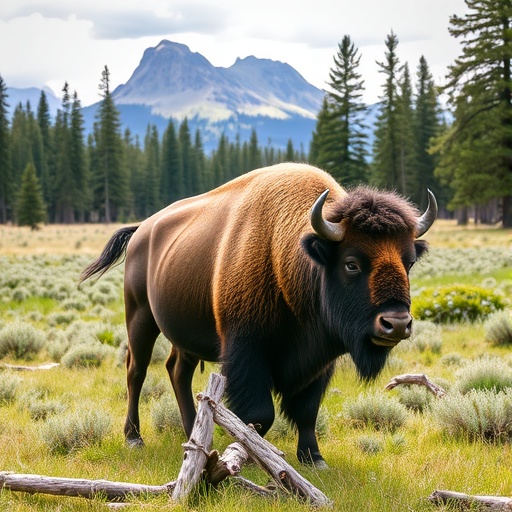
On August 28, a pioneering study led by researchers from Washington and Lee University, the National Park Service, and the University of Wyoming was published in the prestigious journal Science, shedding light on the ecological benefits of large, migratory bison herds in Yellowstone National Park. This groundbreaking research moves beyond traditional conservation strategies, emphasizing the importance of free-roaming bison populations in shaping vibrant ecosystems and enhancing biodiversity.
Bill Hamilton, co-first author and John T. Perry Jr. Professor in Research Science at Washington and Lee University, alongside Chris Geremia from the National Park Service and Jerod Merkle from the University of Wyoming, explored the ecological ramifications of bison grazing practices within Yellowstone. Historically, conservation efforts regarding bison have predominantly concentrated on small, controlled herds, leaving a substantial knowledge gap about the role of larger, migratory herds in ecological restoration.
Focusing on the expansive migratory patterns of bison in Yellowstone, the research team investigated how these magnificent creatures impact the landscapes they traverse. With a stabilized population of roughly 5,000 bison, rebounding from a startling low of just 23 animals in 1902, these powerful grazers undertake migration journeys of nearly 1,000 miles annually, primarily in search of nutrient-rich forage during the spring and summer months.
As bison congregate in Yellowstone’s river valleys, their grazing habits might superficially appear to lead to overgrazing. However, the research team discovered that the dynamics of grazing present a much more complex scenario. In fact, they found that bison grazing accelerates the nitrogen cycling process in these ecosystems. This means that while plant growth remains on par with areas free from grazing, the nutritional quality of the plants significantly increases, making them 150% more nutritious for herbivores.
The nitrogen cycle is integral to ecosystem health, facilitating the movement of this essential nutrient among plants, animals, soil, and atmosphere. The study revealed that bison enhance microbial activity in the soil as they graze, thus increasing the nitrogen available for plants to utilize. As a result, the landscape remains robust and productive even when bison are present, enriching the diets of other herbivores in the region.
As the grazing season progresses into late summer, the continuous interaction between bison and the plant communities reinforces this cycle. The study posits that bison’s grazing habits not only enhance the nutritional quality of the flora but also help maintain a healthy ecosystem dynamic. By promoting short and dense plant growth rich in nitrogen, bison create a fertile environment that benefits a diverse range of wildlife.
Hamilton articulated the significance of their findings, proposing that as bison traverse the Yellowstone landscape, they play a vital role in amplifying ecosystem health and food web dynamics. Calling it a modern-day parallel to ecological shifts witnessed in the Serengeti following the recovery of wildebeest populations, Hamilton suggests that the ongoing recovery and movement of bison present critical lessons in ecological restoration.
To elucidate the intricate relationship between bison grazing and nitrogen cycling, the researchers carried out extensive field studies from 2015 to 2021. They meticulously monitored indicators such as plant growth, nutrient cycling, soil chemistry, and microbial populations, employing movable exclosures to comprehend grazed versus ungrazed conditions. By integrating landscape-scale satellite imagery and GPS collar data from bison, the team successfully mapped the ecological impacts of bison migration throughout the region.
Hamilton further confirmed the positive outcomes of bison presence in Yellowstone. He stated that current conditions in Yellowstone’s grasslands support greater functionality than when bison were virtually eliminated in the late 19th century. This study not only highlights the immediate ecological advantages of large bison populations but also serves as a poignant reminder of the ecological cost incurred when these majestic animals were driven to near extinction.
The ongoing research demonstrated that nutrient storage within the soil remains stable, even as plant communities evolve over time. Rather than succumbing to overgrazing, the ecosystems benefited from increased biodiversity along the migratory pathways, contradicting the typical characterization of overgrazed lands marked by diminished productivity and environmental integrity.
Co-author Merkle emphasized the critical benefits that a thriving bison population bestows upon the ecosystem. Observing the varying impacts of bison grazing across different areas, Merkle noted the pronounced diversity resulting from bison movement—certain regions resembling well-manicured lawns while others remained untouched, demonstrating the landscape’s resilience and heterogeneity.
Yellowstone National Park has long been touted as a model for ecological restoration initiatives, and this new study underscores the transformative power of re-establishing large herbivorous populations. Distinct from confinement-based conservation strategies, which limit bison to small, managed areas, Yellowstone exemplifies the exceptional potential of unrestricted movement and natural selection in fostering ecosystem resilience.
Ultimately, this groundbreaking research champions the restoration of vast, migratory bison populations as an essential strategy for enhancing ecological health and stability. As stakeholders and policymakers deliberate the future of bison conservation across North America, the findings underscore the necessity to prioritize ecological processes driven by natural movements and cycles rather than restrictive management.
The full ramifications of this study extend beyond Yellowstone; they invite a broader dialogue on the interconnectedness of herbivore management, ecosystem integrity, and biodiversity conservation on a global scale. Understanding the lessons gleaned from recent bison recovery efforts can pave the way for more effective conservation frameworks, promoting wildlife resilience in the face of restrictive human interventions.
In essence, the research not only speaks volumes about the integral role of bison in maintaining the integrity of Yellowstone’s ecosystems but also serves as a clarion call to reevaluate and bolster conservation approaches to embrace the natural dynamics of wildlife. As ecological awareness continues to evolve, the resonance of bison grazing as a keystone ecological process becomes increasingly undeniable.
Ultimately, this illuminating research sets a benchmark in ecological studies, revealing the nuanced interdependencies that exist in our natural world. As scientists delve deeper into the complexities of ecosystem interactions, the message remains clear: the restoration of bison populations is about more than just the animals themselves; it’s about nurturing the landscapes that support myriad forms of life.
Keywords
Bison, Yellowstone National Park, Ecosystem, Nitrogen Cycle, Biodiversity, Herbivore Management, Ecological Restoration, Conservation Strategies, Grazing Habits, Wildlife Migration.
Cite Scienmag News
Gavin Prescott. (August 28, 2025). Bison Restoration: Revitalizing the Yellowstone Ecosystem Through Freedom to Roam. Scienmag. https://scienmag.com/bison-restoration-revitalizing-the-yellowstone-ecosystem-through-freedom-to-roam/
Gavin Prescott. "Bison Restoration: Revitalizing the Yellowstone Ecosystem Through Freedom to Roam." Scienmag, 28 August 2025, https://scienmag.com/bison-restoration-revitalizing-the-yellowstone-ecosystem-through-freedom-to-roam/. Accessed 4 September 2026.
Gavin Prescott. "Bison Restoration: Revitalizing the Yellowstone Ecosystem Through Freedom to Roam." Scienmag. August 28, 2025. https://scienmag.com/bison-restoration-revitalizing-the-yellowstone-ecosystem-through-freedom-to-roam/


