


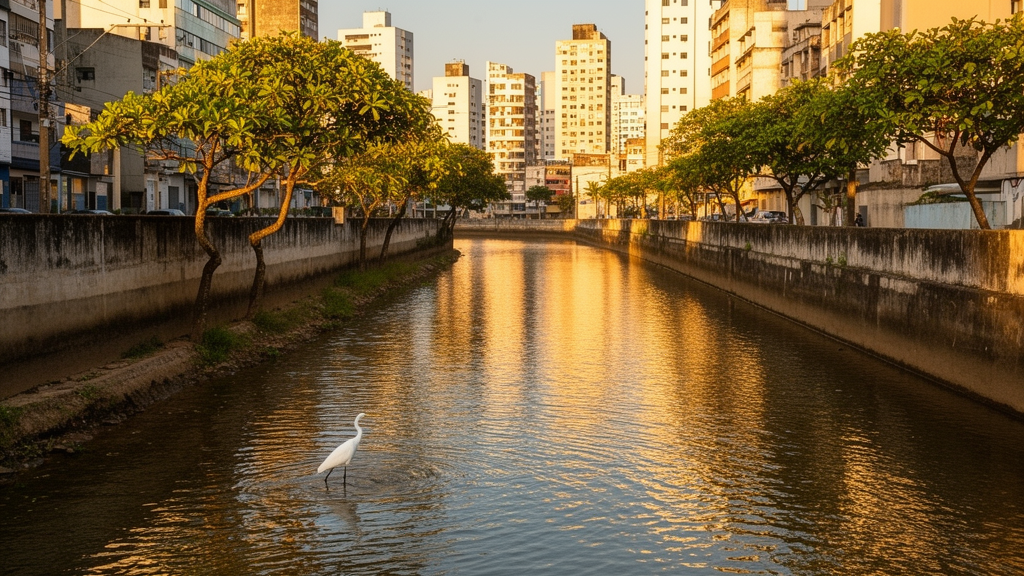
In the rolling ecotone where Brazil’s Atlantic Forest meets the Cerrado savannah, a river basin the size of a mid-sized city has become an unexpected laboratory for one of urban ecology’s most pressing questions: can the places that need nature’s benefits most also be the places that provide them least? A new study of the Monjolinho River Basin, published in the journal One Ecosystem, mapped four indicators of natural value across an urban-to-natural gradient and uncovered a striking pattern. Bird richness, the cooling effect of vegetation and the removal of airborne particulate pollution all climb as landscapes become less urbanised, while nature-based recreation opportunities peak precisely where those benefits collapse, inside the city itself.
The research team, working in São Carlos in the state of São Paulo, focused on a tropical-subtropical basin of roughly 275 square kilometres that contains the municipality’s entire urban core. São Carlos is home to about 222,000 people, 96 percent of whom live in the urban zone, and its surrounding land is split between agricultural areas dominated by sugarcane, native vegetation and city. The region sits in the transition between two of the world’s 25 recognised biodiversity hotspots, making it a particularly sensitive setting for questions about how urban expansion reshapes the services ecosystems deliver.
To capture that reshaping, the researchers selected 43 sampling points along watercourses, spaced at least 200 metres apart and chosen to represent every landscape type in the watershed, from sealed city streets to farmland, peri-urban fringes and intact native vegetation. Around each point they mapped land use and canopy cover within a 500-metre buffer using satellite imagery and field verification. Bird communities were surveyed with the classic point-count method: eight ten-minute visits per point across all four seasons between 2016 and 2017, recording every species seen or heard within a 50-metre radius centred on the watercourse.
Three ecosystem service models completed the picture. The cooling effect was estimated with a model that scores each patch of green infrastructure by soil cover, canopy shading, patch size and regional climate parameters, translating the results into expected temperature differences of up to 4.8 degrees Celsius relative to bare sealed ground. Air pollutant removal was calculated for particulate matter under 10 micrometres in diameter, using a deposition-velocity formula combined with a Leaf Area Index derived from Sentinel-2 satellite imagery processed to one-metre resolution. Recreation opportunities were assessed with an adapted version of the ESTIMAP-Recreation model, which scores access infrastructure such as cycle paths, bus stops and streets alongside facilities like playgrounds and sports fields, then maps the combined opportunity spectrum across the basin.
The results were unambiguous in their spatial pattern. Landscape type significantly influenced all four indicators, and post-hoc comparisons showed that points fully embedded in the urban matrix differed significantly from every other zone. Urban points recorded the lowest mean values for pollutant removal, cooling effect and bird richness, yet the highest mean values for recreation opportunities. Areas dominated by native vegetation, by contrast, stood apart from all other zones in pollutant removal, and the peri-urban transition zone emerged as a biodiversity sweet spot, harbouring higher bird richness than the city while retaining strong regulatory services.
Correlation analysis revealed the underlying architecture of these patterns. Pollutant removal and cooling effect rose together in a strong positive relationship, both driven by canopy cover, and bird richness tracked both of them closely, reflecting the way well-structured vegetation provides habitat as well as shade and leaf surface. But recreation opportunities ran in the opposite direction, showing significant negative correlations with cooling effect, pollutant removal and bird richness alike. This trade-off, the authors note, was unexpected, because the recreation measure was specifically nature-based, and one might expect the sites designed for people to enjoy green space to also be the greenest. Instead, the places people visit most often for leisure are the places where nature’s regulatory machinery is weakest.
The explanation lies in the structure of urban green infrastructure. The vegetation patches inside São Carlos are mostly small fragments, gardens and parks with low canopy cover, sufficient to support access infrastructure but not to generate meaningful cooling or pollution capture. Meanwhile, the demand for those services is highest exactly where they are scarcest, since dense populations and fossil-fuel combustion concentrate both heat and particulate pollution in the urban core. The study also identified a bright spot: a large continuous vegetation fragment belonging to the Federal University of São Carlos and a neighbouring ecological park in the north of the basin, which combines high bird richness, strong regulatory services, recreational trails and at least two springs feeding the Monjolinho River, a textbook example of a multifunctional landscape.
To test whether simple interventions could shift the balance, the team simulated four reforestation scenarios on public land, increasing tree canopy on available non-forested areas by 25, 50, 75 and 100 percent. The available sites amounted to only 1.46 percent of the total basin area, yet the gains were measurable. In the most ambitious scenario, pollutant removal rose by between 2.61 and 7.73 percent depending on the micro-basin, and the cooling effect by between 1.35 and 3.34 percent. A regression model linking vegetation cover to bird species counts in urban and peri-urban zones showed that roughly 39 percent of the variation in bird richness could be explained by forested area alone, suggesting that even modest greening could lift the bird communities that carry pollination, seed dispersal and pest-control functions through the city.
The authors argue that these findings should reshape how planners think about green space. Rather than treating recreation and regulation as competing goals, they propose planning multifunctional landscapes in which reforestation of degraded public land simultaneously boosts cooling, air quality and bird habitat, while targeted infrastructure improvements bring recreation opportunities into the peri-urban and natural zones where the ecological foundation is strongest. Because the analysis was conducted at the scale of individual micro-basins, decision-makers can rank priorities section by section, directing scarce investment to areas such as the Tijuco Preto and Gregório sub-basins, which showed low and medium service levels even after simulated restoration.
The study is candid about its limits. Some models were adapted to local conditions, high-resolution land-cover maps were unavailable, and the recreation assessment relied on OpenStreetMap data verified in the field rather than on structured input from local stakeholders. Even so, the core message stands with unusual clarity for a field often muddied by context: in this Brazilian watershed, the services nature provides and the services people seek are spatially misaligned, and closing that gap is neither mysterious nor expensive. Planting trees on public land that is already idle, the authors conclude, is a simple, near-term nature-based solution that pays dividends for climate, air quality and biodiversity at once, provided planners account for the trade-offs that the landscape itself has already revealed.
Subject of Research: Ecosystem services and bird richness across an urban-to-natural gradient in south-eastern Brazil
Article Title: Bird richness and Ecosystems Services across an urban to natural gradient in south-eastern Brazil: implications for landscape planning and future scenarios
Article References: Lessi, B., Geneletti, D., Cortinovis, C., Dias, M., & Reis, M. (2024). Bird richness and Ecosystems Services across an urban to natural gradient in south-eastern Brazil: implications for landscape planning and future scenarios. One Ecosystem, 9, Article e114955. https://doi.org/10.3897/oneeco.9.e114955
Image Credits: AI Generated
Keywords: ecosystem services, bird richness, urban ecology, Atlantic Forest, Cerrado, nature-based solutions, cooling effect, air pollutant removal, PM10, landscape planning, reforestation, recreation
Cite Scienmag News
Gavin Prescott. (October 19, 2026). Birds and Cooling Breezes Reveal a Hidden Trade-Off in Brazil’s Urban Rivers. Scienmag. https://scienmag.com/birds-and-cooling-breezes-reveal-a-hidden-trade-off-in-brazils-urban-rivers/
Gavin Prescott. "Birds and Cooling Breezes Reveal a Hidden Trade-Off in Brazil’s Urban Rivers." Scienmag, 19 October 2026, https://scienmag.com/birds-and-cooling-breezes-reveal-a-hidden-trade-off-in-brazils-urban-rivers/. Accessed 19 October 2026.
Gavin Prescott. "Birds and Cooling Breezes Reveal a Hidden Trade-Off in Brazil’s Urban Rivers." Scienmag. October 19, 2026. https://scienmag.com/birds-and-cooling-breezes-reveal-a-hidden-trade-off-in-brazils-urban-rivers/


