

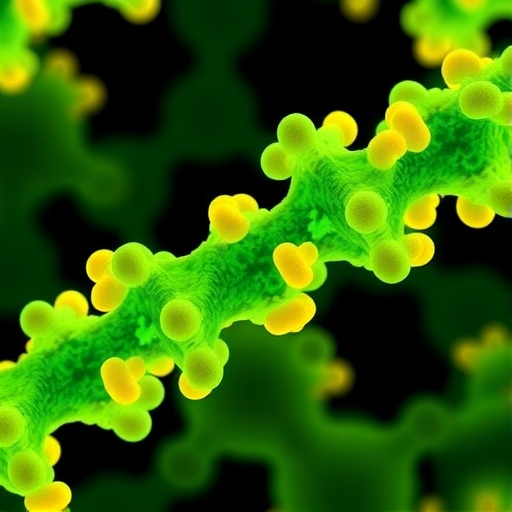
In the intricate world of cellular biology, the assembly of biomolecular structures often reveals astonishing mechanisms that sustain life at the microscopic scale. A newly published study in Nature Plants by Zang, K., Hong, X., Nguyen, N.D., and colleagues (2026) uncovers pivotal insights into the formation of pro-β-carboxysomes, highlighting how biomolecular condensates orchestrate this essential process. This breakthrough offers not only a deeper understanding of photosynthetic efficiency in cyanobacteria but also lays the groundwork for bioengineering innovations targeting carbon fixation pathways.
Biomolecular condensates have emerged as critical players in cellular organization, often acting through liquid-liquid phase separation to assemble complex macromolecular structures without the need for membrane encapsulation. The research team meticulously traced the temporal progression of pro-β-carboxysome assembly, revealing a multistage process driven by the dynamic formation and maturation of these condensates. This study advances the conceptual framework around how protein-protein and protein-RNA interactions guide the spatial-temporal regulation of carboxysome biogenesis.
The pro-β-carboxysome is essential for the carbon concentrating mechanism of cyanobacteria, serving as a proteinaceous microcompartment that enhances Rubisco’s enzymatic efficiency by sequestering and concentrating CO2. Despite their importance, the mechanistic details governing early-stage assembly of these compartments had remained elusive. By utilizing state-of-the-art imaging, biophysical assays, and molecular perturbations, the researchers dissected the nuanced molecular choreography underpinning the early formation of biomolecular condensates. Their observations underscore the importance of specific scaffold proteins that nucleate and stabilize the emerging condensate matrix.
Earlier models posited static assemblies; however, the new findings reveal a dynamic and reversible process characterized by initial nucleation, growth, and eventual condensation into mature pro-β-carboxysomes. Phase separation dynamics facilitate the recruitment and concentration of Rubisco and associated proteins, optimizing the microenvironment to boost carboxylation rates. The team demonstrated how post-translational modifications modulate the interaction landscape, fine-tuning condensate properties to adapt to cellular metabolic states.
One of the most striking revelations is the identification of distinct intermediate condensate states, each with unique biophysical signatures. These states represent checkpoints during assembly, at which the condensate scaffold progressively acquires structural rigidity and biochemical competence. The transition from liquid-like to more gel-like behaviors appears crucial for stabilizing the nascent carboxysome structure while maintaining selective permeability. This phase transition exemplifies the evolutionary sophistication of cellular compartmentalization strategies beyond membrane-bound organelles.
Cutting-edge cryo-electron tomography and fluorescence recovery after photobleaching (FRAP) techniques were instrumental in quantifying these dynamic properties at sub-organelle resolution. By mapping molecular content and mobility simultaneously, the authors constructed a high-resolution timeline of pro-β-carboxysome growth, linking biochemical interactions with emergent structural complexity. These insights challenge canonical views of cellular architecture, advocating for a fluid paradigm of intracellular organization mediated by reversible condensate states.
Moreover, the researchers explored the regulatory cues that initiate and govern condensate formation. Environmental factors such as CO2 concentration and nutrient availability appear to influence the expression and modification of scaffold proteins, effectively coupling external stimuli to intracellular assembly programs. This regulatory flexibility allows cyanobacteria to optimize photosynthetic performance under fluctuating conditions, revealing adaptive molecular strategies with potential translational applications.
The implications of this study extend far beyond cyanobacterial physiology. Understanding the principles of biomolecular condensation in carboxysome assembly opens avenues for synthetic biology, where engineering bespoke condensates could revolutionize metabolic channeling and carbon capture technologies. By replicating or enhancing these natural microcompartments, scientists could create novel bioreactors or improve crop photosynthesis efficiency to meet escalating food and energy demands.
Importantly, this work contributes to the broader field of biomolecular phase separation, which is gaining traction for its role in health and disease. Aberrations in condensate dynamics underpin several neurodegenerative disorders, and lessons from pro-β-carboxysome assembly might inspire therapeutic strategies to modulate pathological phase transitions. Conversely, harnessing controlled condensate formation could optimize protein complexation in pharmaceutical manufacturing and industrial bioprocessing.
The study by Zang and colleagues exemplifies the power of integrated methodologies combining molecular biology, biophysics, and advanced microscopy. Their multidisciplinary approach not only elucidated fundamental biological phenomena but also showcased the evolving landscape of intracellular organization as a highly regulated and dynamic process. These revelations underscore the concept that cellular life is orchestrated through a continuum of molecular interactions finely balanced through phase separation mechanisms.
From fundamental science to applied biotechnology, the findings herald a new chapter in our understanding of cellular compartmentalization without membranes. They encourage future investigations into the universality of biomolecular condensate-mediated assembly across diverse organisms and cellular functions, possibly identifying conserved motifs or mechanisms adaptable for bioengineering.
As the field progresses, it will be critical to decipher how condensate heterogeneity and material properties are fine-tuned in vivo, how molecular crowding influences phase behavior, and how cells integrate these processes with their broader metabolic networks. The pro-β-carboxysome model offers an ideal paradigm to test these questions and extend condensate biology’s conceptual and practical horizons.
In sum, this study not only advances our grasp of carboxysome biogenesis but also redefines our understanding of cellular spatial organization through dynamic biomolecular condensates. By illuminating the stages of pro-β-carboxysome formation, it opens a gateway to novel strategies for engineering more efficient biological systems to address pressing challenges in sustainability, climate change mitigation, and biotechnology innovation. This landmark discovery promises to resonate across multiple scientific disciplines, inspiring a wave of transformative research into the emergent properties of life’s molecular assemblies.
Subject of Research: Biomolecular condensate formation and assembly of pro-β-carboxysomes in cyanobacteria
Article Title: Stages of biomolecular condensate formation in pro-β-carboxysome assembly
Article References:
Zang, K., Hong, X., Nguyen, N.D. et al. Stages of biomolecular condensate formation in pro-β-carboxysome assembly. Nat. Plants (2026). https://doi.org/10.1038/s41477-026-02227-6
Image Credits: AI Generated


