


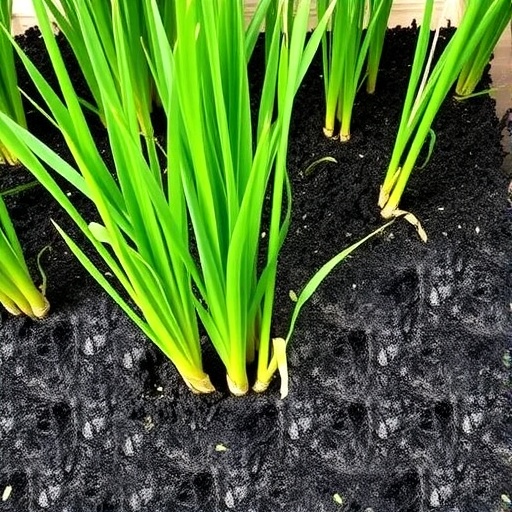
Rice straw management has long been a cornerstone of sustainable agriculture, but a groundbreaking study reveals that converting rice straw into biochar significantly outperforms traditional straw return in tackling the challenges of saline-sodic soils. Conducted over two rice-growing seasons in Baicheng City, Jilin Province, China, this experimental research offers novel insights into how biochar can mitigate salt-induced stress and boost nitrogen use efficiency in rice cultivation.
Saline-sodic soils, marked by high sodium concentrations and alkaline conditions, disrupt plant cellular ion balance, leading to oxidative stress and impaired nutrient uptake. While directly returning rice straw to fields has been a conventional approach to enhance soil health, this method often falls short in these hostile environments due to slow decomposition rates. The recent study, led by Feng Jin and colleagues, demonstrates that biochar derived from rice straw acts not merely as a soil amendment but as a functional agent altering plant physiological responses to salinity stress.
The researchers compared three strategies—straw removal, direct rice straw return, and rice straw biochar return—across four nitrogen fertilizer regimes, including zero application and rates up to 225 kg per hectare. Results showed that biochar application substantially reduced sodium accumulation in rice leaves and decreased the Na⁺/K⁺ ratio, a critical marker of salt-induced damage. Concurrently, biochar enhanced potassium uptake and activated a suite of protective biochemical responses such as elevated soluble proteins, proline content, and antioxidant enzyme activities. These adaptations mitigated oxidative damage, as evidenced by lower levels of malondialdehyde and reactive oxygen species in rice tissues.
Beyond stress tolerance, the study highlighted biochar’s critical role in modulating nitrogen metabolism. Enhanced activities of nitrate reductase, glutamine synthetase, and glutamate synthase enzymes were observed, alongside the upregulation of pivotal nitrogen-related genes including OsNR1, OsNRT1;1, and OsGS1;1. This resulted in a marked improvement in nitrogen use efficiency—biochar treatments boosted total nitrogen accumulation by up to 39.58% and nitrogen utilization efficiency by over 20% relative to straw removal.
Yield benefits mirrored these physiological gains: rice grain production under biochar amendment surpassed straw removal by 16.25% and outperformed direct straw return by 4.04%. Interestingly, direct straw return only demonstrated significant yield improvement in the second year of the experiment, underscoring biochar’s more immediate and robust impact.
Employing structural equation modeling, the team proposed a mechanistic pathway where biochar application alleviates physiological stresses first, thereby enabling enhanced nitrogen metabolism. This cascade ultimately translates into improved nitrogen efficiency and higher yields. Their findings position rice straw biochar combined with a moderate nitrogen input of 225 kg ha⁻¹ as an optimal strategy for rice farming in soda saline-sodic fields.
This research not only opens a new avenue for managing saline soils but also converts agricultural residues into valuable inputs, advancing both environmental sustainability and crop productivity. The study heralds biochar as a transformative amendment capable of reshaping agronomic practices in challenging environments worldwide.
News Publication Date: July 6, 2026
Web References: http://dx.doi.org/10.1007/s42773-026-00619-7
References: Jin, F., Wang, C., Wang, X., et al. Biochar 8, 125 (2026).
Cite Scienmag News
Alan Morgan. (July 9, 2026). Biochar Enhances Rice Straw for Improving Salty Soil Farming. Scienmag. https://scienmag.com/biochar-enhances-rice-straw-for-improving-salty-soil-farming/
Alan Morgan. "Biochar Enhances Rice Straw for Improving Salty Soil Farming." Scienmag, 9 July 2026, https://scienmag.com/biochar-enhances-rice-straw-for-improving-salty-soil-farming/. Accessed 4 September 2026.
Alan Morgan. "Biochar Enhances Rice Straw for Improving Salty Soil Farming." Scienmag. July 9, 2026. https://scienmag.com/biochar-enhances-rice-straw-for-improving-salty-soil-farming/


