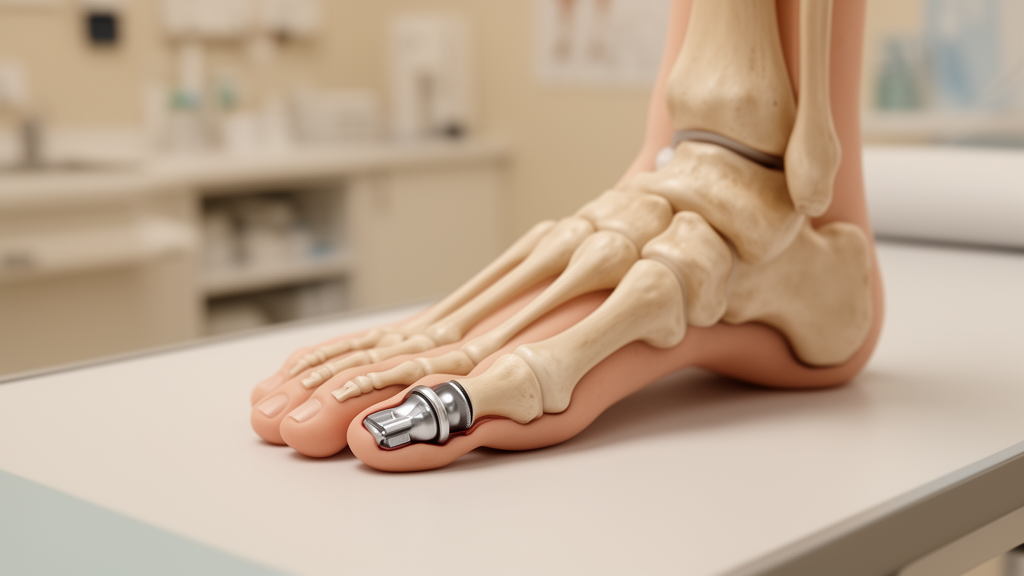
Replacing the arthritic joint at the base of the big toe can deliver large improvements in pain and function, but the implants behind those gains show worrying signs of wear as follow-up lengthens, according to a systematic review and meta-analysis published in the journal Arthroplasty. The review, led by Karthik Chinnaswamy, Archisha Marya and Anand Pillai, pooled outcomes from studies of total first metatarsophalangeal (MTP) joint arthroplasty, a motion-preserving alternative to fusing the joint in patients with hallux rigidus, the most common degenerative disorder of the first MTP joint and a frequent cause of forefoot pain, altered gait and footwear limitation in otherwise active adults.
The researchers searched MEDLINE, Embase and the Cochrane Library on 4 May 2025, covering publications from January 1990 to May 2025. Thirty-two studies met their eligibility criteria, encompassing 960 patients and 1,074 feet. To enter the quantitative synthesis, studies had to include adults with hallux rigidus or first MTP degeneration, evaluate total arthroplasty rather than hemiarthroplasty, interpositional techniques or silicone implants, enrol at least 10 feet, and report a mean follow-up of at least 12 months with at least one prespecified outcome. Fifteen studies provided sufficient data for at least one meta-analysis: twelve contributed to the functional score analysis, seven to the pain analysis and thirteen to the range of motion analysis.
The pooled results were striking for symptom relief. In random-effects models assuming a pre-post correlation of 0.5, total first MTP arthroplasty was associated with a mean improvement of 42.76 points on the American Orthopaedic Foot and Ankle Society Hallux Metatarsophalangeal-Interphalangeal (AOFAS-HMI) score (95% CI 38.44 to 47.09), and a mean reduction of 5.24 points on the visual analogue scale (VAS) pain score (95% CI 3.82 to 6.67). Both pooled estimates were statistically significant and, the authors argue, clinically meaningful, since pain relief is the primary indication for surgery in many patients with advanced disease.
Range of motion told a more complicated story. The pooled gain was 27.02 degrees (95% CI 17.19 to 36.86), but between-study heterogeneity was extreme, with an I-squared of 99.0 percent. Unlike the functional and pain outcomes, the 95 percent prediction interval for motion crossed zero, spanning from minus 9.56 to 63.61 degrees. That statistical detail carries real clinical weight: it means that although the average study reported improved motion, the true effect in a future comparable setting could plausibly be negligible. Individual cohorts illustrate the spread, with some studies reporting arcs improving from the mid-twenties to the low fifties in degrees, while others documented only small, non-significant increases or declines over time after initially favourable early results.
The authors were careful about what their synthesis does and does not show. Because the included studies were predominantly single-arm pre-post designs, the analysis measured improvement from baseline, not superiority over fusion. Prior comparative meta-analyses have suggested that overall clinical outcomes after arthroplasty and arthrodesis are often similar, with pain relief tending to favour arthrodesis, and one long-term comparison reported less pain, greater satisfaction and fewer revisions after fusion at 15 years. The review therefore supports total arthroplasty as a valid motion-preserving option in selected patients, but does not challenge arthrodesis as the most predictable benchmark for advanced disease.
Durability data were the review’s sobering counterweight. Revision, survivorship and complication outcomes were not pooled quantitatively because definitions, denominators and follow-up intervals varied so widely; instead they were reported as crude observational frequencies. Across 32 study entries representing 1,008 operated feet, 101 revisions were recorded, a crude revision proportion of 10.0 percent. Radiographic failure was documented in 14.5 percent of evaluable implants, loosening in 8.6 percent, persistent pain in 7.2 percent and infection in 2.0 percent. The authors stress these are not annualised incidence rates or formal survivorship estimates, and that shorter-term cohorts may miss progressive radiolucency, aseptic loosening, osteolysis and late revision that only emerge with longer surveillance.
Implant-specific trajectories varied dramatically. Early and medium-term studies of the ToeFit-Plus prosthesis reported encouraging gains in pain and function, but longer-term follow-up was far less reassuring: one cohort reported a 21 percent failure or revision rate at a mean of 134 months and concluded the implant should not be recommended, another reported a 24 percent revision rate at a mean of 33 months and discontinued its use, and a third found high long-term revision rates. The ceramic MOJE implant followed a similar arc, with later studies documenting radiographic loosening in over half of cases, a 26 percent reoperation rate, widespread loosening and subsidence at a mean of 44 months, and one series reporting a 16 percent revision rate with implant survival falling to 68 percent at nine years. By contrast, one Rotoglide series reported no aseptic loosening and 91.5 percent survival at 15 years.
The evidence base itself carries heavy caveats. Most included studies were Level III-IV evidence, mainly retrospective case series and single-arm prospective cohorts, with only one randomised trial. Risk-of-bias assessment using the ROBINS-I tool judged most non-randomised studies to be at serious or critical overall risk of bias, driven by participant selection, lack of comparators, single-centre and single-surgeon designs and inconsistent outcome reporting. The authors note that uncontrolled observational studies may overestimate treatment effects through selection bias, regression to the mean and incomplete outcome reporting, and they explicitly state that the pooled estimates should not be used to support routine arthroplasty or to recommend any specific implant system.
Heterogeneity extended to the implants themselves. The pooled figures blend multiple implant families, generations, materials and fixation strategies, making them mixed-technology averages rather than the performance of any single platform. Planned subgroup analyses by implant material were abandoned because ceramic implants appeared in only 2 of 12 functional-score studies, 2 of 7 pain studies and 3 of 13 motion studies, leaving formal subgroup synthesis underpowered and potentially misleading. Definitions of survivorship and failure also varied, with some studies counting implant retention, others any reoperation and others only conversion to fusion, and favourable cohorts often used strict selection criteria excluding severe deformity, poor bone stock, inflammatory arthritis and significant hallux valgus.
Where does this leave patients and surgeons? The authors suggest total first MTP arthroplasty is most appropriately considered in older or lower-demand patients with end-stage hallux rigidus who prioritise preserving joint motion for footwear choice or lower-impact activities, with adequate bone stock, stable first-ray mechanics and minimal fixed deformity. Arthrodesis remains the more predictable option for younger or high-demand patients, those needing durable stability, and patients with substantial deformity, instability or neuropathy. Because failed arthroplasty can leave bone loss, subsidence and soft-tissue compromise that make salvage more complex than primary fusion, the authors call for implant-specific prospective comparative studies, standardised definitions of survivorship and failure, and longer follow-up of contemporary designs before the role of big toe replacement can be defined more clearly.
Subject of Research: Clinical outcomes and implant durability of total first metatarsophalangeal joint arthroplasty for hallux rigidus
Article Title: Outcomes after total first metatarsophalangeal joint arthroplasty for hallux rigidus: a systematic review and meta-analysis
Article References: Chinnaswamy, K., Marya, A., & Pillai, A. (2026). Outcomes after total first metatarsophalangeal joint arthroplasty for hallux rigidus: a systematic review and meta-analysis. Arthroplasty, 8(1), Article 73. https://doi.org/10.1186/s42836-026-00433-3
Image Credits: AI Generated
DOI: 10.1186/s42836-026-00433-3
Keywords: hallux rigidus, first metatarsophalangeal joint, total joint arthroplasty, systematic review, meta-analysis, AOFAS-HMI score, visual analogue scale pain, range of motion, implant revision, arthrodesis, implant survivorship, foot and ankle surgery
Cite Scienmag News
Ophelia Keating. (October 29, 2026). Big toe replacement eases pain, but implants falter over time, review finds. Scienmag. https://scienmag.com/big-toe-replacement-eases-pain-but-implants-falter-over-time-review-finds/
Ophelia Keating. "Big toe replacement eases pain, but implants falter over time, review finds." Scienmag, 29 October 2026, https://scienmag.com/big-toe-replacement-eases-pain-but-implants-falter-over-time-review-finds/. Accessed 29 October 2026.
Ophelia Keating. "Big toe replacement eases pain, but implants falter over time, review finds." Scienmag. October 29, 2026. https://scienmag.com/big-toe-replacement-eases-pain-but-implants-falter-over-time-review-finds/