


(Toronto, May 6, 2024) A new study published in JMIR Mental Health sheds light on the promising role of virtual reality (VR) in treating major depressive disorder (MDD). Titled “Examining the Efficacy of Extended Reality–Enhanced Behavioral Activation for Adults With Major Depressive Disorder: Randomized Controlled Trial,” the research, led by Dr Margot Paul and team from Stanford University, unveiled the effectiveness of extended reality (XR)–enhanced behavioral activation (XR-BA) in easing symptoms of depression.

Credit: Source: Image created by JMIR Publications/Authors
Copyright: JMIR Publications
License: Creative Commons Attribution (CC-BY)
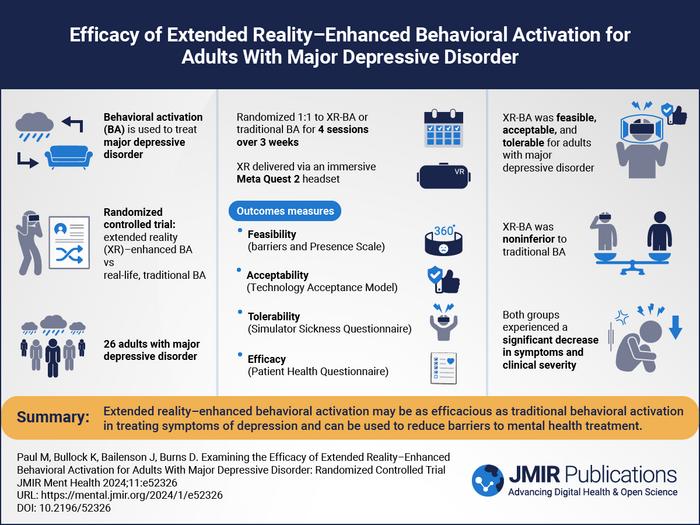
(Toronto, May 6, 2024) A new study published in JMIR Mental Health sheds light on the promising role of virtual reality (VR) in treating major depressive disorder (MDD). Titled “Examining the Efficacy of Extended Reality–Enhanced Behavioral Activation for Adults With Major Depressive Disorder: Randomized Controlled Trial,” the research, led by Dr Margot Paul and team from Stanford University, unveiled the effectiveness of extended reality (XR)–enhanced behavioral activation (XR-BA) in easing symptoms of depression.
MDD affects millions worldwide, and access to evidence-based psychotherapies remains a challenge for many. Traditional treatments often face barriers, prompting researchers to explore innovative solutions. XR, which includes VR, encompasses various immersive technologies involving computer-generated environments that blend physical and digital worlds. Leveraging the immersive power of XR, this study explored XR-BA as a potential game-changer in MDD treatment.
Dr Paul and team conducted a randomized controlled trial among 26 outpatients with MDD receiving remote care. Using a VR Meta Quest 2 headset, the participants engaged in simulated pleasant or mastery activities, including playing a magical VR board game, deciphering clues to solve puzzles, dancing to music, and playing mini golf alone or with friends. Though the learning curve for using the headset was high, participants reported that the experience became more enjoyable and useful over time.
The results were comparable to traditional behavioral activation delivered via telehealth. Both XR-BA and traditional behavioral activation helped reduce the severity of depression in a significant way, as measured by the Patient Health Questionnaire–9. Moreover, the findings suggest that individuals in the XR-BA group might have experienced a heightened expectancy or placebo response because of the novelty of the technology and implicit beliefs regarding mental health treatment.
“These results indicate that XR may help to de-stigmatize mental healthcare and reduce barriers to individuals seeking care. Clinicians could use XR as a treatment tool to help motivate clients to actively participate in their psychotherapy treatment by completing ‘homework’ that is novel, fun, and accessible,” remarked Dr Paul.
The study underscores the potential of VR, particularly XR-BA, in revolutionizing depression treatment by offering efficacy akin to traditional therapy. This is a promising avenue for enhancing treatment outcomes and addressing barriers to accessing evidence-based psychotherapies for MDD, potentially expanding care for affected individuals. Additionally, the exploration of XR’s capacity to amplify placebo effects hints at the transformative possibilities of technology-assisted mental health therapies.
Please cite as:
Paul M, Bullock K, Bailenson J, Burns D
Examining the Efficacy of Extended Reality–Enhanced Behavioral Activation for Adults With Major Depressive Disorder: Randomized Controlled Trial
JMIR Ment Health 2024;11:e52326
###
About JMIR Publications:
JMIR Publications is a renowned publisher with a long-standing commitment to advancing digital health research and progressing open science. Our portfolio includes a wide array of prestigious open access, peer-reviewed journals dedicated to the dissemination of high-quality research in the field of digital health. JMIR Publications is celebrating its 25th anniversary in 2024 as the leading open access, digital health publisher.
To learn more about JMIR Publications, please visit jmirpublications.com or connect with us via Twitter, LinkedIn, YouTube, Facebook, and Instagram.
Head office: 130 Queens Quay East, Unit 1100, Toronto, ON, M5A 0P6 Canada
Media contact: communications@jmir.org
The content of this communication is licensed under the terms of the Creative Commons Attribution License (https://creativecommons.org/licenses/by/4.0/), which permits unrestricted use, distribution, and reproduction in any medium, provided the original work, published by JMIR Publications, is properly cited.
Journal
JMIR Mental Health
DOI
Method of Research
Randomized controlled/clinical trial
Subject of Research
People
Article Title
Examining the Efficacy of Extended Reality–Enhanced Behavioral Activation for Adults With Major Depressive Disorder: Randomized Controlled Trial
Article Publication Date
15-Apr-2024
Cite Scienmag News
Glenn Wilkins. (May 6, 2024). Beyond therapy: Virtual reality shows promise in fighting depression. Scienmag. https://scienmag.com/beyond-therapy-virtual-reality-shows-promise-in-fighting-depression/
Glenn Wilkins. "Beyond therapy: Virtual reality shows promise in fighting depression." Scienmag, 6 May 2024, https://scienmag.com/beyond-therapy-virtual-reality-shows-promise-in-fighting-depression/. Accessed 3 September 2026.
Glenn Wilkins. "Beyond therapy: Virtual reality shows promise in fighting depression." Scienmag. May 6, 2024. https://scienmag.com/beyond-therapy-virtual-reality-shows-promise-in-fighting-depression/

