


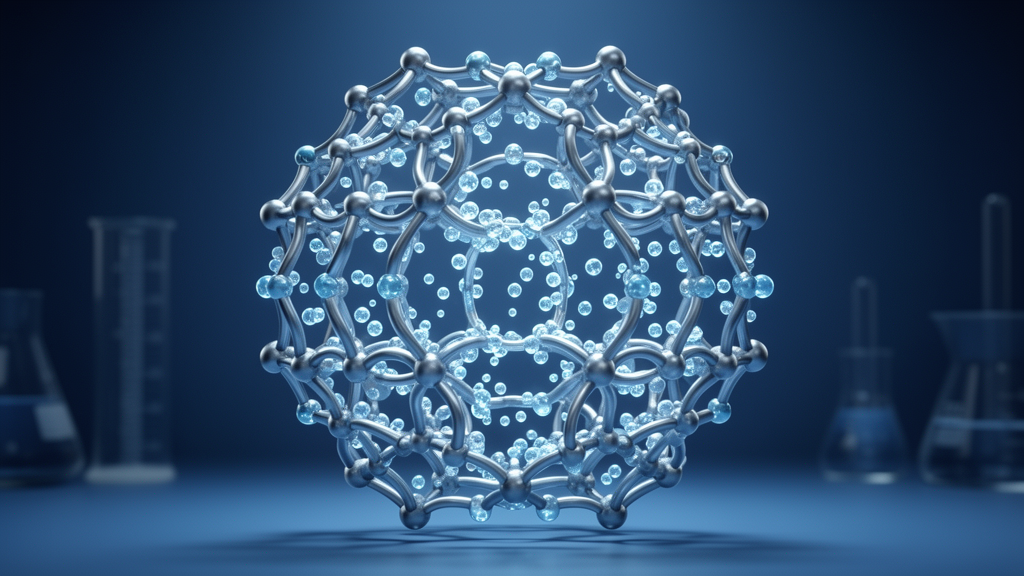
Chemists at the University of Cambridge and their collaborators have built a metal–organic framework with one of the highest surface areas ever measured, using a design trick that sounds almost contradictory: they made the rigid scaffold flexible. The new material, named CU-6, exists in two versions, CU-6-Fe and CU-6-Cr, and can soak up extraordinary quantities of hydrogen and methane, the two clean-burning fuels most often proposed to replace petrol and diesel in trucks, ships and aircraft. Reported in Nature Synthesis, the work demonstrates that a long-predicted but never-before-realised network geometry, known as the red topology, can finally be constructed in the laboratory — and that the key to building it was choosing molecular building blocks that know how to bend.
Metal–organic frameworks, or MOFs, are crystalline materials in which metal clusters are connected by organic linkers into vast, sponge-like lattices. Because their pores can be designed with atomic precision, MOFs have become leading candidates for storing gases at moderate pressures, offering a safer alternative to compressing hydrogen to extreme pressures or chilling it into a liquid. The central challenge is that hydrogen molecules interact only weakly with any surface, so the best adsorbents must combine enormous internal surface area with carefully engineered pore sizes. The most porous MOFs reported to date, such as DUT-60 with 8,890 square metres per gram and NU-1501-Al with 7,241 square metres per gram, have pushed these limits, but each new record demands ever more sophisticated structural design.
The Cambridge team, led by David Fairen-Jimenez together with colleagues at Peking University, Stockholm University, the ISIS Neutron and Muon Source, Diamond Light Source and Synchrotron SOLEIL, approached the problem through reticular chemistry — the discipline of assembling multi-topic organic linkers and inorganic nodes into predetermined network topologies. Their target was the augmented red net, a three-dimensional arrangement theoretically derived from the parent reo net that contains three distinct types of polyhedral cavity: distorted cubes, cuboctahedra and rhombicuboctahedra. Although computational studies had predicted that this topology should be accessible, no one had managed to synthesise it as a pure crystalline phase, largely because the geometry demands that four-connected linkers adopt two different conformations simultaneously — one essentially planar and one noticeably bent out of plane.
Using two different rigid linkers to satisfy these two geometries tends to produce messy mixtures of competing crystalline phases. The researchers’ solution was elegant: a single linker that could switch between both shapes. They selected a diphenylethyne core, in which two phenyl rings are joined by a rigid carbon–carbon triple bond. While the ethynyl spacer itself is linear and stiff, rotation and bending of the adjacent phenyl rings give the molecule enough conformational freedom to accommodate different coordination geometries and framework curvatures. The team designed five candidate linkers of increasing length and evaluated them with density functional theory calculations, plotting total energy as a function of bending angle. Three of the candidates preferred to stay linear, with energy rising monotonically as they bent. But two of them, H4L3 and H4L5, actually became more stable when bent, reaching energy minima at 15 and 21 degrees respectively before the cost of further distortion kicked in.
H4L3, chosen for its simpler synthesis and its potential to yield a denser framework, was combined with six-connected, oxo-centred trinuclear metal clusters. Heating the linker with iron chloride and 4-nitrobenzoic acid in dimethylformamide produced red cubic single crystals of CU-6-Fe. A postsynthetic metathesis reaction, in which iron ions were exchanged for chromium, delivered the green crystals of CU-6-Cr. Synchrotron single-crystal X-ray diffraction revealed that CU-6-Cr crystallises in the cubic space group P-43m with a colossal unit cell edge of just over 50 nanometres — a hundred times larger than a typical molecular crystal. Within the structure, the linkers indeed adopted two crystallographically distinct conformations, bent by roughly 3 and 13 degrees out of plane, exactly as the design logic required.
The resulting architecture is a marvel of hierarchical porosity. Six pairs of cubic building blocks assemble into rhombicuboctahedral cavities with internal diameters of 4.1 nanometres, while stacking of eight neighbouring rhombicuboctahedra generates cuboctahedral cavities of 2.6 nanometres, and the distorted cubic pores themselves measure 1.6 by 2.4 by 2.4 nanometres. Triangular and square windows, framed by the planar and bent linkers respectively, interconnect all three cavity types into a continuous three-dimensional network. Calculations using a probe radius of 1.2 angstroms showed that 89.7 per cent of the crystal volume is accessible to guest molecules. Low-dose scanning transmission electron microscopy, in both annular dark-field and integrated differential phase contrast modes, directly visualised the ordered porous structure despite the crystals’ extreme sensitivity to electron beams, and powder X-ray diffraction confirmed the bulk samples were pure phases.
The measured porosity is staggering. CU-6-Fe achieved a Brunauer–Emmett–Teller surface area of 7,145 square metres per gram, satisfying all five extended-Rouquerol criteria for reliable surface-area determination, while CU-6-Cr reached 6,488 square metres per gram. Total pore volumes were 4.14 and 3.67 cubic centimetres per gram, with bulk densities of just 0.214 and 0.240 grams per cubic centimetre. When the team measured high-pressure hydrogen adsorption at 77 kelvin, CU-6-Fe took up 17.5 weight per cent at 100 bar and CU-6-Cr 15.9 weight per cent, with volumetric uptakes of 45.4 and 45.5 grams per litre. Under a realistic temperature–pressure swing cycle, from 77 kelvin and 100 bar down to 160 kelvin and 5 bar, the materials delivered 16.9 and 15.4 weight per cent gravimetrically and about 44 grams per litre volumetrically — figures that exceed the US Department of Energy’s 2025 system-level targets of 5.5 weight per cent and 40 grams per litre, albeit at cryogenic rather than ambient temperatures.
The methane results were equally striking. At 80 bar, CU-6-Fe stored 0.67, 0.59 and 0.53 grams of methane per gram of adsorbent at 273, 288 and 298 kelvin respectively, with CU-6-Cr close behind. These are among the highest gravimetric methane capacities ever reported and surpass the Department of Energy’s gravimetric target of 0.5 grams per gram at room temperature. The working capacity between 80 and 5 bar reached 0.49 grams per gram for CU-6-Fe at 298 kelvin, comfortably outperforming benchmark materials such as NU-1501-Al and the ultraporous covalent organic framework 3D-TFB-COF-Me. The researchers are candid about the trade-off: because the crystals are so light and porous, their volumetric methane capacities fall short of denser benchmark MOFs, a limitation inherent to ultrahigh-porosity adsorbents.
Computational and neutron experiments revealed exactly where the gas molecules sit. Grand canonical Monte Carlo simulations identified three main hydrogen adsorption regions, and in situ neutron powder diffraction on deuterium-loaded CU-6-Cr confirmed five distinct adsorption sites within the cavities. The dominant site, with an occupancy of 0.73, lies near the trinuclear metal cluster inside the cubic cavity, while secondary sites cluster around the phenyl and ethyne groups of the linkers. Density functional calculations established the energetic hierarchy: adsorption near the metal clusters is favoured at roughly minus 11 kilojoules per mole, compared with minus 2.4 kilojoules per mole at linker sites. This weak-but-preferential binding is precisely what enables both high total uptake and high deliverable capacity, since gas stored too strongly cannot be released on demand.
Stability data add to the material’s practical promise. CU-6-Cr retained its porosity after three months in an inert argon atmosphere and after 24 hours of exposure to ambient air, and its framework remained largely intact after exposure to water vapour — a notable achievement for a MOF of such extreme porosity. CU-6-Fe proved more fragile, losing about 20 per cent of its nitrogen uptake after a month in a glovebox, although X-ray absorption spectroscopy confirmed its iron coordination environment survived the hydrogen storage measurements unchanged. Beyond the headline numbers, the deeper significance of the work lies in its design principle: linker flexibility, long treated as a nuisance in crystal engineering, emerges as an essential, predictable parameter for constructing complex topologies. By matching conformationally adaptive molecules to demanding geometric targets, the Cambridge-led team has opened a route to an entire family of previously unreachable, ultraporous frameworks — and established the red net as a serious platform in the race to store the fuels of a carbon-neutral future.
Subject of Research: Hierarchically porous metal–organic frameworks with red topology for hydrogen and methane storage
Article Title: Hierarchically porous metal–organic frameworks with red topology for hydrogen and methane storage
Article References: Chen, X., Wee, L. H., Alizadeh Kiapi, M. R., Tampaxis, C., Fan, J., MacLeod, H. W., Zheng, Y., Moore, B. J., Manuel, P., Orlandi, F., Keenan, L. L., Zhang, E., Asgari, M., Menon, D., Charalambopoulou, G., Willhammar, T., Yang, S., Shepard, W., Cui, Y., … Fairen-Jimenez, D. (2026). Hierarchically porous metal–organic frameworks with red topology for hydrogen and methane storage. Nature Synthesis. https://doi.org/10.1038/s44160-026-01163-9
Image Credits: AI Generated
DOI: 10.1038/s44160-026-01163-9
Keywords: metal-organic frameworks, hydrogen storage, methane storage, reticular chemistry, red topology, porous materials, clean energy, linker flexibility, gas adsorption, crystal engineering, neutron diffraction, surface area
Cite Scienmag News
Bethany Barker. (October 8, 2026). Bendy molecular linkers unlock record-breaking porous crystals for hydrogen storage. Scienmag. https://scienmag.com/bendy-molecular-linkers-unlock-record-breaking-porous-crystals-for-hydrogen-storage/
Bethany Barker. "Bendy molecular linkers unlock record-breaking porous crystals for hydrogen storage." Scienmag, 8 October 2026, https://scienmag.com/bendy-molecular-linkers-unlock-record-breaking-porous-crystals-for-hydrogen-storage/. Accessed 8 October 2026.
Bethany Barker. "Bendy molecular linkers unlock record-breaking porous crystals for hydrogen storage." Scienmag. October 8, 2026. https://scienmag.com/bendy-molecular-linkers-unlock-record-breaking-porous-crystals-for-hydrogen-storage/


