


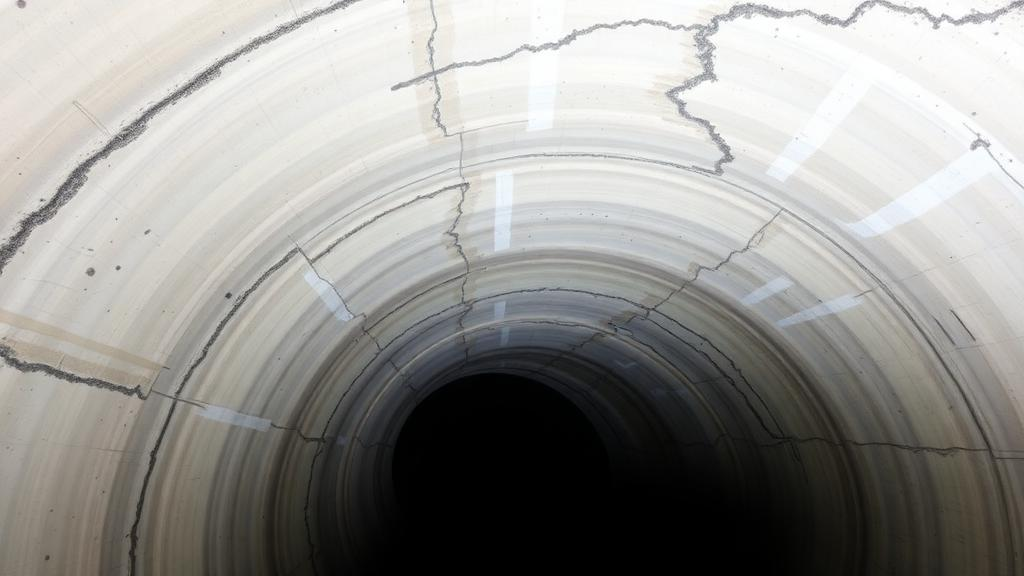
Tunnels are among the most unforgiving environments in civil engineering. Buried beneath mountains and cities, their concrete linings endure crushing rock pressure, temperature swings, and decades of fatigue loading, all hidden from view until something goes wrong. Conventional concrete, strong in compression but weak and brittle in tension, is prone to cracking, spalling, and in the worst cases sudden structural collapse. A new study published in Case Studies in Construction Materials offers a detailed experimental and numerical case for replacing that brittle material with engineered cementitious composites, or ECC, a fiber-reinforced concrete that bends rather than shatters, and the results quantify just how much safer tunnels could become.
The research team, led by Bingbing Liu with Fang Chai, Shuai Tian, and Haijun Liu, built ten groups of scaled-down tunnel lining specimens at a 1:25 geometric ratio, systematically varying three design parameters that engineers rarely optimize together: the thickness of the protective concrete cover over the steel reinforcement, the reinforcement ratio, and the position of the rebar within the lining cross-section. Cover thicknesses of 2, 4, and 6 millimeters in the models correspond to 50, 100, and 150 millimeters in a full-scale tunnel, spanning the conventional range used in real construction. Reinforcement ratios of 0, 0.8, and 1.6 percent were tested, with bars placed on the inner face, the outer face, or both sides simultaneously. Three specimens were cast for each condition, yielding thirty linings in total.
The ECC mix itself is a carefully engineered blend of cement, fly ash, silica fume, fine sand, and short polyethylene fibers just 22 micrometers in diameter and 16 millimeters long, with a water-binder ratio of 0.2. After 28 days of standard curing, the material achieved a compressive strength of 67.1 megapascals and, critically, a tensile strength of 4.5 megapascals with an elastic modulus of 26.1 gigapascals. Unlike ordinary concrete, which cracks catastrophically once tensile capacity is exceeded, ECC exhibits strain-hardening: the fibers bridge emerging cracks and force the material to develop many fine, evenly distributed micro-cracks instead of one fatal fracture, sustaining strains beyond 5 percent in ideal conditions.
When the specimens were loaded to failure in an electro-hydraulic servo testing machine using an arc-shaped plate that simulates uniform surrounding rock pressure, the difference between reinforced and unreinforced ECC linings was stark. The unreinforced control specimens failed in brittle crushing: fine cracks appeared at the arch crown at 70 to 80 percent of peak load, then raced outward with local spalling before large-scale collapse. Their mean peak load was just 28.0 kilonewtons, with a maximum crack width of 0.80 millimeters. Every reinforced specimen, by contrast, failed in a ductile manner, with cracks initiating earlier but growing slowly and steadily, giving unmistakable warning before ultimate failure.
The numbers behind that ductility are striking. Double-layer reinforced specimens with 1.6 percent reinforcement reached peak loads of 49.5, 64.8, and 68.2 kilonewtons as cover thickness increased from 2 to 6 millimeters, more than double the unreinforced capacity, while maximum crack widths stayed between 0.17 and 0.23 millimeters. Outer reinforcement proved consistently superior to inner reinforcement: at equal cover thickness, outer-reinforced specimens carried peak loads 11.9 to 14.6 percent higher than their inner-reinforced counterparts and 50.0 to 71.9 percent higher than unreinforced linings. The reason is geometric. Placing steel closer to the tensile zone allows the bars to restrain crack opening directly where cracks begin, so the ECC matrix keeps generating new fine cracks over a wider area instead of concentrating damage.
To capture this collaboration between fiber matrix and steel, the team introduced a confinement coefficient that compares rebar strain to the surrounding ECC strain at the haunch, spandrel, and arch springing. Outer-reinforced linings achieved an average coefficient of 0.78 against 0.65 for inner-reinforced ones, and the coefficient peaked at 0.85 for the specimen with a 4-millimeter cover, the sweet spot where the bond area is sufficient but the restraint is not delayed by an overly thick layer of cover. Too thin a cover allowed crack development to disturb the steel-ECC bond, dropping the coefficient to 0.70, while a 6-millimeter cover delayed load transfer and reduced it to 0.76. Notably, the high ductility and bonding quality of ECC prevented any debonding between steel and matrix even as cracks propagated.
Strain measurements across five key sections, from arch crown to inverted arch, confirmed that the linings deform the way real tunnels do, with crown settlement, horizontal expansion at the haunches, and modest invert uplift. Even after yielding began, strain growth accelerated smoothly without abrupt jumps, meaning no brittle strain localization occurred even at ultimate load. The unreinforced specimens showed poor strain uniformity, while reinforced linings distributed stress far more evenly, with the best uniformity in the double-reinforced, 4-millimeter-cover configuration. Internal force calculations showed peak axial forces at the arch springing and maximum positive bending moments at the haunch, and revealed that linings built without outer reinforcement fail before the full strength of the steel and ECC can be mobilized, a construction practice the authors explicitly flag as unreasonable.
Because laboratory specimens at 1:25 scale cannot directly substitute for full-size tunnel design, the researchers built a validated finite element model using a Modified Kent-Park constitutive law for ECC, an elastic-perfectly plastic model for the HRB400 steel, and a Mohr-Coulomb model for grade IV surrounding rock. The simulation reproduced experimental cracking loads, crack widths, peak loads, elastic stiffness, and ultimate displacements with errors of at most 7.21 percent, well within the 10 percent accuracy target, and correctly captured the characteristic strain patterns of each reinforcement arrangement. A full-scale model of a 600-millimeter-thick ECC lining then showed compressive and tensile safety factors at every key section comfortably above the code minimums of 2.4 and 3.6, with the haunch emerging as the most critical section.
The most consequential comparison came against a conventional C60 concrete lining of identical geometry, reinforcement, and loading. The ECC lining’s compressive safety factors exceeded the ordinary concrete lining’s by 29.4 to 65.9 percent across all sections, and its tensile safety factors by 48.4 to 75.0 percent. The ordinary lining fell below the tensile safety threshold at the crown, spandrel, and haunch, and its failure mode was brittle: once tensile cracks penetrated, capacity dropped suddenly with almost no residual strength and an ultimate displacement of only 5.5 millimeters. The ECC lining, by contrast, deformed to 11.2 millimeters with a gradual load decline, providing the visible deformation warning that separates a repairable incident from a fatal collapse.
The authors are candid about limits. Their conclusions rest on 1:25 scale models within reinforcement ratios of 0 to 1.6 percent and covers of 2 to 6 millimeters, and size effects, long-term service performance, and life-cycle economics remain to be verified at larger scales. Still, the study delivers something tunnel engineering has lacked: a combined experimental and numerical demonstration that cover thickness, reinforcement ratio, and rebar position can be co-optimized, with double-layer reinforcement and a moderate cover emerging as the safest configuration. As underground construction pushes deeper into difficult geology, a lining material that cracks finely, warns visibly, and outperforms conventional concrete in every safety metric may prove one of the most practical upgrades in modern infrastructure.
Subject of Research: Structural performance and safety enhancement of engineered cementitious composite tunnel linings
Article Title: Study on structural performance and safety enhancement of ECC tunnel linings: Experimental and numerical investigations
Article References: Liu, B., Chai, F., Tian, S., & Liu, H. (2026). Study on structural performance and safety enhancement of ECC tunnel linings: Experimental and numerical investigations. Case Studies in Construction Materials, 25, Article e06579. https://doi.org/10.1016/j.cscm.2026.e06579
Image Credits: AI Generated
DOI: 10.1016/j.cscm.2026.e06579
Keywords: engineered cementitious composites, tunnel lining, ECC, ductile failure, reinforcement ratio, protective layer thickness, confinement coefficient, finite element simulation, safety factor, polyethylene fibers, infrastructure safety, construction materials
Cite Scienmag News
Denise Maddox. (October 3, 2026). Bendable Concrete Could Make Tunnels Far Safer, New Tests Show. Scienmag. https://scienmag.com/bendable-concrete-could-make-tunnels-far-safer-new-tests-show/
Denise Maddox. "Bendable Concrete Could Make Tunnels Far Safer, New Tests Show." Scienmag, 3 October 2026, https://scienmag.com/bendable-concrete-could-make-tunnels-far-safer-new-tests-show/. Accessed 4 October 2026.
Denise Maddox. "Bendable Concrete Could Make Tunnels Far Safer, New Tests Show." Scienmag. October 3, 2026. https://scienmag.com/bendable-concrete-could-make-tunnels-far-safer-new-tests-show/


