


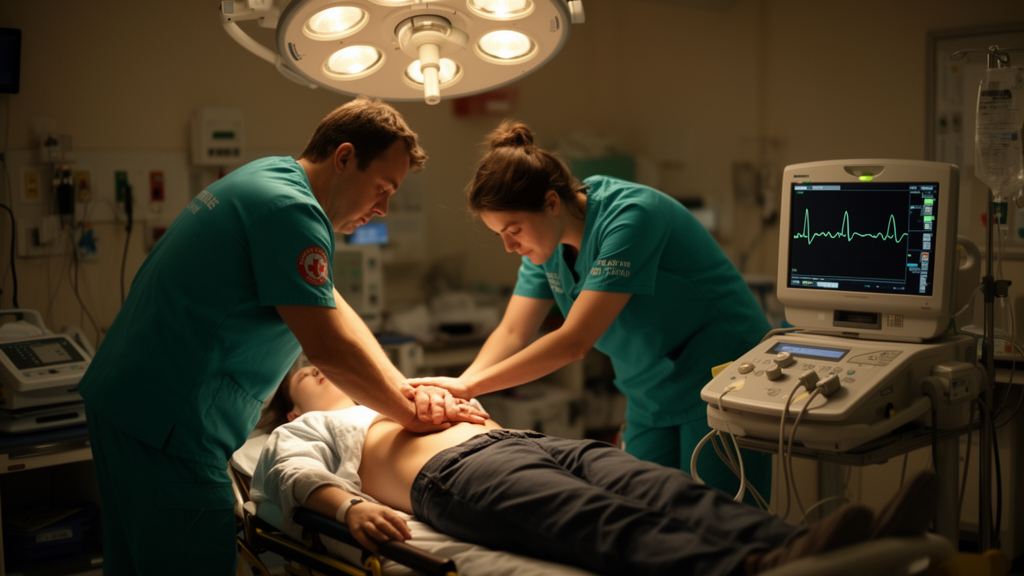
When a person’s heart stops, every second of delay in restoring circulation slashes the odds of survival. For more than six decades, the backbone of resuscitation has been standard cardiopulmonary resuscitation, or STD-CPR: rhythmic chest compressions that squeeze the heart between the sternum and the spine to push blood toward the brain and vital organs. It works, but imperfectly. Manual chest compressions generate only a fraction of normal cardiac output, and fatigue degrades compression quality within minutes. That persistent gap between what standard CPR delivers and what a dying brain needs has driven researchers to experiment with mechanical alternatives for decades. One of the more intriguing proposals is active abdominal compression-decompression CPR, abbreviated AACD-CPR, a technique that recruits the large, muscular cavity of the abdomen as a second pump in series with the chest.
The concept is physiologically elegant. In AACD-CPR, a rescuer or device applies compressions to the abdomen and then actively pulls upward to create negative pressure, or decompression, between compressions. The abdominal compression phase raises intra-abdominal pressure and pushes blood forward through the aorta while also squeezing the venous reservoir of the splanchnic circulation. The active decompression phase then expands the abdominal compartment, potentially drawing venous blood back toward the heart and enhancing filling of the right atrium for the next cycle. Proponents have argued that this push-pull action on the abdomen could augment venous return, improve coronary and cerebral perfusion pressures, and even assist ventilation, addressing several of the hemodynamic shortcomings of chest compressions alone. Until now, however, the clinical evidence for the technique has been scattered across small trials of varying quality, making it difficult for guideline committees to draw firm conclusions.
A new systematic review and meta-analysis published in Scientific Reports by Ruifang Cui, Xiaopeng Liu, Xiaoqing Yang, Yifan Huang, Xiaozhan Yang, and Sisen Zhang, researchers affiliated with the Fifth Clinical Medical College of Henan University of Chinese Medicine and collaborating institutions in Zhengzhou, China, set out to settle the question. The team systematically searched eleven electronic databases from their inception through November 2025, identifying eight randomized controlled trials that compared AACD-CPR directly with standard CPR in adults experiencing cardiac arrest. The analysis was conducted in RevMan 5.4.1, and the authors applied the GRADE framework, the grading of recommendations assessment, development, and evaluation system, to rate how much confidence readers should place in each finding. The outcomes they examined spanned the full resuscitation cascade: return of spontaneous circulation, commonly called ROSC, survival at two weeks, neurological outcomes, hemodynamic parameters, arterial blood gas values, oxygen metabolism measures, and adverse events such as injuries caused by the procedure itself.
The headline result is cautiously encouraging. Across the pooled trials, patients receiving AACD-CPR were more likely to achieve return of spontaneous circulation than those receiving standard CPR, and when their hearts did restart, it happened sooner. Time to ROSC matters enormously in resuscitation research, because the duration of no-flow and low-flow states is one of the strongest determinants of whether a survivor walks out of the hospital with an intact brain. A technique that reliably shortens the interval from collapse to a perfusing rhythm would be a meaningful advance even if other endpoints moved more slowly. The finding that AACD-CPR accelerated ROSC therefore stands out as the most clinically significant signal in the analysis, and it aligns with the physiological rationale that abdominal pumping improves circulation during the critical early minutes of an arrest.
But the review is equally notable for what it did not find. Survival at two weeks did not differ significantly between the two techniques. That disconnect, between a physiological endpoint that improves and a survival endpoint that does not, is a familiar pattern in resuscitation science. Achieving ROSC is a necessary step on the path to survival, yet many patients who regain a pulse later die in the intensive care unit from post-arrest organ injury, or survive with devastating neurological damage. A method that helps more hearts restart may still fail to move the needle on two-week survival if the underlying injury burden is too great or if the improved circulation is not sustained long enough to protect the brain. The authors are explicit that the current evidence remains insufficient to support broader clinical implementation of AACD-CPR, and they call for larger multicenter randomized trials powered to detect differences in survival to hospital discharge, long-term survival, and neurologically favorable survival.
The exploratory physiological findings add texture to the picture, though the authors handle them with appropriate caution. Several hemodynamic, arterial blood gas, and oxygen metabolism parameters showed between-group differences favoring the abdominal technique, consistent with the idea that AACD-CPR improves perfusion and oxygen delivery. However, these estimates carried heavy caveats. Substantial statistical heterogeneity was present across studies, meaning the trials disagreed with one another more than would be expected from chance alone, and many of the pooled estimates rested on only two or three small studies. In meta-analysis, heterogeneity of that magnitude can arise from differences in how the intervention was delivered, how arrest rhythms were defined, how quickly treatment began, or how outcomes were measured, and it makes any single pooled number difficult to interpret. The GRADE assessment reflected this fragility: the certainty of evidence across outcomes ranged from very low to moderate, a span that signals how far the field remains from definitive answers.
Safety is the other half of the equation, and here the review offers a genuinely surprising observation. Rib fractures, a well-known and frequent complication of forceful chest compressions, were reported less often in the AACD-CPR groups in two of the included studies. The finding makes mechanical sense, since shifting part of the pumping workload to the abdomen reduces the repetitive, high-force loading of the chest wall. Yet the authors emphasize that evidence for other adverse events was limited, and abdominal compressions carry their own theoretical risks, including injury to abdominal organs. With only two studies informing the fracture comparison and sparse data elsewhere, the safety profile of AACD-CPR cannot yet be considered established in either direction. Any future large trial would need systematic adverse-event ascertainment to determine whether the technique trades chest injuries for abdominal ones, or genuinely reduces procedural harm overall.
The study also illustrates the structural challenges facing resuscitation research. Cardiac arrest trials are notoriously difficult to run: enrollment must happen within minutes, consent is often deferred, and outcomes depend on a chaotic chain of variables stretching from the bystander who calls for help to the post-arrest care team. Small single-center studies with modest sample sizes, like those dominating this evidence base, are vulnerable to bias and to the play of chance, which is precisely why the GRADE ratings are so restrained. The authors’ funding, from the Natural Science Foundation of Henan Province and the Key Science and Technology Project of Henan Province, supported a rigorous synthesis, but no amount of statistical technique can extract certainty from eight small trials. What the review does provide is a clear map of the gaps: diverse populations, multicenter designs, and clinically meaningful endpoints are all missing pieces.
For clinicians and guideline developers, the practical takeaway is patience. Standard CPR remains the default, and nothing in this analysis justifies abandoning chest compressions for an abdominal device in routine practice. But the direction of the physiological signals, faster return of circulation, favorable trends in perfusion and oxygenation, and possibly fewer rib fractures, suggests that AACD-CPR has earned a place on the short list of resuscitation techniques worth testing at scale. The history of emergency medicine is littered with clever mechanical ideas that looked compelling in small studies and collapsed under multicenter scrutiny; it also contains rare exceptions, such as mechanical compression devices and impedance threshold valves, that reshaped practice after definitive trials. Whether abdominal pumping joins that second group will depend on the large, well-designed randomized trials the authors demand, trials that would finally test whether a second pump in the belly can translate faster heart restarts into more survivors leaving the hospital with their minds intact.
Subject of Research: Comparison of active abdominal compression-decompression CPR with standard CPR for adult cardiac arrest
Article Title: Active abdominal compression-decompression cardiopulmonary resuscitation versus standard cardiopulmonary resuscitation for adult cardiac arrest: a systematic review and meta-analysis
Article References: Cui, R., Liu, X., Yang, X., Huang, Y., Yang, X., & Zhang, S. (2026). Active abdominal compression-decompression cardiopulmonary resuscitation versus standard cardiopulmonary resuscitation for adult cardiac arrest: a systematic review and meta-analysis. Scientific Reports. https://doi.org/10.1038/s41598-026-75339-w
Image Credits: AI Generated
DOI: 10.1038/s41598-026-75339-w
Keywords: cardiac arrest, cardiopulmonary resuscitation, AACD-CPR, return of spontaneous circulation, meta-analysis, systematic review, resuscitation, hemodynamics, rib fractures, emergency medicine, GRADE certainty of evidence, randomized controlled trials
Cite Scienmag News
Denise Maddox. (October 15, 2026). Belly-Pumping CPR Shows Promise for Restarting Hearts, but Evidence Stays Shaky. Scienmag. https://scienmag.com/belly-pumping-cpr-shows-promise-for-restarting-hearts-but-evidence-stays-shaky/
Denise Maddox. "Belly-Pumping CPR Shows Promise for Restarting Hearts, but Evidence Stays Shaky." Scienmag, 15 October 2026, https://scienmag.com/belly-pumping-cpr-shows-promise-for-restarting-hearts-but-evidence-stays-shaky/. Accessed 15 October 2026.
Denise Maddox. "Belly-Pumping CPR Shows Promise for Restarting Hearts, but Evidence Stays Shaky." Scienmag. October 15, 2026. https://scienmag.com/belly-pumping-cpr-shows-promise-for-restarting-hearts-but-evidence-stays-shaky/


