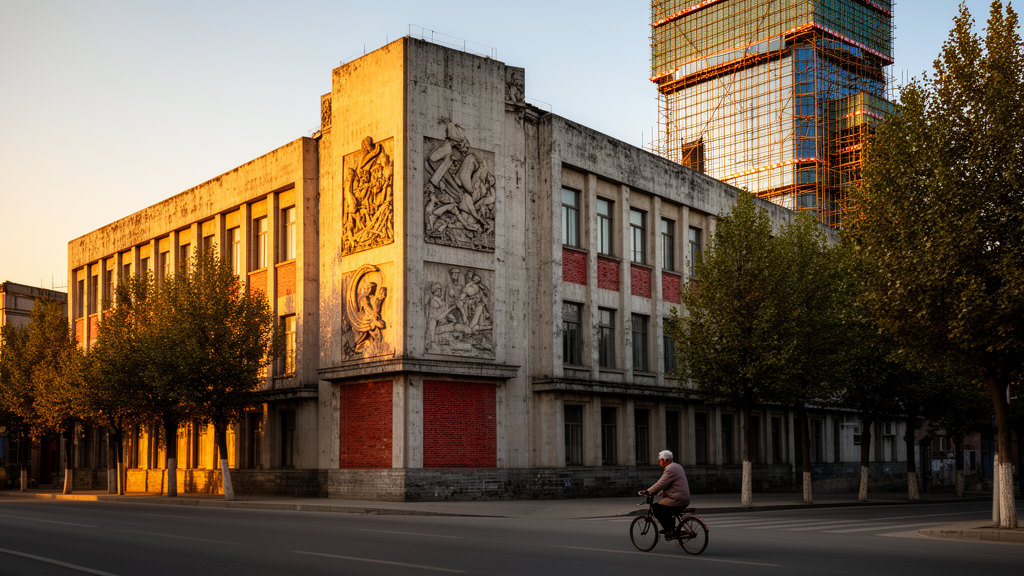
Beijing’s socialist-era buildings, from early Communist Party meeting sites to the monumental “Ten Great Buildings,” are protected unevenly across the city, with the densest concentrations of historic structures showing the lowest rates of official recognition. That is the central finding of a new quantitative study published in the journal Built Heritage, which compiled a database of 424 socialist built heritage sites constructed between 1915 and 1978 and compared them against the 188 sites currently listed by the Beijing Municipal Cultural Heritage Bureau in two official batches released in 2021 and 2022.
The research team, led by Dehao Zheng, Yusheng Hou and Fan Fu, used Geographic Information System spatial analysis combined with the Geodetector model, a statistical technique that measures how closely the spatial distribution of an explanatory variable matches the distribution of an outcome. Here the outcome was the heritage protection rate across Beijing’s 16 districts, and the explanatory variables were 12 indicators spanning five dimensions: natural environment, sociocultural factors, policy support, socioeconomic conditions and urbanisation level.
To build the historical baseline, the authors drew on The History of the Communist Party of China in Beijing, an official government publication documenting events from 1915 to 1978 along with their locations. Sites qualified if they had a clear association with key historical events, figures or institutions of the socialist revolution or socialist construction, and if field surveys and contemporary maps confirmed their locations remained identifiable or corresponded to extant buildings. Of 629 sites initially collected, 424 survived verification. The authors stress that these sites are not all officially recognised heritage; many now serve as administrative offices, museums, housing or industrial facilities, and some have changed function entirely.
The spatial analysis began with kernel density estimation, which maps the intensity of heritage sites per unit area, and the average nearest neighbour index, a statistical test in which a value below 1 indicates clustering. For the 424 historical sites, the index returned R = 0.485, significant at p < 0.01, confirming strong clustering. Dongcheng and Xicheng districts formed the primary core, with Fengtai, Haidian and Fangshan districts as secondary cores. The pattern, the authors argue, reflects both historical path dependence and the concentrated layout of early socialist activities and administrative institutions.
Typology mattered as much as geography. Using an official classification framework, the team sorted sites into five categories: important institutions and meeting sites; former residences, activity sites or burial places of significant figures; sites of major events and battles; locations of martyr activities or martyr cemeteries; and commemorative structures such as monuments and memorial halls. Types 1 and 2 clustered strongly in Dongcheng and Xicheng, corresponding to Beijing’s long-established political and cultural centres, while Types 3 and 4 formed secondary clusters in the northern and western mountainous districts, including Miyun, Pinggu and Fangshan, closely matching the locations of revolutionary bases during the war against Japanese aggression. Commemorative Type 5 sites showed a dual distribution, anchored in the city centre but also in Miyun and Yanqing, and approached a random distribution with R = 0.944.
Across six analytical periods, from the New Culture Movement of 1915–1923 through the Socialist Revolution and Construction Stage of 1950–1978, the spatial pattern traced a cycle of diffusion from the urban core, reconcentration and renewed expansion. Standard deviation ellipses and centroid analysis showed the centre of gravity shifting from around Xicheng District outward to its farthest point in Changping District during the war period, then returning to the central city during the Liberation War and socialist construction periods. Only the Agrarian Revolutionary War period, when guerrilla and underground operations predominated, showed a dispersed distribution, with R = 1.688.
The comparison between historical and current inventories revealed the study’s starkest imbalance. Spatial overlay analysis showed that commemorative Types 4 and 5 are nearly fully covered by the current protection system, while Types 1 to 3, the functional and event-related buildings such as work-unit compounds and workers’ housing, are systematically underrepresented, with difference maps dominated by negative values indicating historically concentrated heritage with insufficient current protection. Temporally, the gap widened toward more recent periods: heritage from the New Culture Movement era received comparatively greater attention, while structures from later decades were progressively less protected. Spatial autocorrelation analysis using Global Moran’s I and local indicators identified significant low–low clustering of protection rates in Dongcheng and Xicheng, meaning central districts with high heritage density sit adjacent to one another with mutually low protection rates, a pattern the authors attribute to redevelopment pressure in the urban core.
The Geodetector results quantified the drivers behind this pattern. Only eight of the 12 variables passed the significance test at p < 0.05. Socioeconomic factors had the strongest combined explanatory power, with summed q-values of 1.1649, followed by policy support at 0.9566 and sociocultural factors at 0.0408; natural environmental and urban development factors were weak. At the individual level, population density was the dominant driver with q = 0.8635, followed by the number of heritage protection units at q = 0.8323, per capita GDP at q = 0.2557 and the number of policy documents at q = 0.1243. Two-factor interaction detection found widespread enhancement, with no weakening effects: interactions involving the number of cultural institutions amplified q-values more than twentyfold, and policy document interactions were amplified more than eightfold with over half of other factors. Counterintuitively, the authors note, districts with high economic activity, concentrated cultural resources and strong policy support were more likely to show low protection rates, consistent with an “urban growth machine” dynamic in which heritage lacking short-term economic returns is excluded from redevelopment coalitions.
The authors interpret the typological bias as rooted in a value hierarchy centred on revolutionary historical narratives. Commemorative heritage was prioritised during early national relics surveys and protection designations, while everyday functional buildings such as work-unit compounds and workers’ housing remained excluded for long periods. They also observe that China’s state-led protection framework, including Red Tourism policies introduced from 2004, selectively favours heritage with symbolic, commemorative and educational functions, and that current evaluation standards prioritising antiquity and artistic value place modern heritage at a disadvantage. The study proposes establishing a dedicated socialist built heritage preservation system, embedding heritage assessment into urban renewal processes, and creating dedicated fiscal support to counter the dilution of policy resources.
The authors acknowledge limitations. The historical database relies on a single official party history publication, which may contain inaccuracies; the classification reflects historical and social-functional attributes rather than architectural form; and the 12 driving factors use annual average data that may introduce error, while soft factors such as social perception, community participation and cultural identity were not captured. Even so, the study provides a quantitative spatial baseline for identifying gaps in Beijing’s protection lists and, the authors argue, a model for more balanced, resilience-oriented conservation strategies for twentieth-century heritage in China.
Subject of Research: Spatial distribution and preservation inequality of socialist built heritage in Beijing from 1915 to 1978
Article Title: Spatial patterns and preservation inequality of socialist built heritage in Beijing: a GIS–geodetector analysis (1915–1978)
Article References: Zheng, D., Hou, Y., & Fu, F. (2026). Spatial patterns and preservation inequality of socialist built heritage in Beijing: a GIS–geodetector analysis (1915–1978). Built Heritage, 10(1), Article 76. https://doi.org/10.1186/s43238-026-00301-8
Image Credits: AI Generated
DOI: 10.1186/s43238-026-00301-8
Keywords: socialist built heritage, Beijing, GIS, Geodetector, kernel density estimation, spatial autocorrelation, heritage protection, urban renewal, commemorative heritage, spatial inequality, cultural heritage policy, urban growth machine
Cite Scienmag News
Courtney Benton. (October 28, 2026). Beijing’s Socialist-Era Buildings Survive Unevenly, GIS Study Reveals. Scienmag. https://scienmag.com/beijings-socialist-era-buildings-survive-unevenly-gis-study-reveals/
Courtney Benton. "Beijing’s Socialist-Era Buildings Survive Unevenly, GIS Study Reveals." Scienmag, 28 October 2026, https://scienmag.com/beijings-socialist-era-buildings-survive-unevenly-gis-study-reveals/. Accessed 28 October 2026.
Courtney Benton. "Beijing’s Socialist-Era Buildings Survive Unevenly, GIS Study Reveals." Scienmag. October 28, 2026. https://scienmag.com/beijings-socialist-era-buildings-survive-unevenly-gis-study-reveals/