


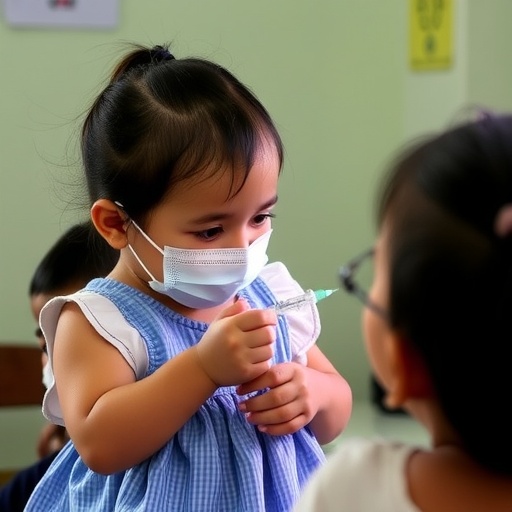
In an era where infectious diseases remain a persistent threat to child health worldwide, understanding the complex behavioral and social factors that influence vaccination uptake is more crucial than ever. A groundbreaking study recently published by Dalisay, Landicho, Lota, and colleagues in Global Health Research and Policy delves deep into the underexplored determinants behind the low coverage of routine childhood immunizations in selected regions of the Philippines. This investigation sheds unprecedented light on why certain communities persist in lagging behind despite decades of concerted public health efforts, signaling novel directions for policy and intervention design.
The nuances unearthed in this research extend beyond simplistic interpretations of vaccine hesitancy or outright refusal. Instead, the authors frame the issue within a multidimensional context that embraces cultural beliefs, socio-economic status, trust in health systems, and social norms. Such a framework is critical to dismantling the “one-size-fits-all” approach traditionally employed in immunization campaigns, which often overlook the intricate realities governing health decisions at the grassroots level. By applying a behavioral and social drivers model, the study moves beyond coverage statistics to interrogate the psychological and community-level phenomena playing decisive roles.
One of the most striking findings reveals that misinformation and misunderstanding about vaccines proliferate rapidly in communities with constrained access to credible health education. This spread is amplified by informal social networks where anecdotal experiences often outweigh scientifically backed data. Here, fear and suspicion about vaccine safety are not merely the result of ignorance but emerge as rational responses shaped by historical inequities and past failures in public health outreach. Thus, vaccination decisions become embedded in a broader narrative of mistrust and skepticism toward health authorities.
The qualitative approach adopted by the researchers allowed them to capture richly textured voices of caregivers, health workers, and local leaders. These narratives reveal that immunization is frequently tangled with practical challenges such as transportation costs, inconvenient clinic hours, and competing daily survival priorities. Such barriers are often compounded by subtle gender dynamics, where mothers, typically the primary caregivers, lack decision-making power or financial autonomy to secure timely vaccination for their children. Consequently, even willing families face structural hurdles undermining consistent immunization.
In addition, the study highlights the critical role of community norms and peer influences as double-edged swords. Positive social endorsement of vaccines can dramatically boost uptake, but conversely, entrenched community skepticism can solidify avoidance behaviors. Particularly in rural or marginalized areas, collective attitudes propagate rapidly and shape individual choices far more potently than isolated educational interventions. Understanding this social contagion effect paves the way for leveraging influential local figures or peer networks as catalysts for change.
Equally pivotal is the issue of health system responsiveness. Participants in the study frequently pointed to negative interactions with healthcare providers, ranging from perceived disrespect to inadequate communication. Such encounters erode trust and diminish families’ motivation to return for follow-up doses or booster shots. The research underscores the necessity for health workers to receive training that fosters culturally sensitive, empathetic engagement aligned with patients’ realities rather than a purely biomedical focus.
A particularly innovative dimension of this research involves dissecting the interplay between individual cognition and social environment in shaping vaccination behavior. The authors employ theoretical constructs from social psychology to map how risk perception, social identity, and normative beliefs converge. This analytical lens accentuates how vaccine acceptance is not merely an individual health decision but an act influenced profoundly by embedded social context, collective memory, and identity affirmation.
On a policy level, the insights furnished by this study call for more decentralized, community-tailored strategies that reconcile biomedical priorities with sociocultural realities. The authors advocate for fostering participatory dialogue with communities to co-create immunization programs that resonate authentically. This participatory model promises to build enduring trust, dismantle misinformation, and promote vaccine literacy in a manner that empowers local agency rather than imposing top-down mandates.
Importantly, the research also addresses broader systemic determinants such as poverty, education disparity, and infrastructure limitations that indirectly undermine immunization efforts. It reminds global health stakeholders that vaccination campaigns cannot operate effectively in isolation from wider socio-economic development initiatives. Integrated approaches targeting multisectoral collaboration could harmonize health gains with improvements in education, transportation, and social welfare systems.
The timing of this study bears additional significance given the Philippines’ recent challenges with vaccine confidence stemming from high-profile controversies and adverse media coverage related to immunization programs. The authors provide a nuanced interpretation of these events, framing them as catalysts that exacerbated pre-existing behavioral and social drivers rather than standalone causes. This context-sensitive perspective enables more robust recovery strategies that acknowledge damage to public trust and the painstaking work needed to rebuild it.
From a methodological standpoint, the research leverages mixed methods to triangulate quantitative coverage data with qualitative ethnographic insights. This approach enhances validity and enriches interpretative depth, setting a benchmark for similar studies in other low-coverage contexts worldwide. It also exemplifies the value of interdisciplinary collaboration spanning epidemiology, behavioral science, sociology, and health policy to comprehensively tackle vaccine inequities.
As infectious diseases evolve and novel pathogens emerge, ensuring equitable vaccine access and acceptance remains a cornerstone of global health security. This meticulous study from the Philippines offers invaluable lessons transcending geographic boundaries and health system typologies. It demonstrates how unraveling the tangled web of behavioral, social, and systemic factors can illuminate pathways toward sustainable immunization coverage and healthier future generations.
The research team’s findings underscore that overcoming vaccine disparities is not merely about delivering shots but about fostering relationships, dismantling barriers, and cultivating trust within communities. Such an approach requires empathy-driven health policies informed by science, respect for local cultures, and robust engagement with diverse stakeholders. Only through these multifaceted efforts will the promise of vaccines as lifesaving tools realize their full potential in improving child survival worldwide.
Ultimately, this landmark study invites renewed commitment and innovative thinking among global health practitioners, policymakers, and researchers. It reinvigorates the conversation about how to design immunization programs that truly resonate with human experience, social realities, and behavioral motivations. By doing so, it paves the way for more inclusive and effective vaccination campaigns that can decisively reduce child mortality and bridge persistent health inequities in low-coverage settings.
Cite Scienmag News
Courtney Benton. (September 29, 2025). Behavioral Drivers Impact Childhood Immunization in Philippines. Scienmag. https://scienmag.com/behavioral-drivers-impact-childhood-immunization-in-philippines/
Courtney Benton. "Behavioral Drivers Impact Childhood Immunization in Philippines." Scienmag, 29 September 2025, https://scienmag.com/behavioral-drivers-impact-childhood-immunization-in-philippines/. Accessed 4 September 2026.
Courtney Benton. "Behavioral Drivers Impact Childhood Immunization in Philippines." Scienmag. September 29, 2025. https://scienmag.com/behavioral-drivers-impact-childhood-immunization-in-philippines/


