


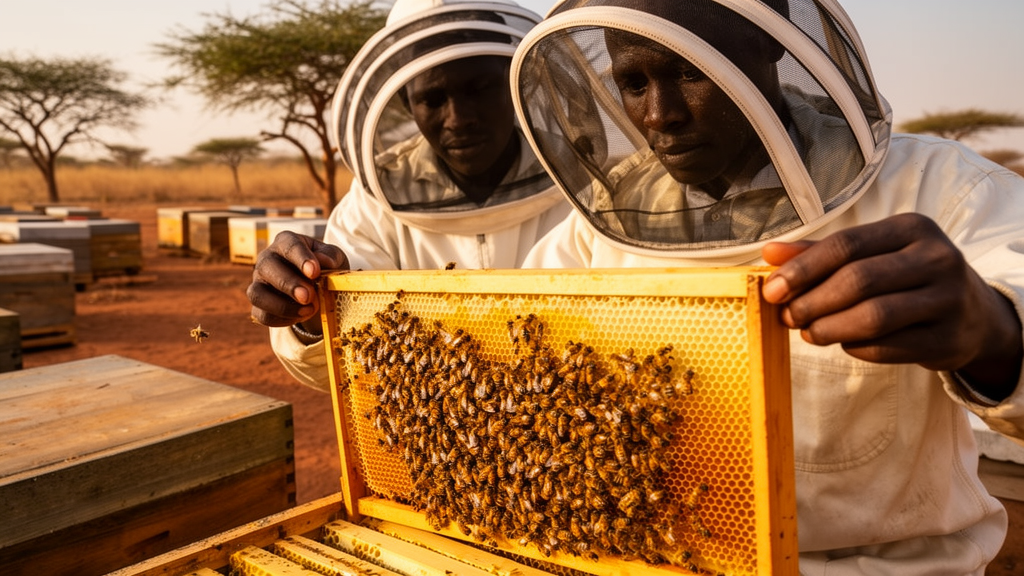
In the sun-scorched savannas of Burkina Faso, honeybees are quietly disappearing from their hives, and the people who know them best are sounding the alarm. A new study published in Frontiers in Bee Science has turned to the country’s beekeepers themselves, treating their daily observations as a scientific early warning system. The findings reveal a complex web of threats to honeybee health, from climate change and pests to pesticides and poor beekeeping equipment, and they offer some of the first systematic data on the state of honeybees in West Africa.
The research, led by Souhaïbou Sawadogo and colleagues at Université Joseph KI-ZERBO in Ouagadougou, surveyed 236 beekeepers across two of Burkina Faso’s three climatic zones: the wetter Sudanian zone in the south and the drier Sudano-sahelian zone in the center. Using a mixed-methods approach that combined semi-structured interviews with statistical analysis, the team documented what beekeepers perceive as the main factors threatening honeybee colonies. The results show that 21.7 percent of hives in the Sudanian zone are empty of bees, compared to 28.7 percent in the Sudano-sahelian zone, a statistically significant difference. Honeybees have either abandoned these hives or never inhabited them at all.
Burkina Faso is a country where beekeeping matters enormously. The agricultural sector accounts for 35 percent of GDP and employs 82 percent of the labor force, and pollination by bees contributes approximately 9.5 percent of the total economic value of global agricultural production. From 2007 to 2017, honey production in Burkina Faso grew from 55 to 570 metric tons, and by 2019 annual production exceeded 1,000 metric tons of honey and 67 metric tons of beeswax, generating approximately 5 million USD in revenue. More than 16,000 beekeepers are currently active, managing approximately 131,000 hives. Yet data on honeybee health in the country have remained scarce and limited, making this new assessment particularly valuable.
The study’s methodology was deliberately participatory. Beekeepers were selected using non-probability snowball sampling, in which existing participants recruit future participants from among their acquaintances. The interviews, which lasted an average of one hour per person, were conducted between July and October 2024 across 56 localities. The researchers digitized their questionnaire on KoboCollect and analyzed the data using descriptive statistics and chi-square tests of independence, supplemented by Fisher’s exact test when expected frequencies were insufficient. The overwhelmingly male sample (88.98 percent) was also experienced: nearly 39 percent of respondents had 15 or more years in beekeeping, and 47 percent had received no formal education. Nearly 85 percent were primarily farmers, suggesting that beekeeping in Burkina Faso functions as a complementary activity to agriculture rather than a standalone profession.
When asked why hives fail to become colonized, beekeepers pointed to a combination of structural, biological, and environmental factors. The most frequently cited cause was inappropriate hive preparation methods and timing (15.86 percent of citations), followed by harmful biological agents such as predators and parasites inside or around the hive (14.77 percent). Inappropriate choice of hive location (13.33 percent) and products or practices used by beekeepers that may repel bees (12.61 percent) were also identified. These findings suggest that beekeeping management itself, rather than any single external stressor, plays a central role in whether wild swarms decide to establish colonies in hives.
Hive abandonment tells a similar story. In the Sudanian zone, the abandonment rate during the previous year was 16.5 percent, while in the Sudano-sahelian zone slightly more than a quarter of hives (28.7 percent) were abandoned by bees. The rainy season from July to September and the heatwave period from March to May were cited as the most critical times for abandonment, characterized by high humidity and high temperatures respectively. Predator activity was the most frequently cited cause (27.4 percent of citations), followed by water infiltration into hives during the rainy season (16.16 percent) and poor quality or damaged hives (13.29 percent). These climatic conditions exacerbate several factors, rendering hives uninhabitable for bees.
Bee mortality was also widely observed. Nearly 35 percent of respondents in the Sudanian zone and 42 percent in the Sudano-sahelian zone reported having witnessed bee deaths in their apiaries. While natural mortality, the normal end of the life cycle, is often cited as the main reason, respondents believe it is exacerbated by external factors. Climatic factors, including heat waves, heavy rainfall, high humidity, and drought, were the most frequently reported threats, cited by 43.9 percent of respondents in the Sudanian zone and 32.2 percent in the Sudano-sahelian zone. Health-related factors such as diseases and parasites were cited by roughly 22 percent in both zones. More than 45 percent of respondents in both zones believe that bee populations are declining in their localities, a perception supported by observations such as apparent reductions in colony numbers, slower hive colonization rates, declining honey yields, and fewer foraging bees in the surrounding area.
The study also documented the plant resources on which bees depend. Shea (Vitellaria paradoxa) and néré (Parkia biglobosa) were cited as the nectar-producing species facing both anthropogenic and climatic pressures, accounting for 34.04 percent and 25.06 percent of mentions respectively. Most respondents report a decline in plant resource availability: 66 percent in the Sudanian zone and 68.6 percent in the Sudano-sahelian zone. Beekeepers clearly perceive the impacts of climate and environmental changes on bee colonies, noting that rising temperatures affect bee behavior, resource availability, and colony health. Global warming was cited by 51.27 percent of all respondents, changes in flowering cycles by 50 percent, and land-use changes linked to urbanization by 50.42 percent.
Pesticides add another layer of concern. Nearly all farmer-beekeepers surveyed (96.53 percent) use herbicides on their farms, and 81.70 percent use insecticides. They primarily apply these products preventively during the pre-sowing stage (79.24 percent) and flowering stage (61.02 percent). The researchers identified 59 different formulations of synthetic chemical insecticides and 4 biological formulations, with organophosphates (26.0 percent), pyrethroids (15.6 percent), and neonicotinoids (14.3 percent) as the main chemical families. The predominance of insecticides is particularly concerning because their use during flowering poses a major risk to bees. Herbicides, although less directly harmful, reduce floral diversity and thereby limit food resources.
When asked about the major challenges facing the beekeeping sector, stakeholders identified pest management (69.6 percent in the Sudanian zone and 74.4 percent in the Sudano-sahelian zone), the impacts of climate change (76.5 percent in the Sudanian zone and 62.8 percent in the Sudano-sahelian zone), and improvements in beekeeping equipment (61.7 percent in the Sudanian zone and 44.6 percent in the Sudano-sahelian zone) as the main issues requiring attention. Wax moths, small hive beetles, and ants were the pests most frequently mentioned, with citation frequencies exceeding 65 percent in both climate zones. The authors argue that this participatory assessment provides a basis for concrete actions to protect honeybees and could serve as an indicator that contributes to the effectiveness and acceptability of conservation measures. While the data are based on perceptions rather than formal causal relationships, the study underscores the need for further research incorporating probabilistic sampling, standardized colony observations, and biological and toxicological analyses to confirm and quantify the observed patterns.
Subject of Research: Threat factors to honeybees’ health and survival according to beekeepers in Burkina Faso
Article Title: Threat factors to honeybees’ health and survival according to beekeepers in Burkina Faso
Article References: Sawadogo, S., Dingtoumda, O. G., Bazié, H. R., & Ilboudo, Z. (2026). Threat factors to honeybees’ health and survival according to beekeepers in Burkina Faso. Frontiers in Bee Science, 4, Article 1958520. https://doi.org/10.3389/frbee.2026.1958520
Image Credits: AI Generated
DOI: 10.3389/frbee.2026.1958520
Keywords: Threat, factors, honeybees, health, survival, according, beekeepers, Burkina, Faso, scientific research
Cite Scienmag News
Margaret Porter. (October 15, 2026). Beekeepers in Burkina Faso Reveal Hidden Threats to Honeybee Health. Scienmag. https://scienmag.com/beekeepers-in-burkina-faso-reveal-hidden-threats-to-honeybee-health/
Margaret Porter. "Beekeepers in Burkina Faso Reveal Hidden Threats to Honeybee Health." Scienmag, 15 October 2026, https://scienmag.com/beekeepers-in-burkina-faso-reveal-hidden-threats-to-honeybee-health/. Accessed 15 October 2026.
Margaret Porter. "Beekeepers in Burkina Faso Reveal Hidden Threats to Honeybee Health." Scienmag. October 15, 2026. https://scienmag.com/beekeepers-in-burkina-faso-reveal-hidden-threats-to-honeybee-health/


